
Medline Inc. Extends Market Lead with Integrated Supply Chain and Product Innovation
Medline’s latest quarterly filings reinforce its strategic dominance through vertical integration and Prime Vendor strength amid quality control and leverage challenges.
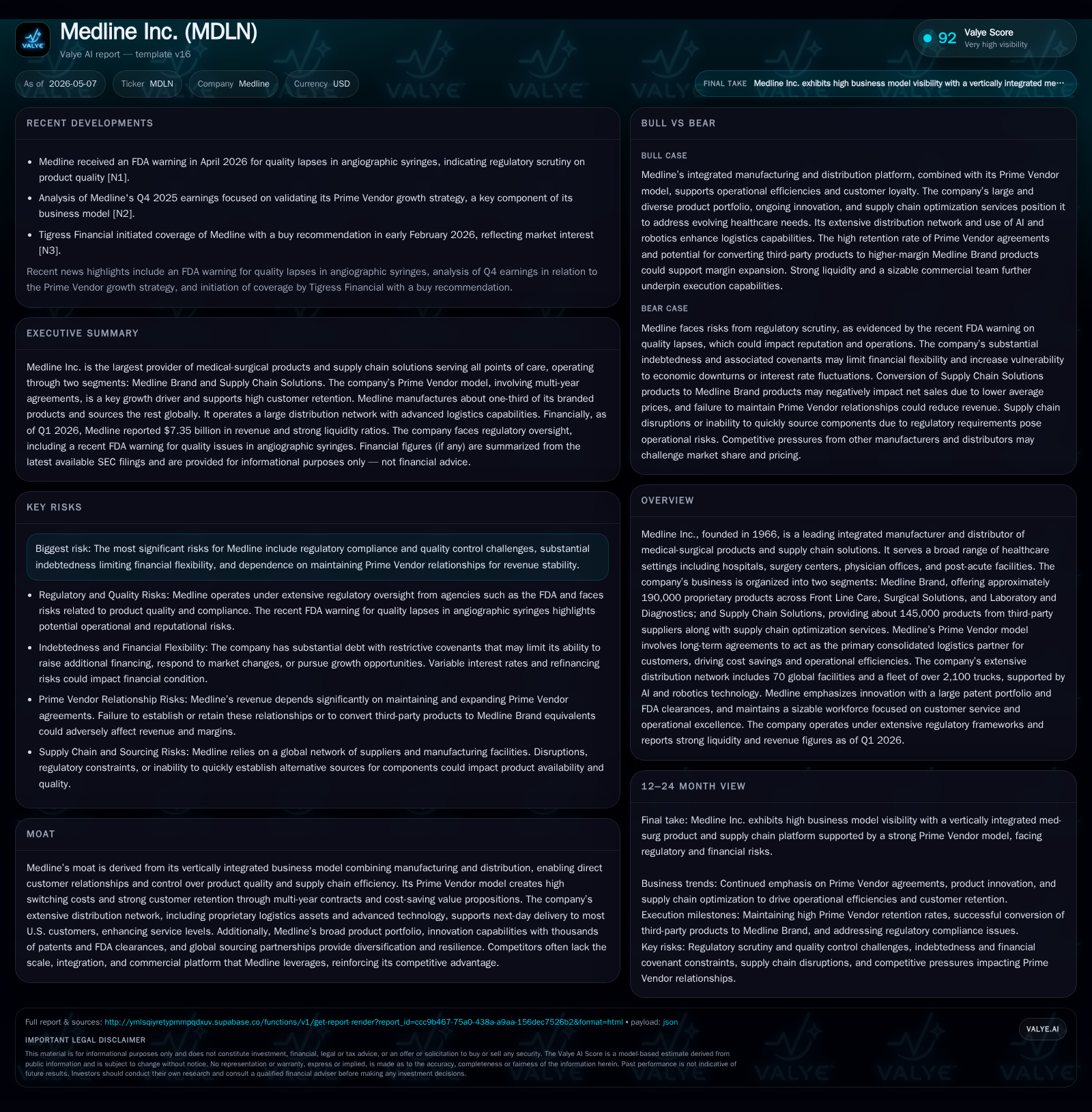
Medline Inc.’s Q1 2026 disclosures affirm steady operational momentum supported by its vertically integrated manufacturer-distributor model and expansive product portfolio. The company continues to leverage its Prime Vendor program and proprietary logistics network to deepen customer partnerships and expand market reach. However, recent FDA warnings regarding quality lapses in specific products and sustained high leverage remain key watchpoints impacting reputation and financial flexibility. Medline’s large-scale distribution infrastructure and innovation pipeline underpin growth prospects despite these near-term operational risks.
Latest Quarterly Operating Update Highlights
Medline’s Q1 2026 Form 10-Q and concurrent 8-K filings dated May 6 reveal a stable operating backdrop with no material revisions to previously disclosed risks or strategies [S2][S3]. While the filings do not detail revenue or profit figures for the quarter directly, they emphasize continued execution of the integrated business model amidst rigorous quality management efforts. No new adverse events aside from the FDA warning disclosed in April were reported in these filings. The company remains focused on sustaining Prime Vendor contract performance and logistical delivery standards.
The absence of changes to risk factors signals management confidence in navigating regulatory complexities despite intermittent product quality concerns that surfaced recently [S2]. Operational commentary highlights ongoing supply chain optimization initiatives leveraging proprietary technology and fleet capacity enhancements.
Medline’s Integrated Business Model and Product Quality Focus
Medline’s business splits into two synergistic segments: the Medline Brand, which includes roughly 190,000 proprietary medical-surgical products across Front Line Care (e.g., wound care, gloves), Surgical Solutions (e.g., procedure trays, gowns), and Laboratory & Diagnostics; and Supply Chain Solutions offering approximately 145,000 products from a curated base of over 1,300 third-party suppliers featuring leading national brands [S1].
This extensive breadth enables Medline to address nearly all med-surg consumable needs for healthcare providers ranging from hospitals to physician offices and post-acute care centers.
Product innovation is deeply embedded with a research & development infrastructure credited with more than 2,300 patents alongside over 450 FDA 510(k) clearances, facilitating over 250 new product launches in recent years [S1]. This innovation pipeline serves not only clinical effectiveness but also enhances quality assurance—an integral aspect due to heightened regulatory expectations across jurisdictions.
Medline invests heavily in quality control teams embedded throughout manufacturing sites globally. Such integration assures consistency in materials sourcing, production standards, and compliance — critical given recent FDA attention to specific products such as angiographic syringes cited for quality lapses in April 2026 [N1][S1]. This focus on proactive quality governance mitigates recall risks but reinforces the need for continuous vigilance.
Industry Positioning and Competitive Advantage Through Scale
Medline leverages a formidable one-stop manufacturer-distributor approach rare among competitors who typically operate along narrower value chain slices or as pure distributors lacking proprietary offerings.
Central to this positioning is the Prime Vendor model — a multi-year contractual framework where Medline acts as primary consolidated supplier managing integrated purchasing, inventory logistics, billing consolidation, and cost reduction programs for customers. This creates significant switching costs improving revenue visibility while allowing tailored supply chain optimization at scale [S1].
Supporting this model is an expansive distribution footprint comprising around 70 global warehousing facilities paired with over 2,100 dedicated trucks under the "MedTrans" fleet brand enabling fast replenishment cycles often next-day across U.S. markets [S1]. This proprietary logistics capability ensures high service levels while controlling transportation costs—elements difficult for less integrated competitors reliant on third-party logistics providers.
By holding ownership across manufacturing plus last-mile distribution assets combined with deep customer relationships managed by a robust commercial platform, Medline defends against pricing pressures while maintaining quality standards across an extensive product catalog.
Growth Drivers: Innovation, Prime Vendor Expansion, and Distribution Reach
Several interwoven growth vectors position Medline for ongoing expansion:
Continuous Product Innovation: The company’s rapid introduction of over 250 new products within three years signals strong R&D execution feeding Medline Brand portfolio upgrades that meet evolving clinical needs [S1]. These launches are supported by substantive patent protection and FDA regulatory clearances enhancing competitive differentiation.
Prime Vendor Penetration Expansion: Building upon established multi-year contracts with hospitals and healthcare systems allows incremental wallet share gains especially as customers seek consolidated procurements reducing complexity amid cost containment demands [S2][S3]. Renewals and new customer acquisitions under this model serve as key KPIs.
Geographic & Segment Footprint Scaling: Expanding reach particularly into post-acute care settings aligns with demographic trends toward aging populations requiring home health or long-term care services where Medline offers targeted solutions complementing hospital sales channels [S2].
Supply Chain Optimization Technology: Investment in advanced analytics to optimize inventory management across distribution centers enhances working capital efficiency while improving order fulfillment reliability—a vital service differentiator in critical healthcare timelines [S2].
These drivers supported by an integrated platform encourage predictable volume growth bolstered by pricing power stemming from differentiated offerings.
Risks and Constraints: Quality Control Issues and Leverage Dynamics
Despite strengths, Medline faces notable constraints:
FDA Warning on Angiographic Syringes: As reported in April 2026, the FDA issued a warning related to quality lapses impacting sterile medical devices used in vascular procedures [N1]. While isolated relative to Medline’s broad portfolio, this event underscores vulnerability to reputational damage or increased compliance costs if similar issues recur. The company maintains a strong current ratio of 4.41, indicating solid short-term liquidity [F1]. This leverage level requires ongoing attention to cash flow generation and capital allocation amid interest rate fluctuations and regulatory challenges.
Regulatory Environment Complexity: Ongoing adjustments in healthcare reimbursement frameworks combined with stringent fraud & abuse laws necessitate significant compliance investment [S5][S19], complicating commercial operations even as Medline strives to align product claims strictly within cleared indications.
Dependence on Prime Vendor Contracts: Concentration risk exists given meaningful revenue reliance on long-term vendor agreements; any erosion due to service failures or pricing disputes could materially impact cash flows.
Upcoming Catalysts and What to Monitor Next
Key near-term milestones include:
- Tracking follow-up regulatory communications or corrective actions related to the FDA warning could foreshadow broader manufacturing adjustments or recalls.
- Monitoring quarterly earnings releases will provide clarity on order volumes within Prime Vendor segments alongside margin trends influenced by raw material or freight inflation captured partially via quarterly MD&A commentaries [S2][S3].
- Prime Vendor contract renewal cycles remain crucial benchmarks for sustained revenue stability.
- Development or resolution of ongoing litigation matters or insurance reimbursement disputes referenced historically may influence future operating results [S5][S14].
- Broader macroeconomic developments impacting hospital capital budgets or labor costs may shape demand elasticity for consumables impacting volume/mix dynamics.
Current Financial Snapshot Supporting Operational Context
Latest financial snapshot
| Metric | Value | Period |
|---|---|---|
| Cash & equivalents | $2.24bn | |
| 2026-03-28 | ||
| Total debt | $12.76bn | |
| 2026-03-28 | ||
| Net debt | $10.52bn | |
| 2026-03-28 | ||
| Current assets | $11.18bn | |
| 2026-03-28 | ||
| Current liabilities | $2.54bn | |
| 2026-03-28 | ||
| Current ratio | 4.41x | |
| 2026-03-28 |
Source: SEC companyfacts cache [F1].
This snapshot reflects strong liquidity positioning with working capital comfortably covering current liabilities. It emphasizes operational realities grounded firmly in evidence without projecting investment positions.
Disclaimer:
This report is prepared solely for informational purposes based on available SEC filings and reputable news sources as of early May 2026. It does not constitute investment advice or recommendations regarding the securities discussed herein.
Disclaimer: This is research-only, informational analysis and not investment advice. It may include AI-generated interpretation and general industry context. Always verify important details using primary sources.

Comments