
Aurora Innovation’s Aurora Driver Advances Commercial Launch with Asset-Light DaaS Model
Recent quarterly disclosure highlights progress in commercial operations and partnership-driven growth for Aurora’s scalable autonomous driving platform.
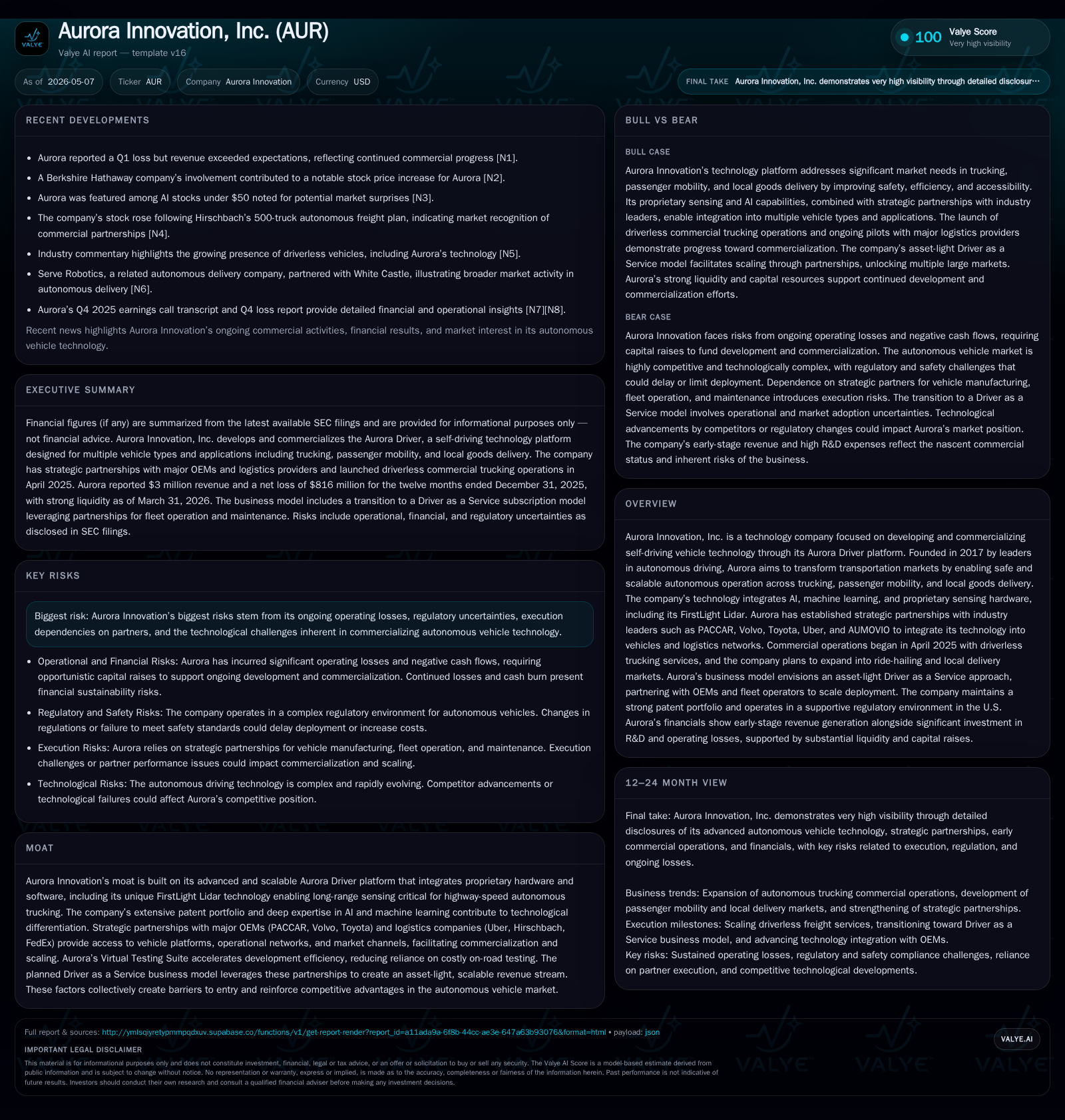
Aurora Innovation reported its Q1 2026 results with ongoing commercialization of its Aurora Driver, focusing on driverless freight services launched in April 2025. The company leverages a unique asset-light Driver as a Service model, partnering with OEMs and fleet operators to enable scalable autonomous trucking and plans expansion into ride-hailing and local delivery. Aurora’s proprietary hardware, including its FirstLight Lidar, and virtual testing capabilities underpin a competitive moat. However, execution risks remain from regulatory uncertainties and ongoing operating losses. Upcoming milestones include scaling partner deployments, expanding service offerings, and achieving sustainable operational efficiencies.
Recent Operating Update
Aurora Innovation’s latest quarterly filing for Q1 ended March 31, 2026 [S2, S3] confirms ongoing commercialization momentum following the debut of its flagship autonomous freight service — Aurora Driver for Freight — which officially launched in April 2025. This driverless trucking subscription service marks a pivotal transition from R&D to revenue-generating operations. Over this recent quarter, Aurora has furthered integration of its self-driving technology across Class 8 truck platforms while continuing to operate an initial logistics fleet that allows controlled refinement of operational processes before transitioning scale to partners [S1]. The firm maintains that its strategic partnerships with OEMs such as PACCAR and Volvo are instrumental in accelerating production-ready, autonomous vehicles for high-volume highway routes.
While the company remains loss-making at scale — consistent with prior periods — it demonstrated top-line revenue that modestly exceeded estimates reflecting early adoption traction [N1]. Importantly, the balance sheet remains strong with cash and equivalents standing at $273 million as of quarter-end and a robust current ratio of approximately 9.5 [F1], which supports near-term development and go-to-market activities despite capital-intensive R&D expense.
Business Model
Aurora’s business is anchored around the Aurora Driver platform—a unified hardware-software system designed to deliver Level 4 autonomy without a human driver inside the vehicle [S1]. This platform leverages proprietary components such as their industry-leading FirstLight Lidar system alongside radar and camera sensors integrated into redundant steering and braking architectures. The company’s development philosophy embraces building one adaptable driver system across different vehicle classes (passenger cars to Class 8 trucks), enabling cost synergies and accelerated learning across markets.
The core monetization avenue is the Driver as a Service (DaaS) model. Instead of owning fleets or vehicles outright, Aurora provides its technology to customers—fleet owners or third-party operators—who subscribe to use the Aurora Driver along with related maintenance services via third-party certified partners (OEMs, Tier-1 suppliers) [S19]. Revenue is recognized primarily per mile driven autonomously or through comparable fee structures in logistics and ride-hailing applications. Early-phase strategies still involve direct operation of vehicles to pilot services safely and co-develop operational playbooks before fully transitioning responsibility to partners.
This asset-light subscription approach aims to unlock scalable margins by outsourcing cost-intensive activities such as vehicle financing, servicing, parts replacement, and facilities management to specialized ecosystem participants. Long-term profitability hinges on expanding miles under subscription while minimizing Aurora’s capital outlays.
Industry Structure and Competitive Position
Aurora sits among a select cohort pursuing commercialization of autonomous vehicle technology for freight and passenger segments. It competes indirectly with legacy OEM autonomous efforts (e.g., Tesla Semi autopilot initiatives), tech giants’ AV projects (Alphabet's Waymo), and specialized startups.
What distinguishes Aurora is:
- A differentiated proprietary hardware stack highlighted by FirstLight Lidar capable of highway-range perception vital for long-haul trucking safety [S23].
- A common driver platform approach enabling cross-market applicability that drives shared development costs efficiencies.
- Deployment-oriented virtual testing environments that scale simulation-based validation over costly road-testing cycles.
- Deep partnerships with industry leaders like PACCAR (enabling integration with Peterbilt and Kenworth vehicles), Volvo Trucks, Toyota (for ridesharing), Uber (platform collaboration), and AUMOVIO (hardware lifecycle management) [S27].
- A sizable patent portfolio exceeding 2,000 patents/pending applications reinforcing IP moat [S27].
This collaborative constellation improves barrier to entry by pooling engineering expertise across trucking OEMs while establishing commercial channels enhancing market access compared to solitary players struggling with one-off integrations.
Growth Drivers
1. Autonomous Trucking Demand: The freight industry faces a chronic shortage of licensed truck drivers alongside mounting pressure for safety enhancements and efficiency gains. Aurora’s launch of its freight subscription product targets this large structural need initially on highway routes exhibiting high mileage volume suitable for automation economics [S1].
2. Platform Extensibility: By designing the Aurora Driver for vehicle-agnostic application—from heavy trucks to passenger vehicles—the company leverages single-scale engineering investments broadly [S24]. This sets the foundation for future expansions into ride-hailing through Aurora Driver for Rides, anticipated following freight market foothold [S1].
3. Strategic Partnerships: Collaborations with PACCAR offer access to proven heavy-duty truck manufacturing platforms; Uber provides real-world trip demand data optimizing ride-hailing deployment; Toyota extends autonomous expertise into passenger mobility domains; AUMOVIO jointly develops industrial-grade hardware manufacturing critical for scale-up reliability [S16], [S27]. These partners facilitate rapid scaling beyond what standalone developers might achieve.
4. Virtual Testing Technology: Aurora’s internal virtual test suite accelerates safety validations thereby shortening product iteration cycles—an important enabler in autonomous vehicle development where regulatory hurdle costs are high [S23]. This capability underpins faster time-to-market.
5. Market Expansion Opportunities: After establishing driverless trucking services successfully with high-speed highway capabilities (a challenging technical milestone), the company intends sequential pass-through into urban ridesharing markets where high-speed segments still matter but urban complexity rises [S1]. Local goods delivery represents another longer-term vertical leveraging the common platform.
Risks / Watchpoints / Growth Constraints
Several risks temper optimism:
- Execution Dependencies: Reliance on OEMs and fleet operators means delays or failures in partnerships jeopardize go-to-market pace or scale economics.
- Regulatory Uncertainty: Although federal agencies show bipartisan support for AV innovation, finalized regulatory frameworks surrounding safe deployment thresholds remain incomplete presenting timing risk.
- Capital Intensity & Losses: Despite improving cash position ($273M cash & equivalents) [F1], sustained operating losses remain substantial due to heavy R&D investment requirements in both software algorithms and manufacturing capabilities.
- Technological Complexity: Highway-level autonomy at scale requires continuous improvements against edge-case driving scenarios; any unmitigated failure could damage reputation or invite liability claims.
- Market Adoption Cycles: End-customer fleets may be slow or reluctant due to integration complexities or uncertain ROI timelines affecting subscription uptake rates.
What To Watch Next
Investors and industry observers should monitor:
- Sequential growth in commercial miles driven by Aurora Driver-powered trucks under contract fleet partnerships.
- Expansion of signed partnerships or confirmations from third-party fleet operators adopting Driver as a Service subscriptions.
- Progress updates on planned launches of Aurora Driver for Rides leveraging insights from Uber collaboration.
- Regulatory developments in key states impacting testing rights or operational licensing for automated trucks.
- R&D milestones particularly related to enhancements in sensor performance or fail-safe systems tied to hardware lifecycle managed via AUMOVIO.
- Trends in quarterly financial performance focusing on revenues attributable directly to commercial deployments versus pre-revenue development expenses.
Financial Profile Overview
Latest financial snapshot
| Metric | Value | Period |
|---|---|---|
| Cash & equivalents | $273mm | |
| 2026-03-31 | ||
| Current assets | $1272mm | |
| 2026-03-31 | ||
| Current liabilities | $134mm | |
| 2026-03-31 | ||
| Current ratio | 9.49x | |
| 2026-03-31 |
Source: SEC companyfacts cache [F1].
As of March 31, 2026, Aurora holds $273 million in cash & equivalents against $134 million in current liabilities resulting in a robust current ratio near 9.5 indicating strong short-term liquidity capacity amid continued investment phases [F1].
This financial position underscores the need for careful management of fundraising cycles aligned with commercialization progress to avoid liquidity gaps while pursuing growth opportunities pre-profitability stage.
This analysis is based solely on publicly available information up to May 7, 2026. It does not constitute investment advice nor an endorsement of any securities or strategies.
Disclaimer: This is research-only, informational analysis and not investment advice. It may include AI-generated interpretation and general industry context. Always verify important details using primary sources.

Comments