
Invesco Mortgage Capital Advances Through Interest Rate Volatility Easing
Q1 2026 shows improved risk sentiment and stable agency RMBS supply, enhancing Invesco Mortgage Capital’s portfolio management and growth outlook.
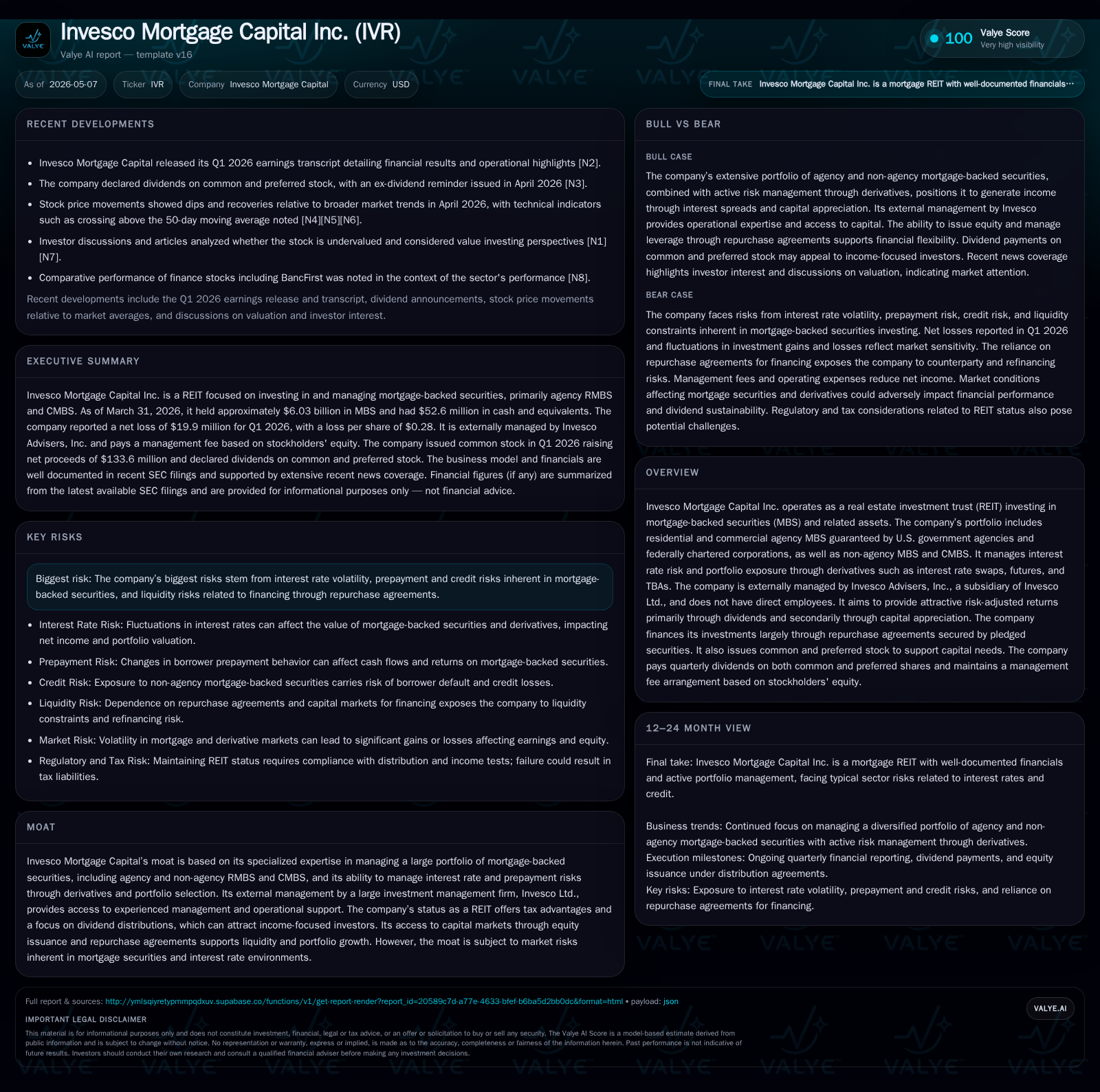
Invesco Mortgage Capital reported a more favorable operating environment entering Q2 2026, underpinned by decreased interest rate volatility and steady agency RMBS issuance. The company’s externally managed mortgage REIT model leverages a diversified portfolio of agency and non-agency MBS, combined with sophisticated derivative hedging, to navigate market risks. Emerging regulatory changes, particularly Basel capital framework proposals, may boost bank demand for high-quality mortgage assets, supporting the company’s liquidity and earnings. Nonetheless, interest rate dynamics, prepayment risks, and repo financing covenants remain critical areas to monitor.
Q1 2026 Operating Update: Interest Rate Volatility and Market Outlook
Invesco Mortgage Capital’s latest quarterly filing [S2] outlines a marked improvement in risk sentiment entering the second quarter of 2026. This shift is primarily driven by a decline in interest rate volatility—a key performance driver given the company's exposure to mortgage-backed securities (MBS) whose values are sensitive to changes in interest rates. The filing explicitly notes that a further de-escalation in the Middle East conflict could provide additional uplift to risk assets broadly, reinforcing market stability.
From a supply-demand perspective vital to IVR's asset performance, agency residential mortgage-backed securities (RMBS) net issuance is expected to remain manageable. Government-sponsored enterprises (GSEs), including Fannie Mae and Freddie Mac, continue their steady purchasing activity. Meanwhile, banks are forecasted to increase participation in the mortgage market, supported in part by recent Basel capital framework revisions aimed at improving capital efficiency for high-quality mortgage holdings [S2]. These dynamics suggest a balanced or supportive environment for IVR's agency MBS investments going forward.
Invesco Mortgage Capital’s Business Model and Portfolio Composition
IVR operates as an externally managed real estate investment trust (REIT), with investment strategies focused on acquiring and managing MBS principally guaranteed by U.S. government agencies or federally chartered corporations along with selected non-agency residential MBS (RMBS) and commercial MBS (CMBS) [S1]. The company does not employ personnel directly; rather management services—including the execution of investment decisions—are provided by Invesco Advisers, Inc., leveraging Invesco Ltd.'s broader expertise and operational infrastructure [S2].
The portfolio is diversified across residential and commercial sectors within both agency and non-agency domains. Agency RMBS offer credit protection through guarantees from entities like Ginnie Mae, Fannie Mae, and Freddie Mac while non-agency assets expose IVR to credit spreads—and hence higher risk/reward profiles—where underwriting quality and loan-level characteristics become critical.
Interest rate risk management is central given sector sensitivity. IVR employs derivatives such as interest rate swaps, futures contracts, and TBA (to-be-announced) securities trading effectively as tools for hedging portfolio exposure against interest rate movements and prepayment uncertainties [S1].
Financing structure relies heavily on short- to medium-term repurchase agreements collateralized by the mortgage assets themselves [S2]. These secured borrowings are subject to financial covenants—IVR disclosed full compliance as of March 31, 2026—thus providing necessary liquidity while maintaining leverage discipline crucial for an MBS-focused REIT [S2].
IVR’s REIT status confers corporate tax advantages if it distributes substantially all taxable income to shareholders primarily through dividends—a feature attractive to income-focused investors seeking yield amid low bond rates.
Competitive Positioning in the Mortgage REIT Sector
Within the mortgage REIT landscape where numerous peers compete across agency/non-agency tilts and credit spectrum focus areas, IVR distinguishes itself through its hybrid approach combining both agency guaranteed securities with selective non-agency positions [S1]. This blend offers flexibility: agency RMBS contribute stability due to implicit/explicit government backing while non-agency exposure may support enhanced returns when credit markets improve.
The external management model brings operational scale benefits but introduces governance considerations; nevertheless board oversight curtails risks related to potential conflicts of interest inherent in third-party management structures. IVR’s heavy use of derivative instruments signifies advanced capabilities in navigating complex MBS valuation challenges relative to less sophisticated peers.
Pricing power remains constrained by market cyclicality typical of securitized products tied closely to macroeconomic cycles and Fed policy adjustments. However, steady dividends tied to relatively predictable coupon flows underpin investor value perceptions [N14].
Growth Drivers: Regulatory Tailwinds and Demand Dynamics
IVR identifies several catalysts underpinning potential growth acceleration or margin stabilization. The most prominent among these is the anticipated uptick in bank participation spurred by Basel capital proposals that improve capital treatment for investments in high-quality mortgage assets [S2]. This regulatory adjustment should foster demand for agency RMBS from banks seeking efficient capital usage—an important source of incremental liquidity supporting valuations.
Supply-side conditions also favorably balance out; manageable net issuance from agencies mitigates oversupply risk which can depress prices or widen spreads. Taken together with improving risk sentiment facilitated by diminished interest rate volatility and easing geopolitical tensions, these factors support sustainable earnings generation through stable or modestly tightening spreads [S3].
Risks and Constraints: Interest Rate Sensitivities and Prepayment Exposure
Despite encouraging near-term conditions, IVR faces multi-dimensional risks embedded in the mortgage REIT model:
- Interest Rate Volatility: While currently declining volatility supports valuations, abrupt changes can erode hedge effectiveness or cause mark-to-market losses on derivatives.
- Prepayment Risk: Borrowers’ tendencies to refinance or repay early vary with economic conditions; accelerated prepayments shorten asset durations disrupting interest spread capture essential for income reliability.
- Credit Risk: Non-agency RMBS segments carry default-related uncertainties differing from agency segments guaranteed by government entities.
- Liquidity Risk: Reliance on repurchase agreements necessitates continuous covenant compliance; adverse market shocks could trigger margin calls requiring swift collateral infusions.
These risks interlink closely with macroeconomic factors like inflation trends, monetary policy shifts impacting employment/income levels (and thus borrower repayment capacity), as detailed in the annual filings [S1], underscoring the need for agile risk management.
Key Milestones and What to Watch Ahead
Key forthcoming developments warrant attention:
- Monitoring covenant compliance dates linked with repo financing maturities ensures no breach-induced liquidity strain emerges [S2].
- Dividend declarations tied closely to reported earnings serve as barometers of ongoing profitability sustainability [S3].
- Geopolitical factors such as Middle East conflict resolution prospects may materially affect broader credit market sentiment influencing asset valuations.
- Agency RMBS issuance trends remain critical gauges of supply-side pressures affecting pricing stability.
- Management's commentary during earnings calls [N1] will provide qualitative insight into execution confidence around portfolio positioning amid evolving macro-financial landscapes.
Tracking these milestones alongside macro indicators offers visibility into IVR’s operational trajectory.
Financial Profile: Leverage, Liquidity, and Capital Structure
At quarter-end March 31, 2026, IVR held approximately $52.6 million in cash equivalents bolstering short-term liquidity cushions [F1]. Repurchase agreements compose the bulk of funding used to finance its investment portfolio; these agreements possess maturities typically ranging between one and six months with agreed contractual rates [S2].
The company confirms full adherence to all financing covenants—a key safeguard against forced deleveraging events under stressed market conditions [S2].
Additionally, equity capital raised through common stock issuances supplements debt funding capacity; select preferred stock repurchases indicate active capital structure optimization efforts geared towards cost-effective leverage management [S29]. The externally managed setup keeps operating costs limited relative to internally staffed counterparts enhancing overall margin structures.
Disclaimer: This analysis is based solely on publicly filed SEC disclosures as of May 2026 and associated news transcripts without consideration of undisclosed information. It does not constitute investment advice or recommendation.
Disclaimer: This is research-only, informational analysis and not investment advice. It may include AI-generated interpretation and general industry context. Always verify important details using primary sources.

Comments