
Steele Bancorp’s Integration Momentum and Regional Banking Strategy Take Shape Post-Merger
Steele Bancorp is advancing its post-merger integration efforts while reinforcing its position as a locally focused community bank in central Pennsylvania.
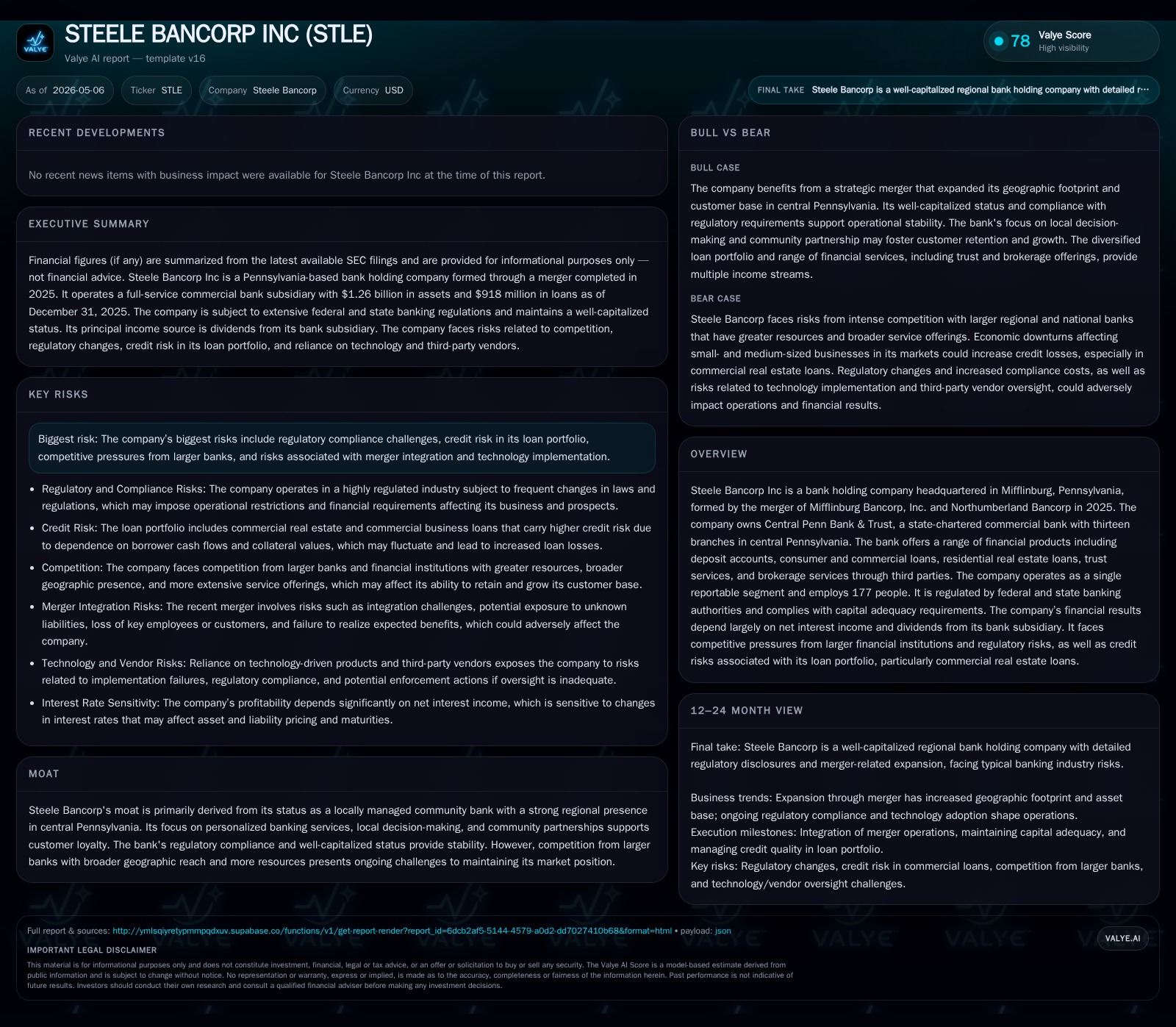
Following the merger completion in August 2025, Steele Bancorp has reported early operational progress and synergy capture as reflected in its latest filings. The company operates through Central Penn Bank & Trust, a single-reporting segment with 13 branches serving four counties. Its business model relies heavily on net interest income and dividends from the bank subsidiary, anchored by localized decision-making and personalized services that support customer loyalty. Competitive challenges from larger institutions, regulatory complexity, and credit risk in a geographically concentrated loan portfolio remain key risks. Growth is expected to be driven by further integration efficiencies, deepening SME relationships, and selectively expanding product offerings.
Near-Term Operating Developments Shaping Steele Bancorp Today
Steele Bancorp’s trajectory since its August 2025 formation through the merger of Mifflinburg Bancorp and Northumberland Bancorp has been actively documented in SEC filings spanning Q4 2025 through Q1 2026. The latest quarterly report (10-Q filed November 14, 2025) confirms early stages of operational integration—combining branch networks under Central Penn Bank & Trust while harmonizing technology platforms and employee structures to begin synergy realization [S2]. The subsequent Q1 earnings release (April 20, 2026) reiterates steady deposit growth within existing markets alongside controlled expenses aligned with merger-related efficiencies [S3].
These filings reflect that management is focused on consolidating back-office operations and optimizing branch coverage without significant contraction of customer access points. Early signs indicate the company is successfully meshing personnel cultures from the two legacy entities while maintaining service continuity—a vital factor for sustaining customer retention during such transitions.
Business Model Overview: Community Banking with a Singular Regional Focus
Steele Bancorp functions primarily as a bank holding company headquartered in Mifflinburg, Pennsylvania. Following the mid-2025 mergers, it wholly owns Central Penn Bank & Trust—the sole operating bank subsidiary—forming a single reportable segment characterized by uniform delivery systems across its thirteen branches spanning four Pennsylvania counties: Union, Snyder, Northumberland, and Centre [S1][F1].
The firm’s core revenue engine stems from net interest income generated by loans predominantly secured against commercial real estate (~$918 million gross loans) coupled with residential real estate and consumer loans. Deposits exceed $1.11 billion supporting these assets [F1][S6]. Dividends received from Central Penn Bank are the principal source of parent company revenues with dividend payments subject to regulatory oversight including capital requirements [S7].
This tightly circumscribed regional footprint underpins a business model centered on localized credit decision-making authority. This strategic orientation enables responsive underwriting practices tailored to distinct market dynamics within central Pennsylvania communities. Such localism also fosters close-knit relationships between lenders and customers essential for addressing nuanced financial needs among individuals, nonprofits, and small- to medium-sized enterprises (SMEs).
Product and Service Quality Supporting Customer Loyalty
Central Penn Bank offers comprehensive banking solutions including demand deposits, time deposits, consumer loans, commercial loans tailored primarily for SMEs, residential mortgage products, trust services via an internal department, plus brokerage offerings facilitated through third-party partnerships [S1]. This breadth ensures diversified revenue streams while allowing cross-selling opportunities within a unified platform.
The emphasis on personalized service arises from a community banking ethos reinforced by local management control. Unlike larger institutions with centralized approval processes that can delay lending decisions or limit product customization, Steele’s localized underwriting promotes agility—critical for winning SME clientele reliant on swift credit access. Moreover, trust services add value for affluent customers seeking wealth management options within their community banking relationship rather than seeking external providers.
Customer loyalty benefits from this combination of product variety anchored in relational delivery models rather than commoditized digital-only engagements prevalent at scale-focused competitors.
Industry Structure and Competitive Position in Central Pennsylvania
Steele operates within an industry landscape characterized by consolidation trends favoring large regional and national banks equipped with extensive technological infrastructure enabling broader product suites at scale [S10]. These competitors often possess stronger branding recognition coupled with digital tools that appeal to tech-savvy demographics.
However, regulatory frameworks impose capital adequacy requirements monitored through Basel III-aligned ratios which Steele consistently meets at both parent and banking subsidiary levels; as of December 31, 2025, it qualifies as well capitalized under FDIC guidelines [S6][S7]. The company also holds an "outstanding" rating on its most recent Community Reinvestment Act examination—a mark enhancing reputational positioning within its territories which regulators assess based on lending activity aligned to low- and moderate-income neighborhoods [S4].
Environmental policies embedded in lending guidelines add due diligence costs but mitigate credit risks associated with financing projects potentially impacted by ecological regulations [S4]. Additionally, compliance demands around anti-money laundering statutes like the Patriot Act impose considerable operational overhead relevant across all institutions but challenging for smaller players with lean compliance teams [S15][S22].
Geographically concentrated exposure presents both strength in market knowledge but also heightens sensitivity to local economic cycles especially relevant given SME client bases' modest financial buffers relative to larger corporate borrowers [S26]. This competitive environment pressures pricing margins yet rewards institutions that sustain trusted personal relationships.
Growth Drivers: Merger Synergies and Community-Centric Expansion
The realized merger between former equals provides multiple structural growth drivers—chiefly cost rationalization via combined back-office functions reducing operating expenses without eroding front-line service delivery quality [S2][S3]. Cross-selling opportunities expand by integrating complementary loan portfolios and deposit bases allowing introduction of new products into existing customer relationships.
Steele’s strong CRA performance enhances access to regulatory approvals when considering new branches or acquisitions—a competitive advantage over less compliant peers [S4][S7]. The company’s digital banking initiatives aim to modernize convenience features catering both to traditional demographic segments preferring branch interactions and younger customers valuing mobile platforms—an important dual approach preserving heritage value while embracing evolving user preferences.
The firm’s focus on SMEs aligns well with demonstrated need for flexible financing locally where larger banks impose stricter underwriting hurdles or favor higher-ticket transactions—a structural demand underpinning lending growth potential absent severe economic disruption.[F1]
Risks and Watchpoints: Regulatory Complexity, Credit Quality, and Market Competition
Ongoing risks center on regulatory oversight intensifying post-financial crisis reforms with evolving capital requirement norms possibly raising future thresholds beyond current well-capitalized status limiting dividend distributions or share repurchases at the holding company level [S7][S8][S24].
Merger integration risks remain material—harmonizing IT systems introduces cybersecurity exposure while cultural assimilation affects employee retention critical for stable client servicing. Failure to fully achieve projected synergies could adversely impact profitability beyond transitional costs noted in initial quarters [S19].
Credit portfolio concentration—particularly commercial real estate—poses vulnerability if central Pennsylvania faces economic stress reducing cash flows supporting debt service capacity among borrowers largely drawn from SMEs potentially less resilient in downturns relative to larger firms with diversified revenue sources [S12][S19]. Internal loan limits conservative relative to competitors may constrain ability to win larger commercial clients necessitating participation sales which carry execution risk.
Competition increasingly includes fintech entrants offering niche products eroding market share gradually if customer convenience preferences shift more rapidly than incumbents’ technology adoption pace.
Key Milestones and What to Watch Next in 2026
Key indicators will revolve around quarterly earnings announcements tracking merger synergy metrics—cost savings realization rates versus plan—and monitoring deposit inflows reflecting community confidence during an economically cautious environment [S3]. Regulatory examination outcomes including updated CRA ratings scheduled post new rule implementations remain crucial barometers of franchise health.
Progress in digital platform rollouts alongside branch network optimization plans will reveal Steele’s capability in balancing tradition with innovation demanded by evolving customer habits. Loan portfolio performance scrutinized under macroeconomic stresses will signal credit risk trends especially related to concentration sectors.
Dividend declarations sourced from bank subsidiary profitability must be watched for insights into cash flow sufficiency affecting capital return policies at the holding company level [S7]. Internal talent retention amid integration efforts remains another execution factor impacting forward momentum.
Disclaimer: This analysis is based solely on publicly available SEC filings up to May 2026 plus Valye News research excerpts. It is intended for informational purposes only without investment recommendations or guidance.
Disclaimer: This is research-only, informational analysis and not investment advice. It may include AI-generated interpretation and general industry context. Always verify important details using primary sources.

Comments