
Hagerty Secures Niche Leadership Through Integrated Enthusiast Ecosystem and Solid Q1 Execution
Q1 2026 results affirm Hagerty's strong engagement-driven insurance model amid underwriting discipline and marketplace growth.
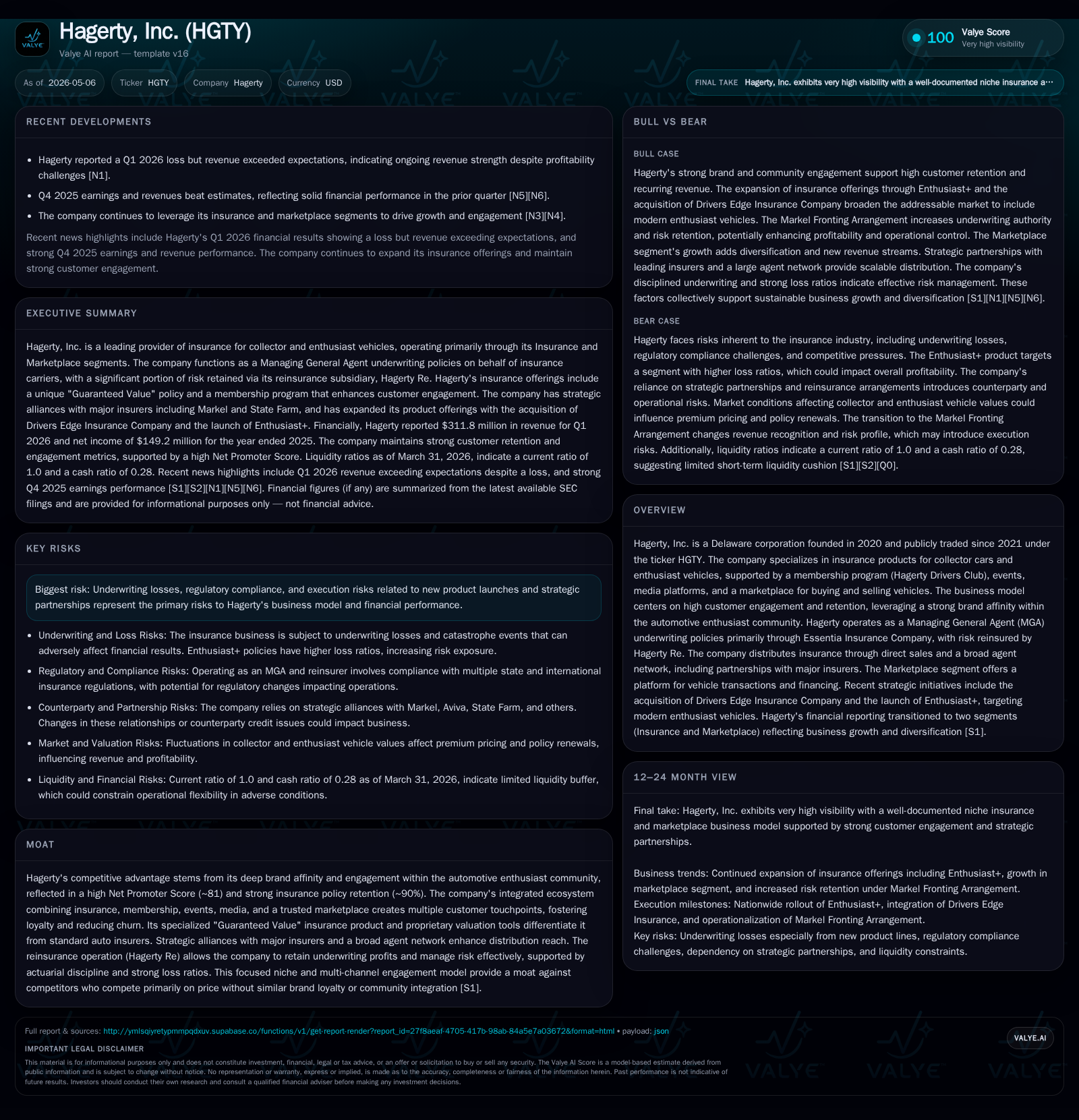
In the first quarter of 2026, Hagerty reported operational progress highlighted by robust premium growth and high policy retention despite a net loss largely attributed to expected seasonality and catastrophe claims timing. The company’s distinctive MGA insurance platform, coupled with its enthusiast membership, media, events, and marketplace assets, supports durable customer loyalty and an integrated revenue base. Hagerty’s underwriting loss ratios remain markedly superior to industry averages, underpinning its competitive moat. Key growth vectors include the rollout of new insurance products, expanding member engagement, and marketplace expansion, balanced against risks from catastrophe exposures and regulatory capital constraints.
Q1 2026 Operating Review: Results and Implications
Hagerty’s first quarter filing for the period ending March 31, 2026, reveals a nuanced operating picture featuring premium growth that outpaced consensus yet was accompanied by a net loss [S2][N1]. The net loss primarily reflects timing nuances around catastrophe claims payments—wildfire and hurricane-related claims stemming from late 2024 into early 2025—as well as seasonality effects inherent to the specialty insurer’s geographical footprint where renewals spike in warmer months. Commission revenue receipts connected to spring/summer peak activity had yet to fully materialize in Q1 [S1][S2]. This pattern aligns with historical disclosures that second- and third-quarter periods concentrate MGA commission income and fee revenues.
The operational takeaway is that Hagerty’s underlying core demand remains stable with retention rates hovering near 90%, corroborating resilience during traditionally lower-activity quarters [S2]. Moreover, management emphasized ongoing premium rate increases reflecting higher vehicle valuations rather than volume-driven top-line changes. This suggests pricing power remains intact despite competitive pressures.
Business Model Nuances: Balancing Insurance Underwriting, Membership, and Marketplace
Hagerty operates distinct but interlocking business units underpinned by its Managing General Agent (MGA) insurance model. The company designs policies tailored specifically for collector vehicles through MGA subsidiaries like Drivers Edge Insurance Company. Risk is partly retained via Hagerty Reinsurance Company (“Hagerty Re”), providing financial leverage over underwriting profits while managing capital efficiently within Bermuda solvency regulations [S1].
Simultaneously, Hagerty cultivates a fervent community of automotive enthusiasts via its Hagerty Drivers Club (HDC), bespoke car events fostering brand proximity, media content platforms that engage audiences year-round beyond transactional touchpoints, and an integrated marketplace facilitating buying, selling, and financing of collector cars [S1]. These multiple engagement channels promote repeat interactions spanning long policy lifecycles averaging nine years—a rare feature in insurance businesses typically facing high churn.
Additionally, proprietary valuation tools supporting the "Guaranteed Value" insurance offering create switching costs by anchoring insured values transparently for rare vehicles [S1]. This synergy of horizontal offerings enhances lifetime value per member/customer beyond conventional auto insurers who compete primarily on price.
Competitive Moat Rooted in Enthusiast Engagement and Superior Underwriting Discipline
Hagerty’s moat stems from deep brand affinity within its niche enthusiast market combined with actuarially disciplined underwritten risk. The company consistently achieves an outstanding Net Promoter Score around 81—well above standard industry benchmarks—which correlates strongly with their reported ~90% policy renewal rates [S1].
Underwriting rigor enabled by proprietary data analytics through the MGA provides a structural advantage reflected in Hagerty Re’s average loss ratio near 42% over recent years compared to roughly 74% industry-wide excluding loss adjustment expenses [S1]. Maintaining such low combined ratios signals effective risk selection relevant when insuring vintage or specialty cars whose claim profiles differ markedly from mass-market fleets.
Reinsurance operations add further economic resiliency by internalizing underwriting profits while enabling prudential capital deployment consistent with Bermuda Solvency Capital Requirements [S1]. These factors create barriers for broad-based insurers without collector car expertise or loyal communities.
Industry Environment: Specialty Insurance Dynamics and Distribution Networks
The specialty vehicle insurance sector faces unique dynamics characterized by pronounced geographic seasonality; warmer months see increased vehicle use culminating in concentrated renewal volumes accounting for most annual premiums [S1]. Such cyclicality requires agile commission recognition aligned with MGA structures.
Competition includes specialist insurers focused solely on enthusiast vehicles alongside major insurers offering niche products. Hagerty benefits from hybrid distribution comprising direct-to-consumer digital sales complemented by broad agent networks including alliances with large insurers increasing reach beyond core enthusiasts [S1].
Distribution breadth mitigates limitations common among niche players restricting scale. Meanwhile, geographic concentration mainly in warmer U.S regions subjects periodic exposure to catastrophic weather events proliferating losses during specific calendar intervals [S1].[N1]
Growth Drivers: New Products, Market Penetration, and Brand Loyalties
Strategic initiatives emphasize product expansion such as the "Enthusiast+" offering broadening coverage options tailored to higher value vehicles or unique ownership profiles [S2]. Enlarging this portfolio aims to capture upmarket segments unwilling or underserved by traditional policies.
The Marketplace segment also presents considerable growth potential by streamlining vehicle transactions including ancillary financing solutions (via BAC subsidiary), leveraging brand trust to attract both buyers and sellers efficiently [S1][S2]. This creates recurring non-insurance revenue streams diversifying income sources.
Membership growth supported by hallmark automotive events alongside engaging multi-channel media content fuels organic demand. The resulting strengthening of community bonds encourages longer policy tenure boosting revenue visibility given long average policy life spans nearing nine years.
Incremental premium rate increases tied to rising collector car valuations also underpin measurable price/mix improvements supporting margin resilience even if unit sales moderate temporarily.
Risks and Constraints: Underwriting Volatility, Regulatory Hurdles, Execution Challenges
Primary risks include heightened underwriting losses attributable to increasingly frequent severe catastrophic weather incidents impacting insured pools disproportionally [S8][S2]. Such claims volatility pressures realized loss ratios quarterly.
Regulatory constraints particularly affect capital deployment via dividend distribution restrictions imposed on regulated entities like Hagerty Re under Bermuda law requiring solvency margins; similar NAIC RBC requirements constrain Drivers Edge dividends pending approvals limiting cash repatriation flexibility [S1][S8].
Operational execution risk accompanies new product launches or alliances extending distribution channels where integration missteps could delay anticipated returns or elevate costs [S2][S3]. Ensuring actuarial discipline amidst growth focus remains critical to sustain favorable underwriting economics.
Legal contingencies exist as routine litigation arises related to intellectual property or contractual enforcement common in dynamic ecosystems; however management regards these as having no material financial impact currently [S8].
Key Upcoming Milestones and Demand Indicators to Monitor
Attention should pivot toward monitoring commercial momentum through second- and third-quarter renewal rates which historically generate peak MGA commission income tied to seasonal activity shifts [S2][N1].
Observation of catastrophe claim trends will illuminate exposure management effectiveness given increased natural disaster frequency noted in recent years.
Regulatory developments impacting allowable dividend payments or capital adequacy could signal shifts in strategic capital allocation impacting shareholder returns.
Tracking marketplace metrics like transaction volume increases or borrower collateral valuations within loan portfolios will evidence traction against vehicle financing objectives driving diversification.
Further product announcements or expanding agent partnerships may presage accelerated penetration into underserved markets bolstering scale economics post-Q2/Q3 periods.
Financial Position Snapshot: Leverage, Liquidity, and Profitability Insights
Latest financial snapshot
| Metric | Value | Period |
|---|---|---|
| Cash & equivalents | $212mm | |
| 2026-03-31 | ||
| Total debt | $229mm | |
| 2026-03-31 | ||
| Net debt | $17mm | |
| 2026-03-31 | ||
| Current ratio | 1x | |
| 2026-03-31 |
Source: SEC companyfacts cache [F1].
As of quarter-end March 31, 2026, Hagerty held approximately $212 million in cash against total debt near $229 million resulting in low net debt close to $17 million—demonstrating manageable leverage amid ongoing operational investment requirements [F1].
While Q1 produced a net loss situation influenced by aforementioned factors including timing mismatch of catastrophe claim payments yet revenue beat affirms robust premium inflows supporting future profitability recovery once seasonal patterns normalize [N1][S2].
Overall financial posture provides adequate runway for continued investment in organic growth initiatives like Marketplace expansion plus funding additional product development without immediate refinancing pressure under current debt covenants maintained since prior credit agreement refinancing concluded in early 2025 [S4][S5][F1].
Disclaimer: This is research-only, informational analysis and not investment advice. It may include AI-generated interpretation and general industry context. Always verify important details using primary sources.

Comments