
Corebridge Financial Pursues Strategic Growth with Equitable Merger and Capital Management
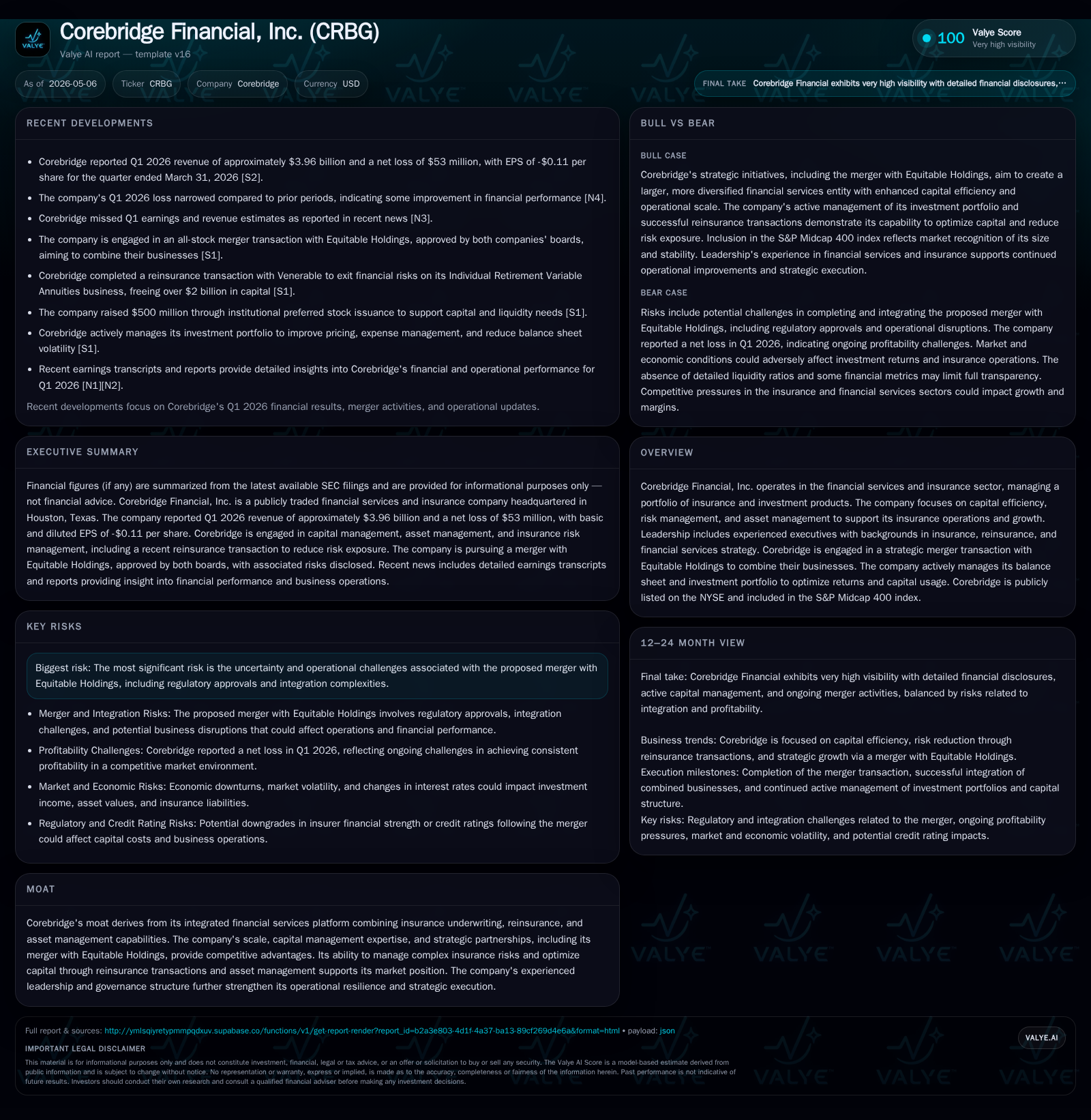
Corebridge’s Q1 2026 performance reflects the near-term operating impact of its pending merger with Equitable Holdings amid capital management initiatives.
In its latest quarterly filing, Corebridge Financial disclosed a mixed Q1 2026 operating performance influenced by market volatility and integration efforts tied to its proposed merger with Equitable Holdings. The company’s business model leverages an integrated insurance and asset management platform designed to optimize capital efficiency and risk management. While the merger offers significant growth synergies and expanded product capabilities, execution risks and regulatory approvals remain key uncertainties. Going forward, milestones around merger completion and synergy realization will critically shape Corebridge’s trajectory.
Latest Quarterly Operating Update: Q1 2026 Disclosures and Key Developments
Corebridge Financial's Q1 2026 results outlined in the May 6, 2026 Form 10-Q revealed a mixed operating picture amid significant corporate transformation. The company reported revenue softness stemming primarily from volatile variable investment income components — including call premiums on bonds and unrealized mark-to-market losses on certain fair value investments — which dampened adjusted pre-tax operating income relative to expectations [S2][N3]. This shortfall was notably influenced by broader interest rate fluctuations impacting fixed income yields.
Management highlighted ongoing resource allocation toward the integration planning phase associated with Corebridge's pending all-stock merger with Equitable Holdings announced late March 2026 [S25][N1]. The filings emphasized that while near-term costs related to transaction readiness have temporarily pressured margins, disciplined capital management remains a priority. An 8-K filing dated May 4 reiterated the Q1 results alongside commentary on maintaining operational resilience amidst merger-related uncertainties [S3].
Investor reception reflected cautious sentiment given the blended results but acknowledged the strategic rationale behind the merger consolidation in a competitive market landscape [N2][N3].
Business Model Overview: Insurance, Asset Management, and Risk Integration
Corebridge operates a financially integrated platform that spans individual life insurance products, reinsurance solutions, and asset management services designed specifically for managing long-duration insurance liabilities [S1]. Its revenue sources derive chiefly from premiums received on protection products complemented by income generated through diverse investment portfolios tied to policyholder funds.
The firm's capital-efficient approach employs intricate reinsurance arrangements to transfer portions of underwriting risk externally while utilizing in-house asset management teams to optimize portfolio returns aligned with long-term liability profiles. This model facilitates disciplined deployment of equity capital with targeted return metrics supported by advanced actuarial assumptions embedded in product pricing [S1].
Importantly, Corebridge’s platform reflects significant switching costs for customers driven by policy longevity and embedded guarantees typical in life insurance contracts, reinforcing persistency dynamics favorable for stable cash flows. Its asset management capabilities extend beyond proprietary insurance assets into third-party mandates enhancing fee-based income streams.
Competitive Positioning within the Financial Services and Insurance Sector
Within the financial services ecosystem, Corebridge occupies a nexus point between traditional insurers focusing on underwriting excellence and specialized reinsurers emphasizing portfolio risk mitigation. Its combination of these roles creates underwriting leverage whereby statutory capital requirements can be efficiently managed through layered reinsurance cessions.
Regulatory frameworks impose nuanced constraints especially under solvency regimes affecting life insurers; Corebridge’s ability to navigate these while maintaining insurer financial strength ratings underscores operational competence. Further competitive differentiation arises from its public company expense discipline juxtaposed against nimble asset allocation strategies exploiting alternative investment markets.
A critical catalyst resides in its pending merger with Equitable Holdings whose complementary distribution channels and insurance product lines are expected to reinforce market share positions while fostering scale economies absent among peers with siloed operations [S1].
Growth Drivers: Merger Synergies, Capital Optimization, and Product Expansion
Corebridge's anticipated growth trajectory rests significantly on realizing cost synergies articulated in its March 26 merger agreement framework with Equitable Holdings totaling estimated run-rate expense savings over time post-closing [S25][S4]. These include reductions in duplicative administrative functions alongside enhanced bargaining power in reinsurance procurement.
Expanded distribution access via Equitable's networks enables intensified cross-selling opportunities of life insurance products supported by enhanced analytics platforms projected during integration phases. Concurrently, capital redeployment strategies aim at improving returns on equity by shifting invested assets toward higher-yielding alternatives within prudent risk parameters set for insurance liabilities.
Product innovation remains a parallel vector as the combined entity explores leveraging asset management capabilities to develop new offerings blending protection features with investment elements tailored to evolving demographic needs.
Overall momentum is anchored on clearly traceable KPIs such as regulatory approval clearances for the merger, synergy achievement benchmarks reported quarterly, customer retention rates post-integration, and progressive expansion of fee-generating asset mandates.
Risks and Constraints: Merger Execution Challenges and Regulatory Uncertainties
The principal risk confronting Corebridge entails successful execution of its transformative merger with Equitable Holdings. Regulatory review remains pending from multiple agencies subject to timing variability; any delays could defer anticipated benefits or increase transactional costs [S2][S26].
Integration complexity presents operational hazards including potential cultural clashes between legacy organizations, attrition of key personnel during transition phases, and disruption risks to existing client servicing levels impacting persistency metrics crucial in life insurance economics.
Capital markets volatility continues to inject unpredictability into Corebridge’s investment income which notably impacted Q1 earnings. Such fluctuations can affect available surplus buffers needed under insurer financial strength requirements limiting opportunistic asset reallocations.
Moreover, external macroeconomic factors such as rising interest rates or geopolitical instability pose downside potentials that may compress underwriting margins or impair access to affordable reinsurance capacity.
Mitigation tactics highlighted involve phased integration plans minimizing overlap friction points alongside proactive communication strategies targeting regulatory engagement processes.
What to Watch Next: Upcoming Milestones and Operational Indicators
Looking ahead, attention centers on progress toward obtaining definitive regulatory approvals necessary for closing the Corebridge-Equitable merger as outlined through forthcoming proxy statements expected following SEC filings linked to registration documentation preparations [S4][S5][S13].
Quarterly earnings reports subsequent to Q1 2026 will serve as barometers tracking synergy realization progress alongside updated guidance reflecting operational integration advances or challenges.
Monitoring credit rating reviews by agencies assessing insurer financial strength post-transaction constitutes a critical factor influencing borrowing costs and market confidence.
Investors should also observe any announcements regarding planned share repurchases prior to closing as indicated in April disclosures suggesting opportunistic capital return initiatives dependent upon board discretion under prevailing market conditions [S27].
Financial Profile: Current Balance Sheet Metrics and Earnings Snapshot
As of year-end 2023 per companyfacts data augmented by recent disclosures, Corebridge carries approximately $9.18 billion of total debt underscoring a moderately leveraged profile typical for integrated insurance businesses focused on matching assets against long-term liabilities [F1][S2].
Recent quarterly filings reaffirm ongoing active capital management including maintenance of liquidity buffers sufficient for operational flexibility during transition phases surrounding the merger event [S2][S3].
Q1 2026 earnings reflect transient pressures from variable investment income volatility but underline intact foundational cash flows derived from core underwriting operations validating structural resilience despite external shocks.
The firm's financial stewardship emphasizes balancing growth funding needs against preservation of robust solvency margins consistent with regulatory expectations governing life insurers’ capital adequacy frameworks.
This analysis synthesizes publicly filed documents including Corebridge Financial’s most recent quarterly disclosures along with referenced event filings up to May 2026. It aims exclusively at providing an informed assessment without any investment recommendations or forecasts concerning company securities or performance outcomes.
Disclaimer: This is research-only, informational analysis and not investment advice. It may include AI-generated interpretation and general industry context. Always verify important details using primary sources.

Comments