
UNIFI's Operational Resilience Hinges on REPREVE Growth Amid Industry Headwinds
UNIFI reported mixed Q3 2026 results reflecting ongoing demand challenges but reinforced its commitment to innovation and sustainability-led growth.
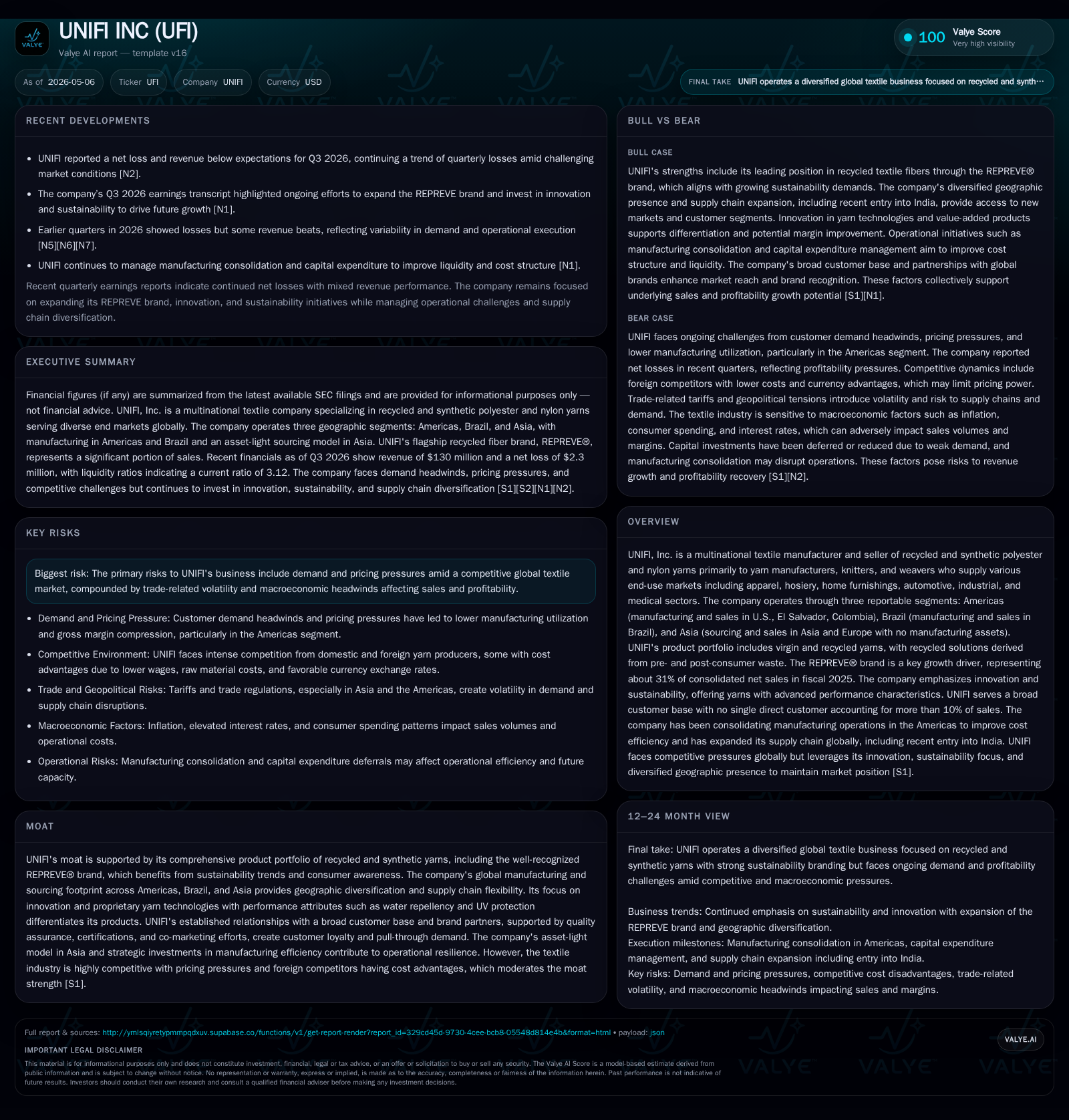
In its latest Q3 2026 filing, UNIFI highlighted several headwinds including subdued global demand and pricing pressures in key textile markets, which weighed on operating margins despite steady net income. The company’s strength lies in its diversified global footprint across Americas, Brazil, and Asia segments and its proprietary REPREVE® recycled yarn brand, which continues to drive around one-third of net sales. UNIFI is responding to macroeconomic and trade volatility with operational efficiencies, portfolio diversification beyond traditional apparel, and an asset-light approach in Asia that supports supply chain flexibility. Key growth levers remain innovation in sustainable fibers and expansion into new geographies with localized capital deployment. However, demand cyclicality and input cost volatility pose risks that require careful monitoring.
Recent Operating Update: Q3 2026 Challenges and Strategic Reaffirmation
UNIFI’s latest quarterly filing dated May 6, 2026 ([S2]) reveals ongoing headwinds from softer global textile demand particularly impacting volumes and pricing within the Americas and Asia segments. Operating income remained negative due in part to lower manufacturing utilization and competitive price pressure across core markets. Despite this, the company reported net income of approximately $15.5 million supported by financial management actions ([F1]). The earnings call accompanying the press release ([S3]) emphasized sustained investments in product innovation—especially around the REPREVE® recycled yarn platform—as central to future growth. Notably, capital expenditures remain conservative at an expected $8–12 million annually focused on maintenance rather than further capacity buildout ([S5]), underscoring a prudent stance during uncertain macroeconomic conditions.
UNIFI's Business Model: Recycling Innovation Anchored by REPREVE®
UNIFI operates primarily as a manufacturer and seller of recycled and synthetic polyester and nylon yarns targeting intermediate yarn producers—knitters and weavers—that supply diverse end-use sectors including apparel (58% of sales), industrial (12%), home furnishings (12%), automotive (6%), and others ([S13],[S26]). Its revenue mechanism is predominantly volume-driven sales to these direct customers with pricing influenced by input costs, product mix between commodity versus differentiated yarns, contract terms, and capacity utilization.
The company’s strategic differentiation lies in its patented REPREVE® branded fiber made from pre- and post-consumer recycled materials such as plastic bottle flake. The brand not only taps into growing sustainability mandates among brands but also commands premium positioning through demonstrated performance attributes like UV protection and water repellency ([S21],[S29]). REPREVE represented about 31% of fiscal year 2025 net sales, indicating significant reliance on this platform ([S5]).
Operationally, UNIFI runs vertically integrated manufacturing facilities across North America (U.S., El Salvador, Colombia) under its Americas segment; Brazil operations comprise key localized manufacturing assets; while Asia functions as an asset-light sourcing hub selling proprietary products primarily through contract manufacturing ([S1],[S6]). This segmentation enables supply chain agility during varying regional demand patterns.
Key value drivers include accelerating innovation through R&D collaborations with customers to enhance fiber functionality, broadening REPREVE’s market penetration especially outside apparel into industrial applications, and leveraging free trade agreements such as USMCA/CAFTA-DR to maintain competitive duty structures for compliant yarns ([S27],[S28]).
Industry Structure & Competitive Position
The global textile industry exhibits intense competition characterized by numerous foreign manufacturers equipped with cost advantages including lower labor expenses, cheaper raw materials due to proximity or scale, and favorable currency dynamics ([S25],[S23]). Nonetheless, UNIFI maintains defensible positioning through:
- The niche leadership in compliant yarns meeting stringent North American trade-origin rules (“Berry Amendment”) encoding domestic sourcing preferences for defense contracts ([S27]).
- Established customer relationships cultivated through co-marketing alliances highlighting sustainability credentials.
- Continuous product innovation embedding performance attributes fostering switching costs.
- Geographic diversification mitigating reliance on any single region while providing exposure to high-growth emerging markets via its Asia segment’s asset-light approach ([S20]).
Competitors vary by region but several global recycled fiber players like Far Eastern New Century also compete against the REPREVE platform ([S25]). Operational efficiency gains achieved through new eAFK Evo texturing machinery upgrades in Americas & Brazil further buttress cost competitiveness without excessive capital intensity ([S5]).
Growth Drivers
Sustainability Demand & REPREVE Momentum
Corporate commitments among brands to reduce carbon footprints bolster demand for recycled fibers such as those under REPREVE offering environmental differentiation over virgin polyester yarns.
Geographic Expansion & Asset-Light Sourcing Model
UNIFI plans expansion into India, Europe, Africa, and the Middle East leveraging its proven Asian service-and-sourcing model without significant upfront capital investment ([S20]). This model provides rapid scalability helping capture global supply chain shifts triggered by trade conflicts or regional sourcing optimization.
Innovation Pipeline & Portfolio Diversification
R&D efforts emphasize next-gen yarn technologies enhancing properties like color-fastness with less water use or flame retardancy—providing margin uplift opportunities outside commoditized segments ([S29]). UNIFI has also introduced new platforms like Textile Takeback recycling initiatives targeting circular economy applications.
Manufacturing Efficiency & Capacity Consolidation
Recent consolidation moves within Americas aim to optimize facility utilization rates previously depressed amid inventory destocking cycles by major apparel brands ([S21]). Technology upgrades through machinery investments are designed to improve throughput while reducing per-unit cost structures ([S5]).
Risks & Watchpoints
- Demand Cyclicality: Apparel sector volumes remain sensitive to consumer spending trends impacted by macroeconomic slowdowns or inventory adjustments upstream.
- Raw Material Volatility: Feedstock prices fluctuate with petrochemical market dynamics introducing input cost variability affecting gross margins.
- Trade & Tariff Uncertainty: Ongoing geopolitical tensions result in tariffs on imports from Asia creating potential demand distortion or cross-border supply interruptions ([S23],[S28]).
- Competitive Pricing Pressure: Foreign producers’ wage/cost advantages may pressure price realization despite product differentiation efforts.
- Operational Leverage: Subdued volume levels reduce facility utilization leading to fixed-cost absorption challenges injuring profitability.
What to Watch Next
Investors should track the following milestones:
- Q4 fiscal 2026 volume trends across segments signaling whether recent commercial efforts are translating into sustained demand recovery.
- Pricing actions implemented particularly in Americas where competitive pressure is most acute.
- Progress on geographic expansion into new markets outside Asia leveraging asset-light models without significant incremental capex commitments.
- Innovations released or broadened licensing for REPREVE® products particularly into industrial or non-apparel uses offering margin improvement potential.
- Updates on tariff landscape or renewal of antidumping duties impacting import flows.
- Operational metrics reflecting efficiency gains from eAFK Evo machinery deployments amid consolidation progress.
Financial Profile Snapshot as of Q3 2026 End [F1]
Latest financial snapshot
| Metric | Value | Period |
|---|---|---|
| Cash & equivalents | $27mm | |
| 2026-03-29 | ||
| Total debt | $82mm | |
| 2026-03-29 | ||
| Net debt | $56mm | |
| 2026-03-29 | ||
| Current assets | $212mm | |
| 2026-03-29 | ||
| Current liabilities | $68mm | |
| 2026-03-29 | ||
| Current ratio | 3.12x | |
| 2026-03-29 |
Source: SEC companyfacts cache [F1].
While operating income fell short at roughly -$9.52 million primarily due to unfavorable volume/mix pressures, net income stayed positive highlighting effective financial controls during turbulent market conditions ([F1]).
This analysis synthesizes UNIFI’s latest quarterly disclosures alongside historical operational insights without issuing investment recommendations or forecasts. It aims to contextualize company developments amid prevailing industry dynamics and evolving sustainability trends shaping synthetic textile markets today.
Disclaimer: This is research-only, informational analysis and not investment advice. It may include AI-generated interpretation and general industry context. Always verify important details using primary sources.

Comments