
Kraft Heinz Navigates Cost Pressures with Portfolio and Innovation Momentum
Kraft Heinz’s Q1 2026 results show pricing resilience and revenue growth amid competitive challenges, alongside a strategic pause on its planned separation.
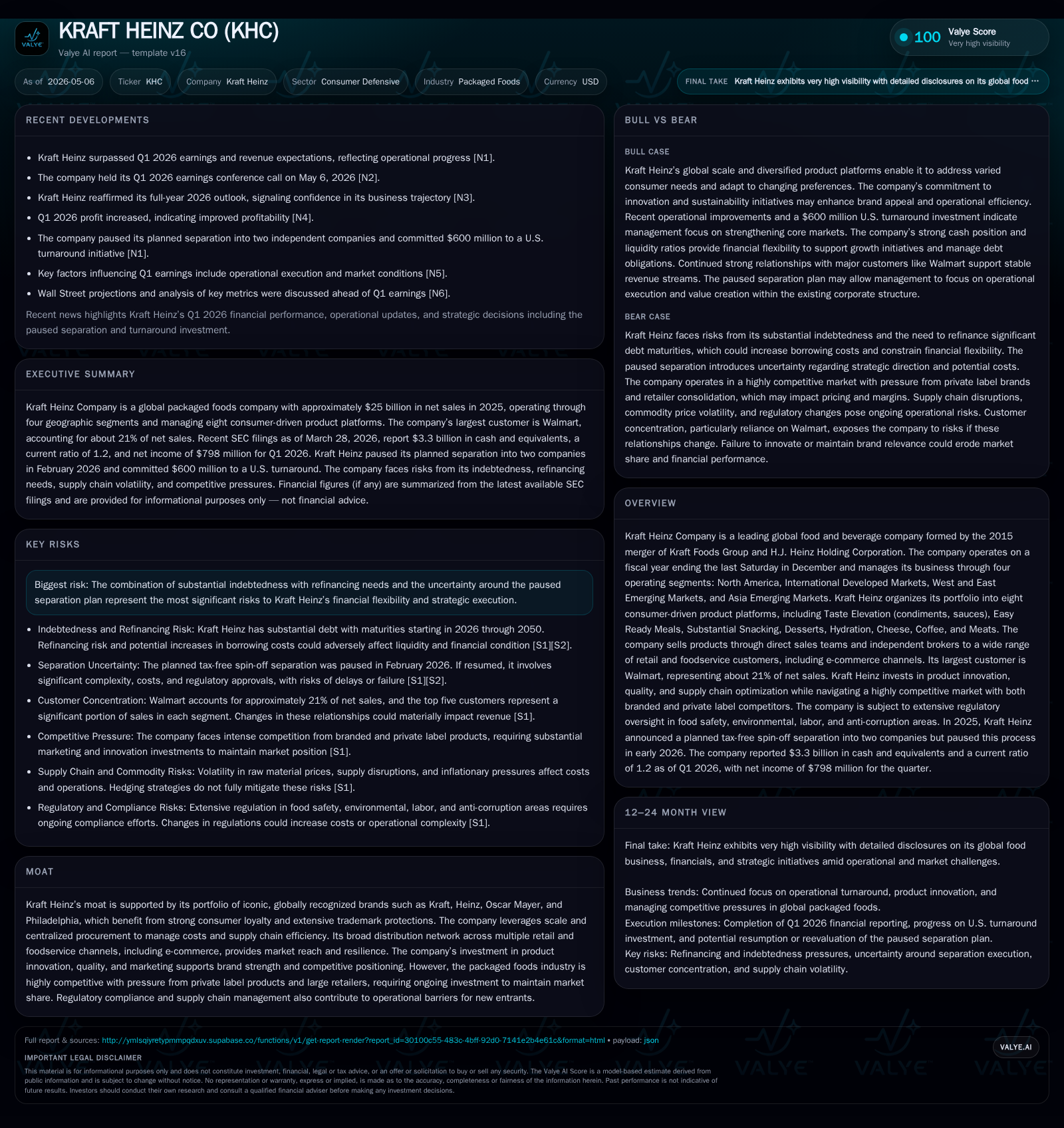
In its latest quarterly filing for Q1 2026, Kraft Heinz reported solid revenue performance driven by disciplined pricing and strong brand platforms, offsetting elevated commodity cost pressures. The company has paused work on its previously announced spin-off plan to focus on operational execution amidst ongoing industry competition and inflation. Growth prospects center on product innovation, emerging markets expansion, and expanding e-commerce channels. However, the firm faces notable risks from substantial leverage, refinancing obligations, and margin volatility due to cost inflation. Monitoring pricing realization and margin trends will be key in the near term.
Latest Quarterly Operating Update: Signs of Resilient Pricing and Revenue Growth
Kraft Heinz’s first quarter of fiscal 2026 demonstrated tangible progress in revenue resilience despite ongoing cost headwinds. The 10-Q filing dated May 6, 2026 reveals that the company successfully implemented price increases across key product categories to counteract inflationary commodity pressures [S2]. These pricing actions helped sustain gross margins in an environment where input costs remain elevated globally—a critical metric given the packaged food sector’s sensitivity to raw material fluctuations.
No new risk factors were introduced in the quarterly report, reinforcing management’s ability to navigate existing industry challenges without additional disruptions [S2]. Meanwhile, the company maintained its full-year guidance for 2026 sales growth and margin targets post-quarter-end, signaling confidence in ongoing execution capabilities [N11].
A notable development is the board’s February 2026 decision to pause work on the previously announced tax-free spin-off separating Kraft Heinz into two distinct publicly traded entities. This strategic pause reflects reassessed priorities: focusing capital allocation and management bandwidth on optimizing the existing portfolio rather than undertaking a complex structural transaction at this juncture [S1][S3]. Given the uncertainties around regulatory approvals and market conditions impacting such separations, this deferral helps mitigate near-term execution risks.
Business Model and Product Portfolio: Iconic Brands Driving Consumer Loyalty
The Kraft Heinz Company operates through a constellation of highly recognizable food and beverage brands that constitute one of the largest global packaged foods portfolios. Formed by the 2015 merger of Kraft Foods Group and H.J. Heinz Holding Corporation, it channels its offerings into eight consumer-driven platforms: Taste Elevation (condiments/sauces), Easy Ready Meals (e.g., Kraft Mac & Cheese), Substantial Snacking (Lunchables/meals kits), Desserts, Hydration (beverages), Cheese, Coffee, and Meats [S1].
Revenue generation primarily comes from selling branded products through direct sales forces complemented by independent brokers targeting extensive retail distribution—including supermarkets, mass merchandisers like Walmart (its largest customer representing roughly 21% of net sales), foodservice providers, club stores, pharmacies, drug stores, and growing e-commerce channels [S11]. This multi-channel approach offers diversified revenue streams while leveraging scale in procurement and logistics.
Strong brand equity underpins consumer loyalty with established assets such as Kraft cheese products, Heinz ketchup and condiments, Oscar Mayer meats, Philadelphia cream cheese, among others. These products benefit from consumer trust built over decades alongside extensive trademark protections that create entry barriers against niche or private label competitors. However, maintaining shelf space against increasingly aggressive retailer private labels requires sustained investments in marketing effectiveness, trade promotions, innovations tailored to evolving tastes including health-conscious options, convenience-focused solutions such as ready meals, as well as active SKU rationalization to optimize assortment efficiency [S1].
Industry Context: Competition, Private Labels, and Pricing Dynamics
Packaged foods represent a highly competitive industry landscape characterized by price-sensitive consumers facing economic pressures as well as rapid shifts in preferences toward healthier or more convenient options. Kraft Heinz competes against large multinational food players as well as local producers offering both branded lines and private label alternatives sold by dominant retailers.
The company's scale offers advantages in centralized procurement reducing input costs per unit; however fiercely competitive supermarket chains wield significant bargaining power to push down prices or develop proprietary store brands at lower cost structures [S1]. This dynamic places constant pressure on Kraft Heinz's ability to raise prices seamlessly to absorb rising production costs without volume erosion.
Additionally, increasing penetration of e-commerce food sales requires adaptiveness both in digital marketing strategies and supply chain agility—factors critical for maintaining relevance with younger demographics who prioritize convenience. Competitors similarly ramp up innovative product launches while utilizing targeted promotions forcing Kraft Heinz to balance trade spend efficiently against profitability goals. Consequently pricing discipline combined with product quality differentiation remains central to sustaining market share.
Growth Drivers: Innovation, Emerging Markets, and Channel Expansion
Looking forward, Kraft Heinz bets on several growth levers aligned with shifting consumer behaviors:
- Product Innovation: Focused R&D investments drive new product introductions particularly within health and wellness trends (e.g., cleaner ingredient profiles) as well as taste elevation enhancing traditional categories such as condiments or ready meals. These newer offerings respond directly to demand for convenience without compromising flavor or nutrition.
- Emerging Markets Expansion: Combined revenues from West & East Emerging Markets (WEEM) plus Asia Emerging Markets (AEM) compose meaningful growth avenues due to rising middle-class populations increasing packaged food consumption with westernized tastes over time [S16].
- Omnichannel Distribution: Continued penetration into e-commerce platforms complements brick-and-mortar retail presence enabling broader reach among tech-savvy consumers shopping online.
This multi-pronged approach aims to induce volume growth beyond mature North American markets where consumption patterns are more static or slowly shifting.
Risks and Constraints: Leverage Profile, Separation Uncertainty, and Cost Inflation
Despite operational strides, notable risks temper the outlook:
- Leverage Burden: As of March 28, 2026, total debt stood at approximately $19.22 billion with net debt around $15.9 billion after accounting for $3.31 billion cash balances—indicative of a stretched capital structure demanding vigilant liquidity management amid upcoming maturities [F1]. Elevated leverage limits financial flexibility impacting capacity for incremental investment or share repurchases.
- Paused Separation Plan: The delay in executing the announced spin-off defers potential unlocking of shareholder value through portfolio simplification but removes near-term complexity; uncertainty remains regarding if or when this strategy will be resumed conditional on market/tax developments [S3][S7].
- Input Cost Inflation: Persistent commodity price volatility restricts room for gross margin improvement even with tactical price hikes—competitive constraints may prevent full pass-through causing pressure on operating profits [S2].
- Competitive Pressure: Intensified rivalry from private labels could erode shelf space or force increased promotional spending thereby pressuring profitability further.
Near-Term Outlook: Monitoring Pricing Power, Margin Trends, and Execution
Management has reaffirmed full-year guidance for fiscal 2026 reflecting confidence in sustaining pricing discipline while controlling costs within competitive parameters [N11][S2]. Key performance indicators warranting close observation include segment-level revenue trends especially within emerging markets subcategories; shifts in e-commerce sales mix; stability of global supply chains affecting input availability; successful launch cadence from innovation pipeline; and any updates regarding separation plans tied to regulatory or tax opinions.
Execution effectiveness will largely determine whether Kraft Heinz can convert pricing actions into durable margin improvements without volume loss amid ongoing inflationary headwinds.
Current Financial Snapshot
As of March 28, 2026, Kraft Heinz maintains a current ratio of approximately 1.2x indicating modest short-term liquidity coverage although working capital remains tight given sizable current liabilities relative to assets [F1].
This analysis reflects information available as of early May 2026 based primarily on SEC filings including the Q1 quarterly report supplemented by recent company disclosures and industry reports. It places emphasis on operational developments supported by underlying financial data consistent with established company facts without prescribing investment conclusions.
Disclaimer: This is research-only, informational analysis and not investment advice. It may include AI-generated interpretation and general industry context. Always verify important details using primary sources.

Comments