
Caterpillar’s Q1 2026 Sales Surge Reflects Dealer Inventory Build and Broad Segment Strength
A 22% revenue increase driven by robust dealer inventory growth signals resilience amid cyclical industry dynamics.
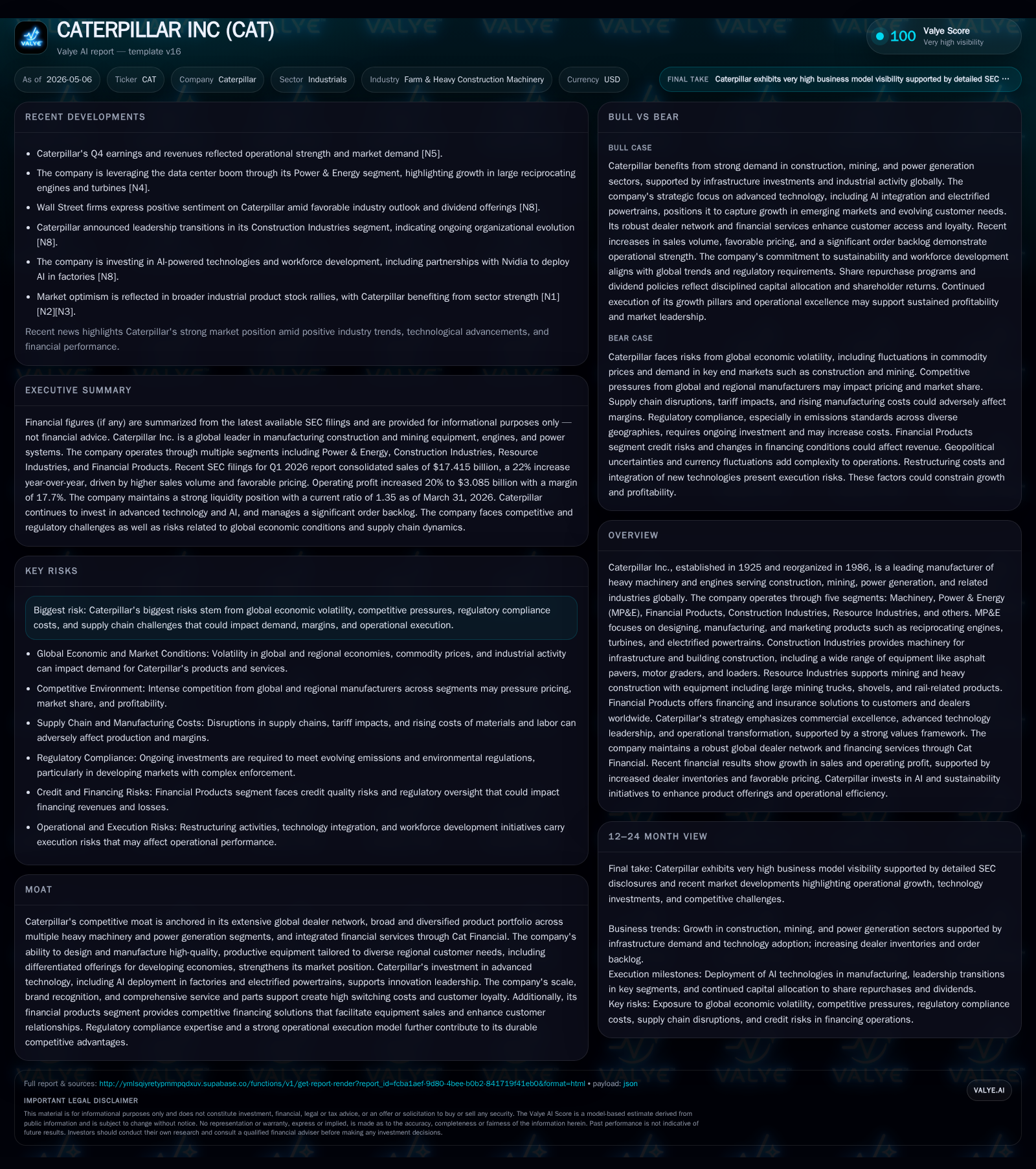
In Q1 2026, Caterpillar reported a 22% rise in sales and revenues to $17.4 billion, largely attributable to higher sales volumes and price realization, underpinned by a significant $2 billion increase in dealer inventories. Growth was broad-based across all primary segments and geographies, with North America leading gains. The company continues to leverage its global dealer network, diverse product portfolio, and integrated financing solutions to capture demand in construction, mining, and power generation sectors. While the firm faces macroeconomic risks and ongoing restructuring costs, its strategic focus on commercial excellence, advanced technology, and operational transformation supports long-term growth.
Recent Operating Update
Caterpillar Inc.’s first quarter of 2026 marked a robust revenue surge to $17.415 billion—a 22% year-over-year hike fueled primarily by higher sales volume ($2.3 billion) and favorable price realization ($426 million) [S2]. An unprecedented build-up in dealer inventories added approximately $2 billion more stock compared to just $100 million expansion in the prior year quarter. This dealer stocking dynamic is pivotal; it manifests dealers’ confidence in sustained demand alongside anticipated lead times under increasingly complex supply chains.
Geographically, North America led revenue gains with a striking 34% jump powered by both end-user equipment sales growth and inventory replenishments. Europe-Africa-Middle East (EAME) followed with a solid 21% increase aided by currency tailwinds reflecting a stronger euro [S2]. Latin America grew modestly at 5%, supported by currency effects primarily from the Brazilian real plus inventory increases. Asia-Pacific lagged marginally with a 4% uptick chiefly due to currency impacts.
On order backlog front, Caterpillar reported approximately $62.7 billion deemed firm at quarter-end—an $11.5 billion rise over the prior quarter—with nearly $24.8 billion anticipated beyond the next twelve months [S6]. The largest backlog increment occurred within Power & Energy segments driven by large reciprocating engine and turbine businesses.
Operationally, restructuring remains an active theme as the company expects to incur between $300 million to $350 million in related costs during 2026 aimed at enhancing manufacturing efficiency and cost structure improvements [S1][S2]. Prior restructuring benefits are projected to yield about $35-$40 million of annual operating cost savings compared with previous periods.
Business Model
Caterpillar generates revenues through direct sales of construction equipment, engines, industrial turbines, and locomotives distributed globally via an extensive independent dealer network complemented by captive financial services (Cat Financial) that facilitate equipment financing and leasing solutions for customers and dealers [S1]. Revenue mechanics hinge on product volume sold (to both dealers and end users), pricing power tied to innovation leadership and brand premium positioning, product mix evolution including electrified powertrains introduction within Machinery Power & Energy (MP&E), as well as ancillary aftermarket parts and service offerings that enhance recurring revenue streams.
Pricing power is bolstered by Caterpillar’s integrated approach where the financial products segment drives affordability through lease structures or loan offerings which anchor customer loyalty and reduce switching propensity versus competitors lacking such breadth [S1]. Dealers act as critical intermediaries managing localized inventories responsive to regional market dynamics.
Margins are influenced by raw material costs embedded chiefly in Cost of Goods Sold (COGS), operating efficiencies targeted through restructuring initiatives, product portfolio shifts favoring high-value advanced technologies like AI-enhanced automation platforms for machines and factory floor processes [S1], [S8], and foreign currency fluctuations particularly impacting the Machinery Power & Energy segment.
Industry Structure and Competitive Position
Caterpillar operates within a fragmented yet competitive global heavy equipment market characterized by several sizable multinational peers including Deere & Company’s Construction & Forestry division, CNH Industrial’s CASE brand, Doosan Bobcat (under Doosan Group), Hitachi Construction Machinery Co., Ltd., Hyundai Heavy Industries Group entities among others [S1]. The industry is cyclical with demand closely tied to underlying macroeconomic conditions influencing construction infrastructure spending, mining capital outlays dictated by commodity cycles, energy sector investments particularly for power generation equipment,
Competitive advantages anchored in Caterpillar’s scale afford vertically integrated manufacturing efficiencies alongside one of the world’s largest global dealer footprints which enhances customer outreach capability across developed and emerging markets [S1]. This dealer network coupled with strong brand equity creates formidable switching costs especially given the after-sales service warranty coverage intrinsic to large capital equipment purchases.
Technological leadership is also a differentiator; Caterpillar’s investments in electrification of powertrains align with growing sustainability mandates while AI-driven factory automation fosters productivity gains lowering time-to-market for new models without compromising quality standards.
Also noteworthy is integration of digital solutions offering predictive maintenance analytics embedded into equipment telemetry data streams extending lifecycle value for customers – an emerging moat that few competitors replicate comprehensively [S1].
Growth Drivers
Infrastructure Investment Cycles
Governments globally continue sizable infrastructure modernization programs targeting transportation networks (roads/rail), urban development projects including smart cities requiring sophisticated construction machinery – all underpinning sustained equipment demand growth.
Mining Sector Dynamics
Commodity prices remain volatile yet generally supportive over medium term driven by electrification metal demand e.g., copper/nickel required for batteries benefiting Resource Industries segment deliveries especially mining trucks/shovels.
Power Generation Transition
Caterpillar’s MP&E segment addresses evolving energy needs through advanced reciprocating engines optimized for natural gas markets plus expansion into industrial gas turbines tailored toward cleaner boiler systems enhancing fuel efficiency.
Electrification & Digital Innovation
Rollout of electrified powertrain machinery models reduces emissions footprint while software-enabled operational efficiencies attract customers desiring total cost-of-ownership reduction – advancing Caterpillar’s position as advanced technology leader [S1][S8].
Service & Parts Revenue Expansion
Increasing installed base grows aftermarket parts consumptions providing stable recurring revenue beyond initial capital goods sale periods.
Risks / Watchpoints / Growth Constraints
- Macroeconomic Cyclicality: Demand sensitivity to global/regional economic slowdowns can lead to sharp order curtailments impacting revenue visibility.
- Commodity Price Volatility: Mining investment decisions strongly linked to raw material pricing leads to uncertain capital spending patterns.
- Supply Chain Disruptions: Manufacturing reliant on steel/semi-conductors vulnerable to disruptions increasing lead times or input costs.
- Regulatory Costs: Environmental compliance particularly emission standards revisions may raise R&D spending burden or necessitate costly product redesigns.
- Restructuring Execution Risk: Realizing anticipated cost savings from ongoing restructuring incurs execution uncertainty impacting near-term margins.
- Dealer Inventory Fluctuations: Large shifts in independent dealer inventory strategies can distort near-term sales volumes complicating demand assessment.
- Currency Headwinds: Geographic diversification exposes profitability margins to adverse exchange rate movements unless suitably hedged.
What To Watch Next
- Progress updates on restructuring programs delivering targeted cost savings increments versus prior periods [S2][S8].
- Backlog conversion rates translating into shipped volumes particularly within Power & Energy given backlog size [$62.7B] [S6].
- Quarterly dealer inventory trends indicating channel confidence or tightening potentially signaling shift in end-user demand outlooks.
- Innovation launches expanding electrified machinery availability or new digital tools reinforcing technological edge.
- Macroeconomic data releases impacting infrastructure spend forecasts across different regions relevant for Construction Industries segment revenues.
- Currency movement volatility impacting translation of international profits into U.S. dollar reporting basis.
- Capital allocation decisions balancing growth investments (~$3.5B capex guidance for MP&E) versus shareholder return policies including dividend stability ($1.51/share quarterly approved April 2026) alongside sizable ongoing share repurchases ($5B+ Q1 activity) [S7][S10].
Financial Profile Snapshot (Q1 2026)
Latest financial snapshot
| Metric | Value | Period |
|---|---|---|
| Cash & equivalents | $4.1bn | |
| 2026-03-31 | ||
| Total debt | $37.8bn | |
| 2025-12-31 | ||
| Net debt | $33.7bn | |
| 2025-12-31 | ||
| Current assets | $48.6bn | |
| 2026-03-31 | ||
| Current liabilities | $35.9bn | |
| 2026-03-31 | ||
| Current ratio | 1.35x | |
| 2026-03-31 |
Source: SEC companyfacts cache [F1].
Caterpillar maintains credit ratings mostly in mid-to-high A categories with positive liquidity supported by substantial undrawn credit facilities totaling over $10 billion available post commercial paper borrowings [S13][S20]. Operating cash flow showed healthy improvement (+$581 million vs prior year Q1) alongside strong profit before taxes adjusted for non-cash items underscoring core operating strength amidst cyclicality factors [S13]. Capital expenditures remain elevated consistent with deployment toward advanced technologies capex (~$3.5B guidance for MP&E segment) while share buybacks continue extensively supported by free cash flow generation abilities even amid notable restructuring costs provisioned for full year [S7][S10].
This analysis incorporates facts from Caterpillar Inc.'s latest SEC filings through May 6th, 2026 along with vetted industry context but excludes investment recommendations or price forecasts per analysis policy guidelines.
Disclaimer: This is research-only, informational analysis and not investment advice. It may include AI-generated interpretation and general industry context. Always verify important details using primary sources.

Comments