
Teradata Advances Autonomous AI Analytics with Hybrid Cloud Growth Momentum
Teradata’s latest quarterly results highlight Public Cloud ARR expansion, growing hybrid analytics adoption, and ongoing platform innovation supporting autonomous AI capabilities.
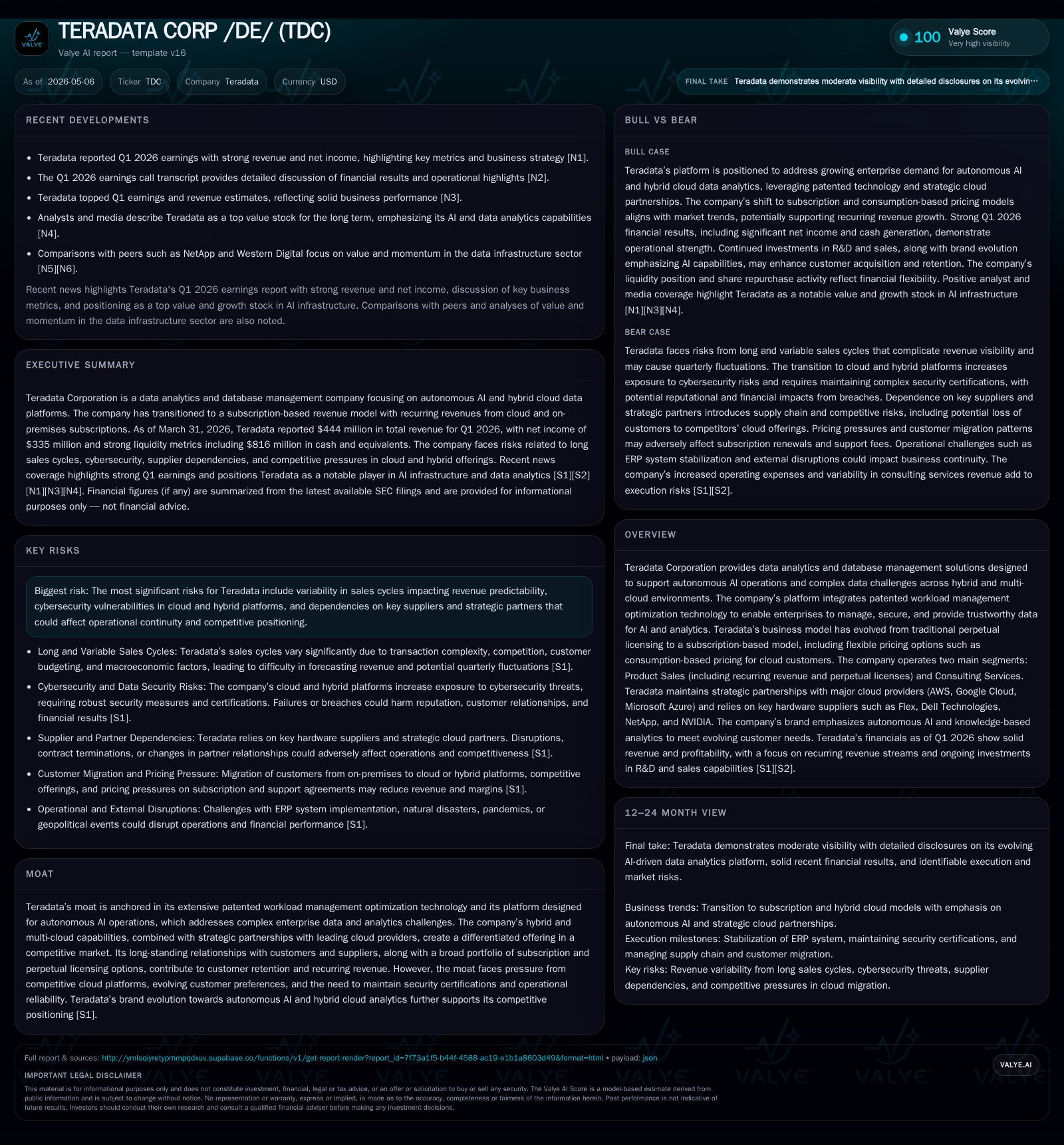
In Q1 2026, Teradata demonstrated sequential momentum driven by expansion in its Public Cloud Annual Recurring Revenue (ARR) through new workloads and customer migrations, coupled with improving gross margins signaling operational leverage. The company continues its strategic shift from legacy perpetual licensing toward subscription and consumption-based models tailored for hybrid multi-cloud environments optimized for autonomous AI analytics. While competitive pressures persist amid rapid technology change and evolving regulatory demands, Teradata’s proprietary workload management technology and strong cloud partnerships bolster its differentiated positioning. Key growth levers include continued Public Cloud ARR growth, hybrid deployment flexibility, and sustained R&D investment in next-generation AI-enabled analytics functionality.
Q1 2026 Operating Update: Cloud Expansion and Margin Dynamics
Teradata's Q1 2026 10-Q filing dated May 6 reveals important signals of operational momentum as the company advances its transition toward autonomous AI-powered analytics solutions in hybrid cloud environments [S2]. The primary driver of growth within recurring revenues is the expansion in Public Cloud Annual Recurring Revenue (ARR), which includes both net new customer workloads deployed on Teradata’s cloud subscriptions and migration activities from prior deployment modes. This combined effect underpins a positive trajectory of the company's core subscription base for 2026.
Gross profit rose to $276 million representing 62.2% of revenue versus $248 million or 59.3% a year earlier — indicating margin improvement supportive of operating leverage as subscription shifts drive a higher quality revenue mix. Recurring revenues constitute approximately 69.3% of total revenue in Q1 compared to 69.8% last year, maintaining a stable base despite modest headwinds 94especially as consulting services declined from -6.0% to -4.7% year over year signaling some softness or rebalancing in professional services engagements [S2].
The firm's commentary highlights tangible acknowledgment of the emerging hybrid environment demand wherein customers are deploying integrated architectures combining on-premises systems with multiple public clouds to optimize cost-performance balance for their agentic AI initiatives. This reflects an industry-wide recognition that purely centralized public cloud deployments may not fully address enterprises' stringent security or latency requirements.
Business Model Evolution: Subscription and Autonomous AI Platform
Teradata has strategically pivoted away from legacy perpetual license sales towards subscription-based pricing models that integrate flexible consumption-based options particularly for cloud clients [S1]. This transition aligns with broader SaaS market trends emphasizing recurring revenue stability while simultaneously accommodating diverse customer demand profiles across on-premises private clouds and major hyper-scalers like AWS, Microsoft Azure, and Google Cloud.
At the core of Teradata's differentiation lies patented workload management optimization technology embedded within its platform architecture. This technology facilitates efficient autonomous AI operations characterized by automated resource allocation, data security enforcement, and seamless orchestration across heterogeneous infrastructures—capabilities crucial for enterprises confronting complex data challenges spanning multi-cloud ecosystems.
Such platform strengths enable Teradata to address evolving enterprise use cases requiring high levels of reliability, performance predictability, and security compliance—key factors influencing customer retention in these mission-critical analytics domains. While the subscription model promises more predictable recurring revenues over time, it introduces variability due to elongated sales cycles influenced by deal size complexity and internal enterprise approval processes noted in the risk disclosures [S1].
Competitive Environment and Industry Dynamics
The data analytics market where Teradata operates is intensely competitive; marked by frequent technological innovation cycles with AI-infused product rollouts competing on capability breadth and price [S1]. Teradata must continuously innovate not only internally but collaborate effectively with third-party technology providers who supply critical hardware components such as Flex manufacturing partners, Dell Technologies servers/storage infrastructure, NetApp storage solutions, and NVIDIA GPUs for AI acceleration.
Strategic partnerships with leading cloud providers create valuable go-to-market channels reinforcing Teradata's multi-cloud capability positioning but also represent arenas where vendor lock-in risks loom if integration or performance does not meet expectations. The company also manages environmental social governance (ESG)-linked financial covenants under its credit arrangements which underscores the importance placed on sustainable capital structure discipline amidst competitive pressures [S4][S5].
Price sensitivity remains a key concern given competition from native cloud platforms offering embedded analytics capabilities at scale alongside emergent start-ups innovating with narrow AI application focus. Teradata’s advantage revolves around its proven scalability for large enterprises coupled with data governance robustness suited for regulated industries.
Growth Drivers: Public Cloud ARR, Hybrid Deployment, and Innovation Investment
Looking forward into 2026, Teradata anticipates sustained Public Cloud ARR growth driven primarily by customers expanding their existing cloud workloads complemented by steady migration trends from traditional on-premises environments to hybrid cloud composites [S2]. This organic growth is supplemented by opportunities to deepen penetration in sectors demanding customized data security layers supported by Teradata’s platform.
The hybrid deployment model serves as an important growth lever since segments of customers seek to maintain sensitive workloads on-premises while exploiting elasticity offered by public clouds for burst capacity or non-sensitive analytics tasks. Such flexibility caters to diverse corporate IT policies balancing cost control against innovation agility.
Investment remains concentrated in research & development focused on enhancing autonomous AI functionalities including improved usability features that accelerate time-to-insights and broaden applicability across more complex analytical scenarios. This R&D commitment reflects an understanding that staying ahead technologically is critical given rapidly evolving use cases fueled by artificial intelligence advances [S1][S2].
Subscription pricing innovations—such as consumption-based billing—also enable better alignment with customer ROI metrics promoting stickiness while opening potential incremental revenue streams linked to variable usage volumes rather than fixed contracts.
Key Risks and Operational Challenges
Despite clear strategic direction there are significant execution risks inherent to Teradata’s transformation journey [S1]. Revenue visibility is challenged by historically variable sales cycles impacted by deal complexity especially when selling hybrid or cloud solutions that involve cross-organizational approvals at customer end.
Cybersecurity vulnerabilities inherent in operating complex hybrid platforms remain an ongoing concern both internally and externally mandated through regulatory requirements impacting product design cycles. Dependence on key suppliers like hardware vendors also poses supply chain risks potentially disrupting delivery timelines or cost structures if these partners encounter bottlenecks.
Market competition can erode pricing power particularly if competitors introduce aggressive discounting or superior integrated frameworks reducing switching barriers. Furthermore operational disruptions arising from internal reorganization or technology integration delays could impair brand reputation adversely affecting renewals.
Overall these compositional risks demand careful resource allocation balancing rapid innovation cadence against stable delivery execution.
Near-Term Milestones and What to Watch Next
Market participants should closely track updates expected from the upcoming Q2 earnings release alongside management commentary scheduled on conference calls detailing outlook revisions especially regarding Public Cloud ARR projections [S3][N2]. Order backlog development will serve as an early indicator of sales momentum amid typically extended procurement cycles.
Adoption rates for hybrid model deployments should be monitored as a barometer of enterprise acceptance verifying whether infrastructure flexibility claims translate into concrete client wins. Progress against roadmap milestones focused on autonomous AI feature enhancements will further validate R&D effectiveness relative to peers.
Regulatory landscapes governing AI applications remain fluid globally; any changes imposed could necessitate product adjustments potentially delaying launches or raising costs — factors worth assessing through corporate disclosures going forward.
Latest Financial Snapshot
Latest financial snapshot
| Metric | Value | Period |
|---|---|---|
| Cash & equivalents | $816mm | |
| 2026-03-31 | ||
| Total debt | $449mm | |
| 2026-03-31 | ||
| Net debt | $-367mm | |
| 2026-03-31 | ||
| Current assets | $1240mm | |
| 2026-03-31 | ||
| Current liabilities | $954mm | |
| 2026-03-31 | ||
| Current ratio | 1.3x | |
| 2026-03-31 |
Source: SEC companyfacts cache [F1].
Teradata holds a solid liquidity profile with cash balances outweighing total debt obligations by approximately $367 million at quarter-end [F1][S2], bolstered by substantial operating cash flow generation partly aided by SAP litigation settlement proceeds realized prior quarter [S2][S25]. The weighted average all-in interest rate on credit facilities remains moderate near 4.10%, underscoring manageable financing costs within current capital structure parameters [S2]. This robust financial footing supports ongoing investments needed for global R&D initiatives alongside strategic partnerships critical to sustaining competitive differentiation.
This article is based solely on publicly available SEC filings dated through early May 2026 including Q1 10-Q (May 6), recent earnings event filings (8-K May 5), annual report (10-K Feb 27), and incorporates domain-specific insights contextualizing Teradata's operating environment without providing investment recommendations.
Disclaimer: This is research-only, informational analysis and not investment advice. It may include AI-generated interpretation and general industry context. Always verify important details using primary sources.

Comments