
AtriCure Advances Hybrid Afib Solutions Amid Clinical and Market Expansion
Latest Q1 results highlight steady execution and strategic innovation in specialized cardiac arrhythmia treatment.
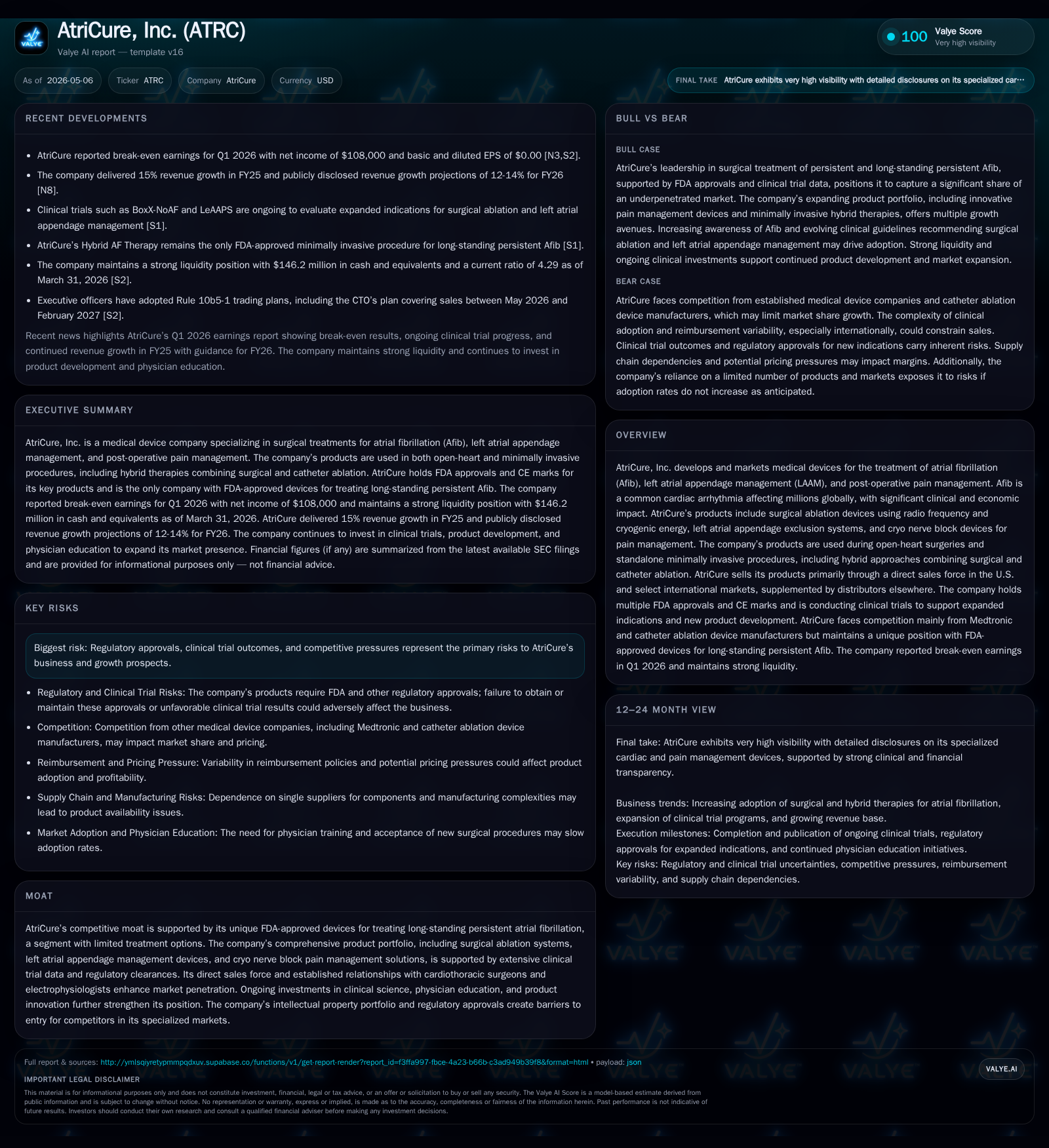
AtriCure’s first-quarter 2026 filing shows continued focus on surgical and minimally invasive therapies for atrial fibrillation, including long-standing persistent cases with limited alternatives. The company leverages its FDA-approved hybrid ablation platform, comprehensive product portfolio, and significant clinical trial pipeline to deepen physician adoption and expand market reach. While growth is underpinned by robust physician education and procedural innovation, regulatory, competitive, and reimbursement challenges remain key watchpoints. Financially, AtriCure maintains a strong liquidity position with a high current ratio and conservative leverage.
Recent Operating Update
AtriCure’s latest quarterly report filed May 6, 2026 ([S2]) reinforces the company’s steady operational status with no material changes reported in risk profile or capital structure since their February annual report ([S1]). Management disclosed a Rule 10b5-1 trading plan by the CTO but no other insider trading changes. The company continues investing in clinical science and physician education programs critical for procedural adoption. These disclosures precede earnings commentary covered in contemporaneous press releases ([S3], [N1], [N2], [N3]) indicating break-even earnings for Q1 2026 but underscoring the strategic emphasis on innovation over near-term profitability.
Business Model
AtriCure develops medical devices targeting atrial fibrillation (Afib), left atrial appendage management (LAAM), and post-operative pain management. Their revenue model is predominantly direct sales to medical centers in the U.S. and select developed markets via a specialized sales force approximately 330 strong domestically plus ~75 internationally ([S1], [S21]). In other international geographies they rely on distributor networks to extend reach.
Key offerings include:
- Surgical ablation systems using radiofrequency and cryogenic energy designed for treatment of persistent Afib types including the hard-to-treat long-standing persistent Afib segment ([S1], [S14], [S17]).
- Left atrial appendage exclusion devices, such as the AtriClip PRO-Mini introduced in early 2025, tailored for minimally invasive settings ([S16]).
- Cryo nerve block devices providing temporary pain relief post cardiac or thoracic surgery ([S1]).
Revenue drivers center on product penetration during major cardiac surgeries — either as adjunctive therapy during valve repair or bypass operations or standalone minimally invasive hybrid procedures combining surgical ablation with catheter interventions by electrophysiologists ([S1]). Pricing power is supported by limited FDA-approved device options addressing complex Afib cases where catheter ablation alone falls short.
Industry Structure & Competitive Position
The Afib device market is complex due to overlapping specialties (cardiothoracic surgeons/EPs), regulatory barriers, and clinical evidentiary demands. AtriCure stands distinctive because of:
- FDA approval of the EPi-Sense System specifically for long-standing persistent Afib patients based on pivotal CONVERGE IDE trial data demonstrating a statistically meaningful efficacy advantage over catheter-only approaches ([S17]).
- A broad IP portfolio covering surgical devices that create significant entry barriers against generic competitors ([S26]).
- Comprehensive clinical trial investment supporting label expansions and increasing physician confidence ([S14], [S17]).
- Dedicated training programs leveraging simulation models (CADets) and novel digital education tools to drive surgeon/electrophysiologist adoption ([S1]).
Competitors tend to focus primarily on catheter-based ablation devices or lack comparable evidence-backed hybrid surgical solutions. However, evolving electrophysiology technologies and potential new entrants constitute ongoing competitive pressure.
Growth Drivers
Clinical Evidence & Regulatory Approvals
Ongoing pivotal studies such as BoxX-NoAF targeting prevention of post-operative AF bolster the foundation for broader utilization of AtriCure’s systems ([S14]). The CONVERGE PAS study continues enrolling patients for long-term outcomes data to solidify safety-efficacy profiles crucial for future FDA labeling expansions.
Product Innovation & Portfolio Expansion
Incremental improvements like the size-reduced AtriClip PRO-Mini improve clinical usability in minimally invasive procedures while new procedural workflows (hybrid ablation combining surgical + catheter techniques) gain traction globally ([S16], [S14]). Pain management via Cryo Nerve Block provides diversification beyond Afib treatments.
Geographic Expansion & Physician Education
Focus on growing direct sales teams in established territories (US, Europe) combined with strategic partnerships with distributors aims to increase penetration into emerging markets where procedural volumes are ramping ([S1], [S21]). The enhancement of education programs using simulation technology enhances physician comfort with novel techniques driving procedure volume growth.
Market Structural Trends
Rising prevalence of Afib—especially persistent forms linked to aging demographics coupled with comorbidities—creates an expanding addressable patient base over the medium term. Additionally, heightened awareness due to guideline endorsements by professional societies promotes procedural uptake ([S14]).
Risks / Watchpoints / Growth Constraints
- Regulatory Risks: Success hinges on timely FDA approvals of expanded indications; failure or delays could hinder market expansion plans ([S11], [S15]).
- Clinical Trial Outcomes: Negative or inconclusive trial results may slow adoption among cautious physicians primarily trained in catheter ablation methods ([S14], [S17]).
- Competitive Dynamics: Advances from rival catheter-focused companies or alternative surgical technologies could erode AtriCure’s niche dominance ([S11]).
- Reimbursement Environment: Pressure on healthcare costs could affect procedural reimbursement rates or hospital willingness to adopt higher-cost hybrid procedures.
- Supply Chain & Manufacturing: Although currently stable supply chains minimize risk ([S18]), reliance on single-source components necessitates vigilance.
What to Watch Next
Investors and industry observers should track:
- Updates from long-term follow-up of pivotal trials like CONVERGE PAS scheduled for presentation in mid to late 2026 ([S17], [N1]).
- Regulatory submissions or clearances expanding device indications beyond current approvals.
- Quarterly sales trends reflecting increasing volume/mix gains from hybrid ablation adoption across markets.
- Competitive product launches from electrophysiology device companies introducing next-generation catheters.
- Operational metrics around expansion of direct sales footprint internationally and progress in training programs.
- Any revisions in guidance related to margins or R&D investment pace that might signal shifting strategic priorities.
Financial Snapshot (Q1 2026)
Latest financial snapshot
| Metric | Value | Period |
|---|---|---|
| Cash & equivalents | $146mm | |
| 2026-03-31 | ||
| Current assets | $314mm | |
| 2026-03-31 | ||
| Current liabilities | $73mm | |
| 2026-03-31 | ||
| Current ratio | 4.29x | |
| 2026-03-31 |
Source: SEC companyfacts cache [F1].
| Metric | Value | Period Ended |
|---|---|---|
| Cash & Equivalents | $146.2 million | |
| 2026-03-31 | ||
| Current Assets | $313.7 million | |
| 2026-03-31 | ||
| Current Liabilities | $73.2 million | |
| 2026-03-31 | ||
| Current Ratio | 4.29 | |
| 2026-03-31 |
AtriCure maintains ample liquidity reflected by a robust current ratio exceeding 4x, supporting both operational resilience and ongoing investments in R&D as well as clinical education initiatives. Total debt levels have remained consistent without recent filings indicating material changes beyond the $53.3 million figure recorded end of 2020 ([F1]).
Disclaimer: This is research-only, informational analysis and not investment advice. It may include AI-generated interpretation and general industry context. Always verify important details using primary sources.

Comments