
Landmark Bancorp Reports Margin Expansion in Latest Quarterly Results
Q1 2026 results reveal enhanced net interest margin and sustained loan growth driven by a diversified lending strategy.
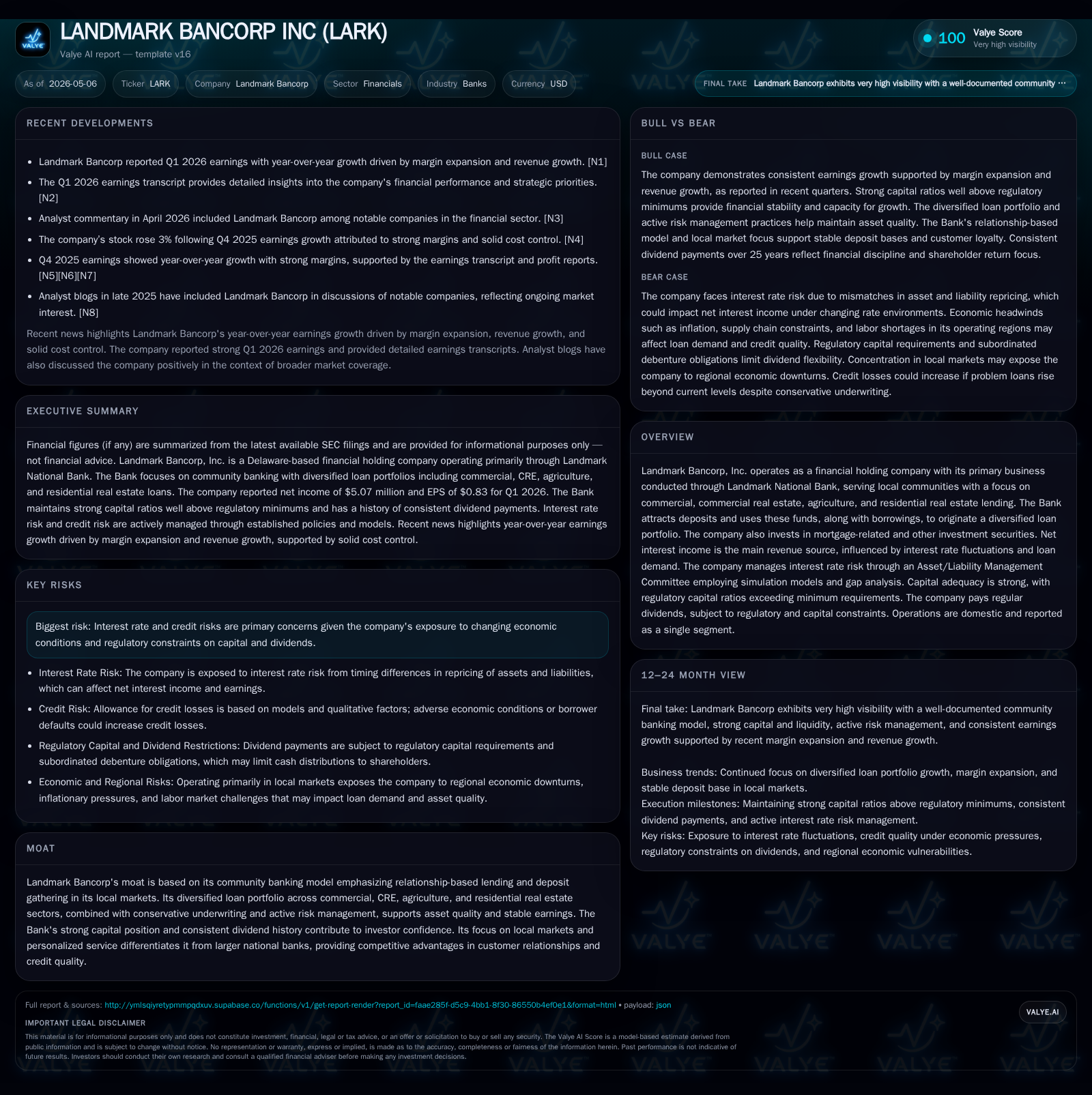
Landmark Bancorp’s Q1 2026 10-Q filing highlights notable margin expansion anchored by increased net interest income, reflecting effective asset-liability management amid evolving interest rates. The company’s community banking model focused on diverse commercial, CRE, agricultural, and residential loan portfolios supports stable credit quality and consistent earnings. Strong capital adequacy ratios provide a buffer for operational flexibility, underpinning the recent approval of higher dividends. Key risks remain around interest rate sensitivity and regulatory constraints. Monitoring loan demand trends and ALCO guidance will be critical ahead.
Latest Quarterly Operating Update: Margin Expansion and Loan Growth in Q1 2026
Landmark Bancorp’s latest quarterly filing dated May 6, 2026, reveals that the company has achieved meaningful margin expansion during Q1 2026, primarily attributable to increased net interest income. This improvement reflects a higher yield on its diversified loan portfolio coupled with effective asset-liability management practices amid an evolving interest-rate environment [S2]. Notably, the company reported a pre-tax charge of less than $500,000 related to limited fraudulent activity uncovered during internal investigations; this did not materially affect overall operations [S20]. On April 29, 2026, the board approved an increased cash dividend of $0.21 per share payable in May, signaling confidence in capital adequacy and ongoing profitability [S3].
Topline revenue benefits from continued robust demand in commercial, CRE, and agricultural lending segments that form the backbone of Landmark’s book. The reported quarterly results underscore steady loan balance growth while maintaining solid asset quality metrics supported by prudent underwriting standards [S2]. Collectively, these factors contribute to the realized expansion of net interest margins (NIM), a critical revenue driver for this community-focused bank [N1][N2].
Business Model Overview: Community Banking Focus Across Diverse Lending Portfolios
Landmark Bancorp operates principally through its wholly-owned subsidiary Landmark National Bank. Its business model centers on cultivating deep customer relationships within local communities spanning Kansas and Missouri through a diversified portfolio centered on commercial loans, commercial real estate (CRE), agriculture loans, and residential real estate lending [S1]. This relationship-based lending approach sets Landmark apart from larger regional or national banks by emphasizing personalized service and tailored credit solutions.
Revenue generation hinges predominantly on net interest income—the spread between yields earned on loans and investment securities versus funding costs from deposits and borrowings. Deposits remain the primary funding source, augmented selectively by borrowings when necessary [S1]. The company also generates ancillary non-interest income through service fees and gains on loan sales.
This business structure leverages localized market knowledge to optimize credit quality and volume growth potential while mitigating regional economic cyclicality risks prevalent in each loan segment. Conservative underwriting policies support stable earnings through economic cycles.
Quality of Products and Services: Relationship-Based Lending and Conservative Underwriting
Landmark’s loan portfolio diversification across commercial, CRE, agricultural, municipal, consumer, and residential loans is a strategic strength enhancing risk spread [S1]. The bank employs forward-looking CECL (Current Expected Credit Loss) models adopted since early 2023 to establish credit loss allowances based on historical data adjusted for current economic conditions—quarterly updates ensure provisioning reflects prevailing environments [S1].
Asset quality remains robust with relatively low classified loans as a percentage of total gross loans. Non-accrual loans have declined sequentially evidencing effective risk management. Conservative underwriting standards flexibly adapt to evolving credit profiles without compromising portfolio integrity.
The company’s capital position remains strong with risk-based capital well above Basel III regulatory minimum thresholds underpinning resiliency against credit shocks or systemic stress [S1][S25].
Industry Structure: Competitive Dynamics in Regional Banking and Community Markets
Within the highly competitive U.S. regional banking landscape, Landmark Bancorp occupies a niche rooted in community banking focused on relationship lending within defined geographies [S1]. Competition pressures persist notably in deposit gathering where pricing and product innovation are crucial to retain core customers against large regional banks offering broader digital platforms.
Regulatory frameworks such as Basel III impose stringent capital requirements impacting leverage decisions. Landmark maintains prudent buffers with reported leverage ratio of approximately 9.67% versus regulatory minimums near 4%, positioning it well within “well-capitalized” status required for operational flexibility including acceptance of brokered deposits [S1].
Industry-wide challenges including rising compliance costs and changing consumer expectations necessitate ongoing investment in operational efficiency balanced against personalized customer engagement that defines Landmark’s moat.
Growth Drivers: Expanding Commercial, CRE, and Agricultural Loan Portfolios
The principal growth engine lies in targeted expansion of commercial loans alongside CRE and agricultural lending where Landmark leverages long-standing local expertise [S1][S2]. These segments benefit from sustained activity tied to regional economic development trends such as agribusiness cycles or real estate construction dynamics.
Loan production KPIs indicate increasing originations supported by deposit growth used as low-cost funding sources. Cross-selling insurance services through wholly owned insurance subsidiary adds incremental revenue opportunities contributing to total banking relationships.
Maintaining conservative credit policies while actively managing loan underwriting enables selective capitalization on pockets of rising demand without undue risk accumulation—a balance critical to sustainable growth amid varying macroeconomic conditions.
Risks and Constraints: Interest Rate Sensitivity and Regulatory Dividend Limitations
Landmark Bancorp remains exposed to interest rate risk inherent in banking operations due to mismatches in repricing schedules between assets (loans) and liabilities (deposits/borrowings). Though ALCO employs gap analysis models simulating rate shocks for risk mitigation, residual gap exposure leaves room for NIM volatility especially if macroeconomic rate shifts accelerate beyond modeled scenarios [S1][N1].
Regulatory constraints on capital adequacy directly influence dividend policy; payments cannot reduce capital below prudential thresholds limiting dividend flexibility despite sustained earnings performance [S7][S26]. Moreover, competition for deposits may elevate funding costs impacting margin dynamics if pricing pressures intensify [S10].
Credit risks related primarily to underwriting assumptions under CECL guidelines bear monitoring given their sensitivity to changing economic forecasts impacting allowance computations quarter-to-quarter.
Forward Look: Monitoring Loan Demand, Interest Rate Environment, and Capital Ratios
Key milestones ahead include ongoing assessment of loan pipeline health revealed in upcoming quarterly results that will validate sustained demand assumptions driving margin strength [S2][N2]. Deposit trends remain vital not only for funding but also as customer engagement indicators relevant for cross-sell opportunities.
Interest rate policy decisions from the Federal Reserve will materially affect duration management strategies executed by ALCO; an adverse shift could compress spreads necessitating recalibration of asset/liability mix or heightened focus on fee income sources.
Capital adequacy metrics will continue to be focal points measured against Basel III buffers ensuring compliance amidst dividend distributions planned for May 2026 that align with regulatory prudence [S3][S25].
Financial Snapshot: Capital Adequacy, Earnings Performance, and Dividend Policy
As per the latest disclosures ending December 31, 2025, Landmark Bancorp’s leverage ratio stands at a resilient 9.67%, comfortably above the required minimum of 4%, while Common Equity Tier 1 Capital ratio is strong at approximately 12.92%, also exceeding Basel III mandated floors [S1]. Total risk-based capital was reported at nearly 14%, buffering regulatory capital conservation requirements.
Net earnings for fiscal year ended December 31, 2025 rose significantly year-over-year reflecting the impact of improved net interest income due to higher average loan balances growing from $974 million in prior year to over $1 billion along with slightly improved yields [F1][S24]. Quarterly operating cash flows demonstrate ongoing internal generation capacity supporting both loan growth financing needs as well as shareholder returns through dividends paid consistently over decades with recent increases accordingly [S7][S3].
The Board's recent dividend increase to $0.21 per share reinforces confidence in ongoing profitability balanced against capital preservation mandates governing banking institutions under federal regulations limiting payout ratios relative to retained earnings buffers [S7][S3].
Disclaimer: This report is prepared solely for informational purposes based on publicly available SEC filings and news reports as cited; it does not constitute investment advice or recommendations.
Disclaimer: This is research-only, informational analysis and not investment advice. It may include AI-generated interpretation and general industry context. Always verify important details using primary sources.

Comments