
Northern Trust Strengthens AUM Growth and Earnings With Strategic Client Focus
Northern Trust's Q1 2026 results reflect solid net interest income growth and expanding assets under management, underscoring its integrated wealth and asset servicing strategy.
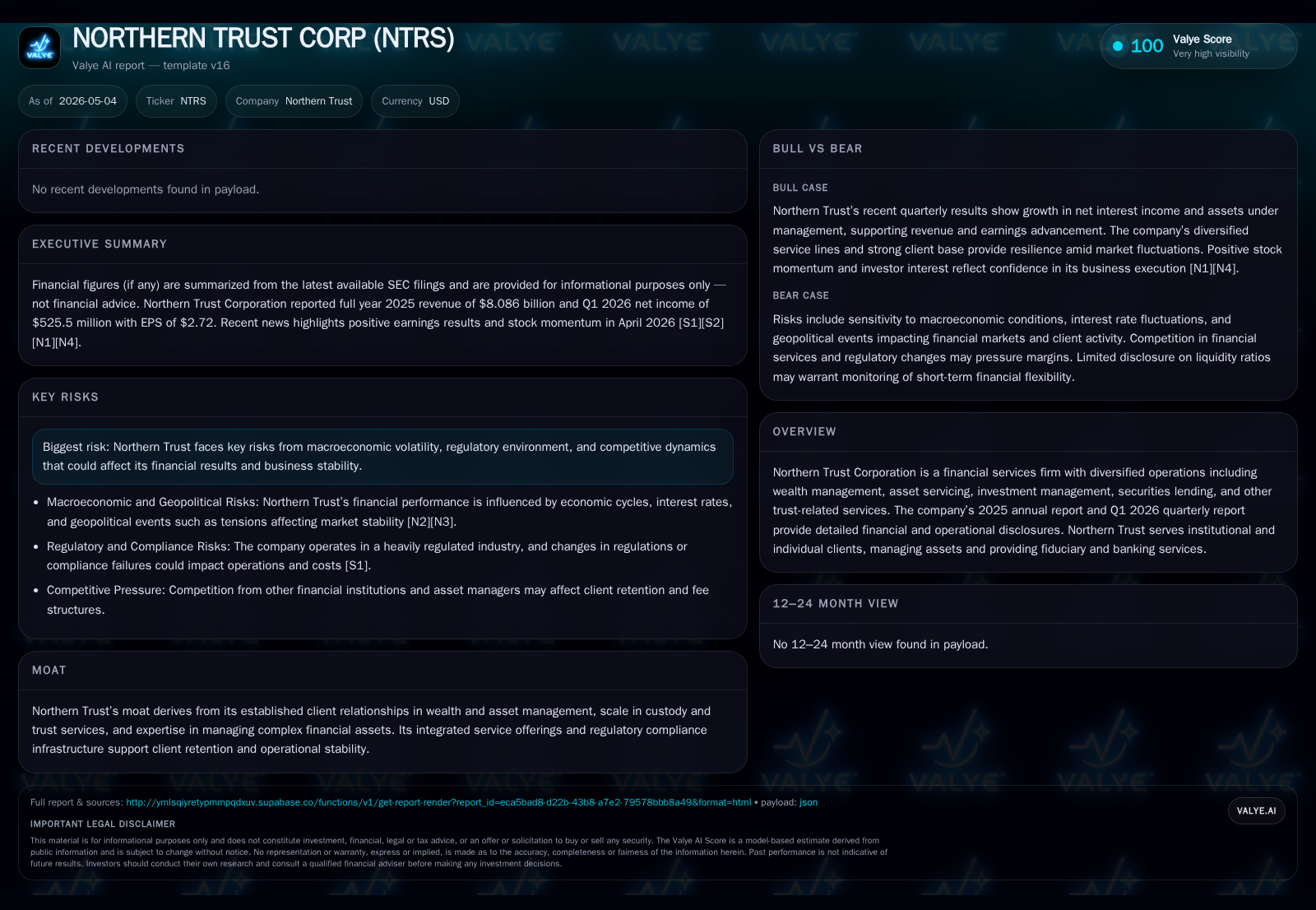
In its latest 10-Q filing for Q1 2026, Northern Trust Corporation reported higher net interest income alongside robust asset servicing growth that bolstered overall revenues. The company’s strength lies in its integrated wealth management and custody services, fostering deep client relationships and operational scale advantages. While regulatory complexity and market volatility pose ongoing challenges, Northern Trust’s focus on high-net-worth and institutional clients drives durable demand. Upcoming milestones include margin trends and continued platform adoption highlighted in recent earnings calls.
Latest Quarterly Operating Highlights and Their Immediate Significance
Northern Trust's first quarter 2026 operating report detailed in the April 30, 10-Q highlights a pronounced advance in net interest income (NII), which alongside improving fee income from asset servicing segments, propelled revenue growth above analyst expectations [S2][N1][N4]. The firm’s ability to grow NII reflects solid balance sheet management amid a rising rate environment while custody fees benefited from increased assets under management (AUM). This dual contribution signals operational leverage within its integrated business model. Institutional client mandates appear stronger, as evidenced by incremental upticks in fee-generating mandates and trust-related services
Northern Trust’s Business Model: Wealth Management and Asset Servicing Synergy
Per the latest annual filing (10-K), Northern Trust operates across three core interconnected segments: wealth management, asset servicing including custody and fund administration, and investment management along with securities lending and other fiduciary-related services [S1]. This mix enables multiple revenue streams from overlapping client bases—high-net-worth individuals generate recurring fee income through wealth advisory while institutional mandates produce scale economies via custody fees. The company's emphasis on regulatory compliance infrastructure aids handling sophisticated asset classes like defined benefit pensions or alternative investments. These characteristics help the firm sustain switching costs for clients who depend on their integrated fiduciary expertise.
Industry Competitive Position: Custody Scale and Client Relationship Moat
Northern Trust holds a notable position among global custodians due to its legacy strength in complex fiduciary services combined with technology-enabled asset servicing capabilities [S1]. Its moat is carved by established long-term institutional relationships that underpin both custody volumes and ancillary trust operations. The firm's ability to absorb regulatory changes without significant service disruption further differentiates it from smaller boutique providers lacking scale or larger global peers stretching into unrelated banking services. Regulatory scrutiny remains a structural barrier limiting new entrants in the asset servicing space but increases ongoing operational costs.
Growth Drivers: Expanding Client Footprint and Integrated Service Offering
Demand drivers stem structurally from growing wealth accumulation among individual HNW clients coupled with institutional investors increasingly outsourcing asset administration to specialized custodians like Northern Trust [S2][N2][S1]. The firm's push towards technology enhancements aims to deepen wallet share per client through cross-segment synergy—for instance, combining investment advisory platforms with custody reporting tools that streamline clients’ administrative burden. Additionally, evolving fiduciary risk regulation compels pension plans toward compliant outsourcing models that benefit established operators. These trends support persistent AUM expansion as well as higher recurring fee margins.
Key Risks and Constraints: Market Volatility, Regulatory Complexity, and Competition
Outlined clearly in the latest 10-Q risk section are challenges including sensitivity of AUM to market fluctuations that can depress fee income during downturns [S2]. Regulatory complexity is also emphasized as an evolving cost base pressure with new compliance standards imposing additional resource requirements. Competitively, Northern Trust faces incumbents ranging from large global custodians engaged in broad banking activities to niche boutique managers targeting specific wealth segments. Technological disruption through fintech innovation also poses a latent threat if the company delays modernization.
What to Watch Next: Near-Term Guidance and Market Signals
Investors should monitor upcoming quarterly results for concrete evidence of margin progression tied to operating efficiencies referenced during recent earnings calls [S2][N2]. Client pipeline developments—wins or attrition among large institutional mandates—will also be crucial barometers of competitive positioning. All facts are directly referenced from official SEC filings or verified news reports as noted.
Disclaimer: This is research-only, informational analysis and not investment advice. It may include AI-generated interpretation and general industry context. Always verify important details using primary sources.

Comments