
Tenet Healthcare's Q1 2026 Operating Momentum Bolsters Ambulatory Expansion and Managed Care Negotiations
Latest quarterly results demonstrate resilience in patient volumes and revenue cycle management amid regulatory and payer challenges.
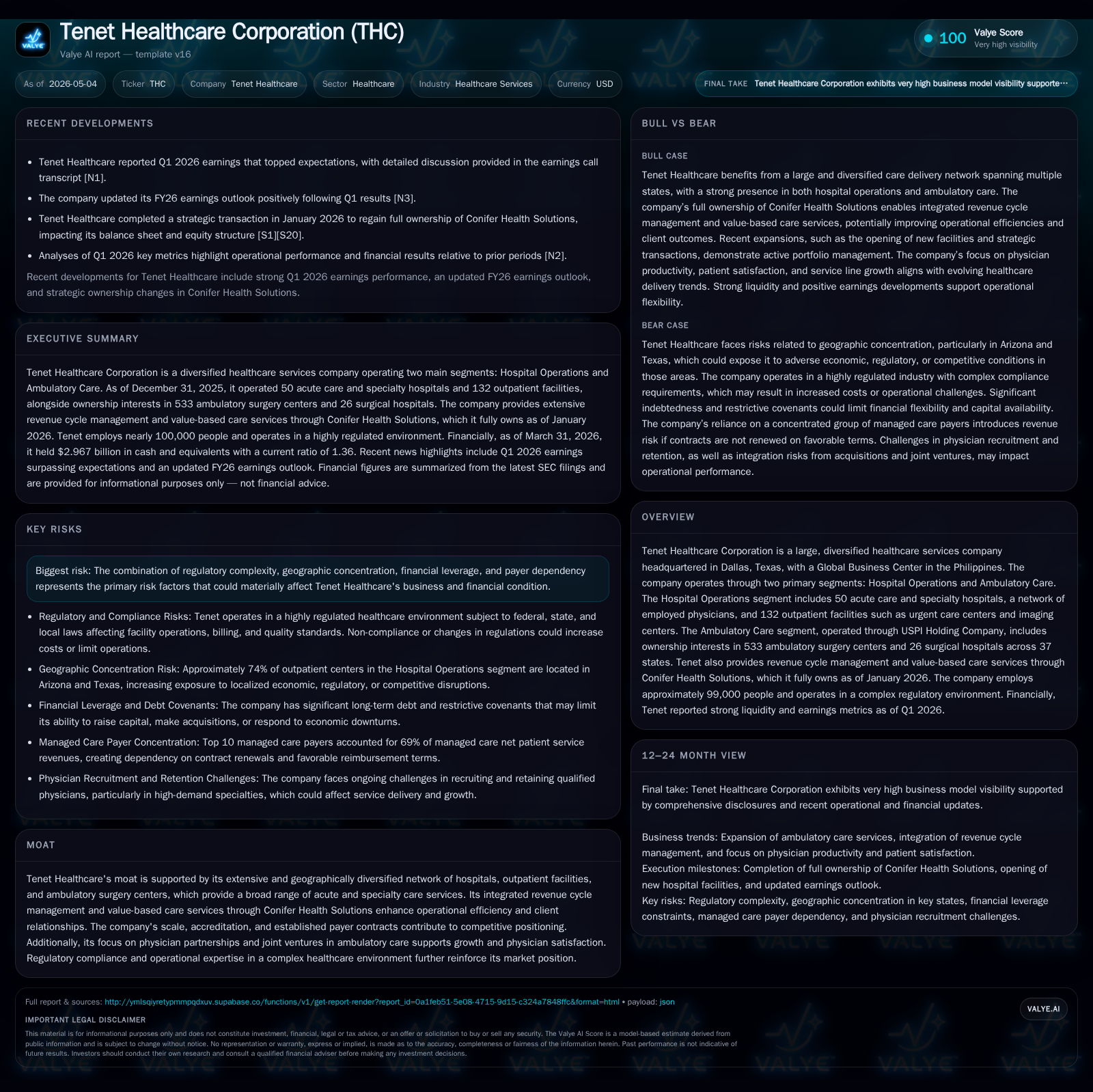
Tenet Healthcare Corporation reported solid operational performance in Q1 2026, underpinned by growth in its Hospital Operations and Ambulatory Care segments. The company’s integrated strategy of expanding ambulatory services via USPI and optimizing revenue cycle management through Conifer Health Solutions has strengthened its competitive positioning. Challenges persist around managed care payer negotiations, regulatory complexity, and leverage, but Tenet’s network scale and physician partnerships provide durable advantages. Monitoring contract renewals with major payers and execution on outpatient capacity expansion will be key near-term milestones.
Recent Operating Update: Q1 2026 Performance Highlights
In its latest quarterly filing dated April 30, 2026 [S2], Tenet Healthcare Corporation reported continued operational momentum across its two main segments: Hospital Operations and Ambulatory Care. The company noted stable patient volumes amid a challenging macroeconomic backdrop characterized by increasing enrollment in high-deductible health plans and sustained managed care cost controls. Tenet's consolidated report highlights the impact of expanding ambulatory service offerings through USPI-owned centers alongside hospital-based acute care capabilities.
A key recent development is the full acquisition of Conifer Health Solutions in January 2026, integrating revenue cycle management (RCM) and value-based care services more tightly within Tenet's operational model [S1]. This integration aims to enhance operational efficiency, accelerate cash flow conversion, and improve payer-client relationships. Early indications from Q1 results suggest that Conifer’s operations have contributed positively to sustaining robust cash collections despite ongoing administrative complexities in payer reimbursements [N1].
There were no material changes to the risk factors disclosed in the prior annual report [S20], implying continued vigilance toward managed care negotiations, regulatory compliance burdens, labor market dynamics, and capital structure management.
Business Model: Revenue Mechanics and Strategic Positioning
Tenet’s business model is anchored on delivering diversified healthcare services through an extensive network encompassing:
Hospital Operations Segment: Comprises 50 acute care and specialty hospitals primarily located in urban/suburban markets across eight states. These hospitals offer both general acute inpatient services (including intensive/critical care units) and outpatient offerings such as urgent care centers (UCCs), imaging centers, micro-hospitals, and off-campus emergency departments.
Ambulatory Care Segment: Run through USPI Holding Company, this segment owns interests in over 533 ambulatory surgery centers (ASCs) and 26 surgical hospitals spanning approximately 37 states.
Conifer Health Solutions: Focused on revenue cycle management, accounts receivable collections, coding accuracy, payer contracting strategies, analytics for value-based care programs, and population health management.
Revenue generation involves patient service fees reimbursed primarily through various payer contracts including Medicare, Medicaid managed care programs, HMOs, PPOs, private insurers, as well as direct patient payments influenced by insurance plan designs. Managed care payers account for roughly 70% of hospital segment net patient services revenues [S1]. Contract terms typically include negotiated fee schedules with volume thresholds or utilization caps.
Margins are influenced by factors such as payer mix shifts toward higher deductible plans (raising collection risks), contractual rate adjustments amid intense competition between providers and payers seeking cost containment [S1]. Conifer’s consolidation serves to mitigate margin pressure by improving billing efficiency and accelerating cash collections.
Strategically Tenet leverages geographic diversification to reduce dependency on any single market while expanding outpatient footprint to lower-cost sites aligns with broader industry trends for shifting procedures from inpatient hospital settings to ASCs — which offer convenience to patients and cost advantages to payers.
Industry Structure and Competitive Position
The U.S. healthcare delivery system is highly fragmented but increasingly consolidating at the payer-provider interface. Major health systems compete intensely for managed care contracts which constitute a crucial revenue lifeline. Tenet’s network size — operating hundreds of facilities nationally — enables broad contracting bandwidth but also exposes it to counterparty risk concentrated among the top ten managed care providers accounting for nearly 70% of managed care revenues [S1].
Tenet differentiates itself through:
- Integrated hospital-ambulatory platform allowing cross-referral flows,
- Broad range of specialty acute services complementing outpatient procedural expansion,
- Revenue cycle expertise via Conifer improving back-end collections,
- Physician partnerships facilitating market-aligned service offerings,
- Investments into technology-enabled patient access channels.
However, competitors including other large integrated health systems like HCA Healthcare or Community Health Systems also pursue vertical integration strategies emphasizing ambulatory expansion alongside inpatient dominance. Regulatory scrutiny toward antitrust concerns imposes limits on aggressive market share gains via acquisitions or collaborations especially in concentrated local markets [S16].
Growth Drivers
Ambulatory Care Expansion
The ambulatory surgery center market continues to see strong demand driven by technological advances supporting minimally invasive procedures that can be safely performed outside traditional hospitals at lower cost points. Tenet’s ownership stake in over 500 ASCs plus surgical hospitals provides scalable volume growth opportunities. Efforts focus on increasing accessibility with elective procedures moving out of hospital settings where feasible to improve payer appeal.
Revenue Cycle Optimization Through Conifer Integration
Acquiring full ownership of Conifer Health Solutions integrated a vital function historically external to core operations into Tenet’s control framework starting early 2026. Tenet pursues comprehensive contracting approaches bundling multiple facilities in geographic regions or nationally creating shared values between provider network breadth/patient volume versus negotiated reimbursement rates.
Specialty Service Line Growth & Facility Openings
Investment into specialized clinical services such as advanced cardiac programs at newly opened Florida Coast Medical Center expands Tenet’s high-acuity service capabilities helping capture higher-margin referral streams while meeting community demands [S1].
Physician Enterprise Development
Building employed physician networks focused on specialists supports both retention of referral flows within the system ecosystem plus improved patient satisfaction scoring which correlates with volume growth [S1].
Risks / Watchpoints / Growth Constraints
Managed Care Contract Risk: The concentration among few top payers limits bargaining leverage for facility operators like Tenet. Failed renewals or unfavorable rate adjustments could materially affect revenues if alternative payers cannot be substituted quickly [S1]. Payment delays or increased denials from administrative complexities remain operational hurdles impacting cash flows.
Regulatory Complexity: Multiple layers of federal/state regulation govern facility licensure (including certificate-of-need states), billing compliance (Medicare/Medicaid rules), data privacy requirements (HIPAA), anti-kickback laws affecting joint venture arrangements with physicians, environmental standards for waste disposal etc. Changes could require costly adaptations or restrict strategic initiatives like facility expansions [S16][S17].
Financial Leverage & Capital Requirements: The company reported a current ratio of 1.36 as of March 31, 2026, indicating adequate liquidity for short-term obligations [F1]. Large-scale capital investments needed for updating infrastructure or expanding new sites may stress cash flow if not balanced against operating income generation.
Labor Market Pressures: Nurse staffing assessments incorporate local hiring conditions but ongoing shortages could elevate costs or impact quality metrics jeopardizing accreditations or reimbursement levels [S1].
Legal / Litigation Exposure: Healthcare providers regularly face lawsuits relating to treatment outcomes or regulatory compliance failures; while insured against some losses these contingencies introduce earnings volatility potential [S18][S19].
What To Watch Next
Key near-term indicators include renewal progress on major managed care contracts given their impact on financial guidance updates recently issued post-Q1 earnings call [N3]. Monitoring utilization rates at newly commissioned ambulatory centers alongside integration milestones for Conifer Health Solutions will provide evidence on execution risk mitigation.
Quarterly volume trends particularly elective procedures sensitive to economic conditions will signal cyclical influences versus structural demand persistence reported so far. Regulatory developments such as any shifts in certificate-of-need regimes across states where Tenet operates will also bear watching for competitive positioning implications.
Other signals are physician recruitment/retention metrics within Tenet's employed network as these support sustainable referral pipelines along with healthcare cost inflation data which could influence pricing negotiations indirectly.
Financial Profile Snapshot (Q1 Ending March 31, 2026)[F1]
Latest financial snapshot
| Metric | Value | Period |
|---|---|---|
| Cash & equivalents | $3.0bn | |
| 2026-03-31 | ||
| Current assets | $8.4bn | |
| 2026-03-31 | ||
| Current liabilities | $6.2bn | |
| 2026-03-31 | ||
| Current ratio | 1.36x | |
| 2026-03-31 |
Source: SEC companyfacts cache [F1].
The company's liquidity profile appears sufficient for short-term obligations though leverage levels remain elevated requiring prudent capital management given interest costs represent a sizable share of operating income expense [S11].
Disclaimer: This analysis is based solely on publicly available information including the company's latest SEC filings as of April 30, 2026 ([S2][S3][S1]) supplemented with companyfacts data ([F1]) and does not constitute investment advice or recommendations. All forward-looking statements mentioned reflect company disclosures subject to risks detailed therein.
Disclaimer: This is research-only, informational analysis and not investment advice. It may include AI-generated interpretation and general industry context. Always verify important details using primary sources.

Comments