
NEXGEL Expands Regenerative Biomaterials Portfolio via Celularity Asset Acquisition and Licensing
NEXGEL's recent strategic acquisition deepens its footprint in regenerative biomaterials amid financial restructuring and leadership changes.
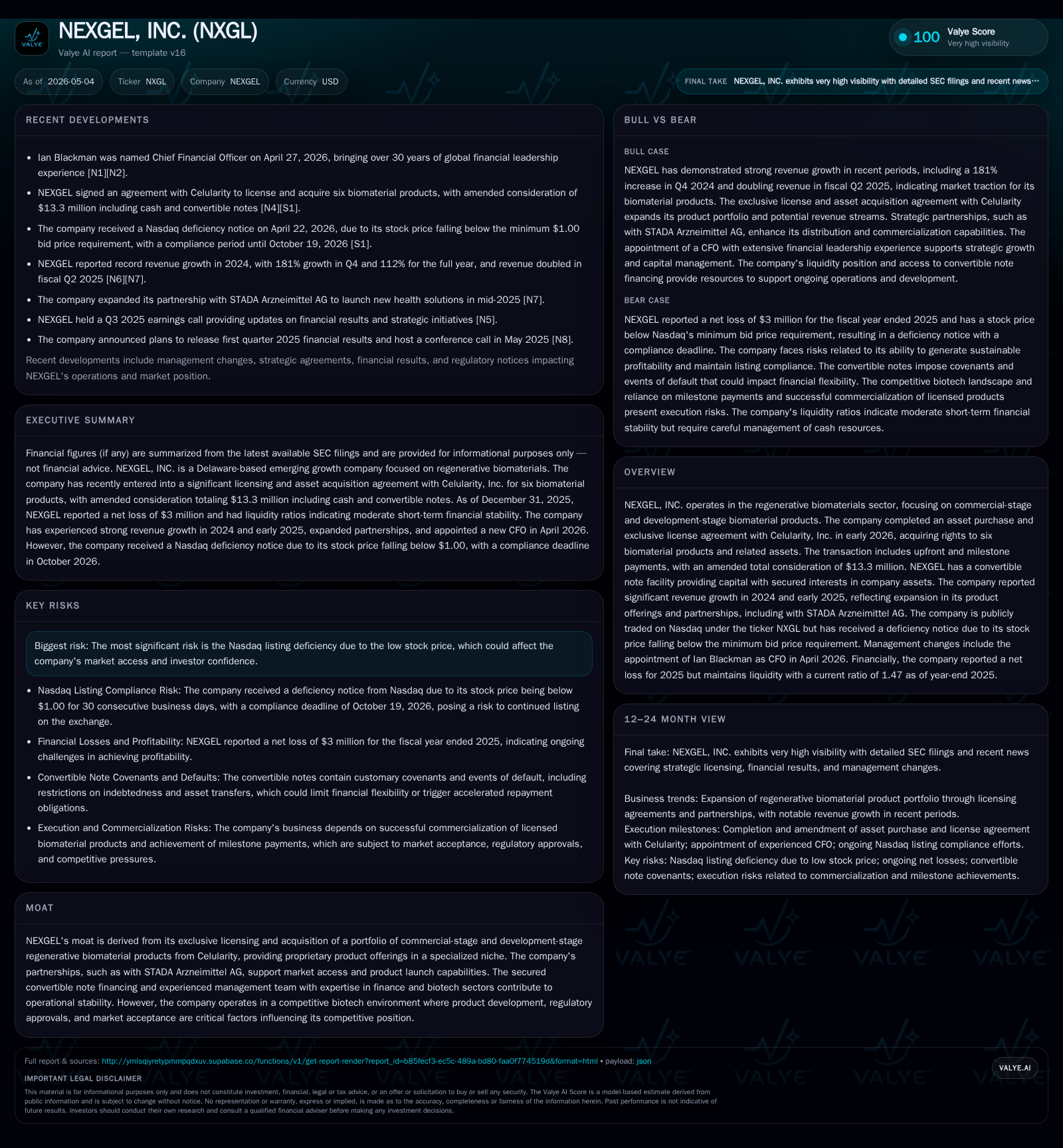
In early 2026, NEXGEL, Inc. acquired exclusive rights and assets to Celularity’s commercial-stage and development-stage biomaterial portfolio, involving upfront and milestone payments totaling $13.3 million. This transaction strategically enhances NexGel’s regenerative biomaterials offerings, supporting revenue growth seen in 2024 and 2025, while operating under a convertible note financing facility that ensures capital availability amid Nasdaq listing challenges. The company’s competitive position benefits from proprietary licenses and partnerships but faces risks related to stock price compliance and market adoption dynamics.
Recent Operating Update
The latest material update for NEXGEL came from an April 27, 2026 Form 8-K filing [S3], announcing the company's strategic move through the execution of an Asset Purchase and Exclusive License Agreement with Celularity, Inc. Finalized earlier in Q1 2026 and amended in April 2026 [S16], this transaction transferred rights to six commercial-stage and development-stage regenerative biomaterial products along with associated assets to NexGel. The amended total consideration of $13.3 million includes an upfront cash payment of $8.3 million complemented by convertible promissory notes aligned with future sales milestones.
Simultaneously, NEXGEL strengthened its financial foundation by entering into agreements for convertible promissory notes totaling nearly $7 million through private placements with accredited investors [S26]. These financing arrangements come secured against company assets under a pledge agreement [S9], incorporating standard covenants around liquidity maintenance and debt incurrence.
Leadership updates also featured prominently with the April 2026 appointment of Ian Blackman as Chief Financial Officer [S3], [N2], bringing over a decade of experience in capital markets relevant to NexGel's focus on biotech finances.
Business Model
NEXGEL operates primarily within the regenerative biomaterials sector—a specialized niche focusing on biomedical products designed to facilitate tissue repair and healing. The company's model hinges on acquiring or exclusively licensing innovative biomaterial assets at various stages of development to build a diversified portfolio of commercial-stage products capable of generating near-term revenues alongside promising pipeline candidates.
Revenue streams derive from product sales enabled through strategic partnerships (notably with STADA Arzneimittel AG), milestone payments linked to licensing arrangements such as those with Celularity, as well as potential royalties from co-development or distribution agreements. Product revenues are thus sensitive to both volume adoption in healthcare applications and price realization shaped by regulatory approvals and competitive positioning.
Margins are impacted by ongoing investment in manufacturing scale-up under contract manufacturing agreements linked to the Celularity deal [S6], research and development activities for pipeline advancement, plus sales/distribution costs associated with partner collaborations. Cash flow conversion remains challenged during scale-up phases but is supported by the company's convertible note facility designed to maintain capital availability during these investment cycles.
Industry Structure and Competitive Position
The regenerative biomaterials sector resides at the intersection of biotechnology innovation and medical device commercialization. Barriers to entry include significant R&D lead times, complex regulatory approval pathways (FDA or equivalent globally), necessity for supply chain precision in biologics manufacturing, plus requirement for clinical validation demonstrating efficacy and safety.
NEXGEL's competitive advantage stems chiefly from its exclusive licensing arrangement with Celularity that secures proprietary technologies not readily available to rivals—constituting a meaningful moat within this specialized value chain segment. Additionally, partnerships with established pharmaceutical firms like STADA enhance go-to-market capabilities by leveraging existing distribution networks.
Nevertheless, competition includes other biotech firms pursuing regenerative therapies either through original biologics or synthetic scaffold technologies. Furthermore, evolving regulatory environments could impose additional compliance burdens or delay market entry timelines affecting all players.
Growth Drivers
Portfolio Expansion: Acquisition/licensing of Celularity's commercial-stage biomaterials adds six new products, bolstering revenue-generating assets while diversifying pipeline risk.
Strategic Partnerships: Collaborations with pharmaceutical distributors accelerate market penetration—critical in fragmented healthcare systems requiring localized expertise.
Milestone Payments: Achievement of net sales triggers tied to the Celularity deal provides contingent revenue opportunities linked directly to commercialization success.
New Leadership: CFO Ian Blackman’s background in biotech finance may facilitate optimized capital structures enabling further acquisitions or pipeline investments.
Market Demand: Structural demand for regenerative solutions driven by aging populations and chronic wound prevalence supports sustainable volume growth beyond cyclical fluctuations.
Risks / Watchpoints / Growth Constraints
Nasdaq Listing Deficiency: The company received a deficiency notice due to share price falling below minimum bid requirements, threatening delisting risk that could reduce liquidity and investor participation.
Capital Raising Pressure: While convertible notes provide near-term funding stability, ongoing access to capital markets remains critical—market sentiment shifts could constrain future funding rounds.
Regulatory Complexity: Product approval processes are lengthy; delays or adverse regulatory outcomes for any core product could materially impact commercialization timelines.
Commercial Execution: Success depends on effective launch strategies; partnering entities’ performance affects distribution reach and pricing power.
Competitive Innovation: Advances by competitors in biomaterials or alternative regenerative approaches might erode product relevance or pricing dynamics over time.
What to Watch Next
- Pro forma financial disclosures related to the Celularity acquisition scheduled within regulatory timelines post-April 2026 [S18].
- Milestone achievement progress reports tied to sales targets under the asset purchase agreement.
- Updates on Nasdaq compliance status or any company initiatives addressing market capitalization or stock price thresholds.
- Capital market activity indicating additional funding availability or changes in ownership structure following convertible note maturities or warrant exercises.
- Operational updates detailing pipeline advancement, especially toward regulatory submissions or clinical trial initiations for development-stage products acquired from Celularity.
Financial Profile (Latest Snapshot)
Latest financial snapshot
*Net debt defined as total debt minus cash & equivalents indicating net cash position at period end [F1].
The financial snapshot illustrates a company investing heavily in business expansion reflected by operating losses but maintaining a positive liquidity cushion supported by manageable debt levels secured through recent convertible instruments.
This analysis synthesizes available SEC filings alongside public disclosures up to May 2026 to evaluate NexGel's operational trajectory within its regenerative biomaterials niche. It does not constitute investment advice nor offers projections beyond documented evidence.
Disclaimer: This is research-only, informational analysis and not investment advice. It may include AI-generated interpretation and general industry context. Always verify important details using primary sources.

Comments