
Fangdd Network Group Raises Equity, Navigates PRC Regulation with Multi-Class Share Issuance
Fangdd's recent convertible note conversion highlights evolving capital structure amid China’s regulatory constraints and real estate market pressures.
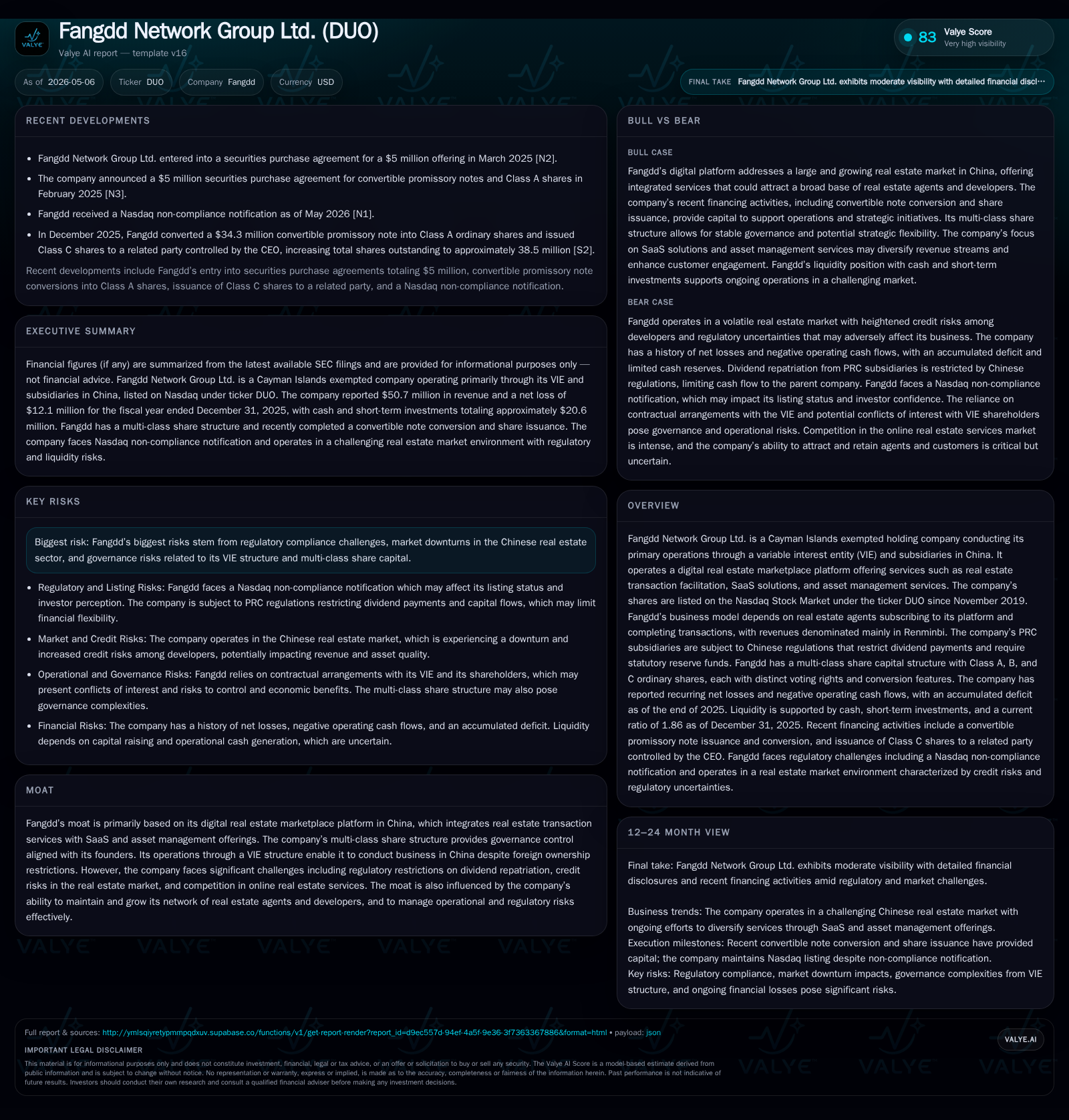
Fangdd Network Group Ltd. completed a significant convertible note conversion in late 2025, issuing over 32 million Class A shares and additional Class C shares to cornerstone investors. This transaction improved liquidity without altering control dynamics but underscores the company's ongoing challenge of monetizing profits amid tight PRC dividend regulations. Operating losses persist alongside provision for credit risks in a turbulent real estate environment. Fangdd's digital platform model remains strategically relevant but hinges on sustained agent engagement and navigating structural regulatory barriers. Capital commitments and internal control weaknesses are watchpoints alongside evolving equity arrangements.
Recent Operating Update: Convertible Note Conversion and Capital Actions
Fangdd Network Group Ltd. reported notable capital restructuring events in its December 2025 interim filing. The company converted a $34.32 million senior convertible promissory note fully into approximately 32.97 million Class A ordinary shares at a price near $1.04 per share, issued to permitted designees under the original Note Purchase Agreement related to an asset acquisition from the noteholder [S2]. Additionally, Fangdd issued around 12,731 Class C shares at a higher purchase price of $1.81 per share to ZX International Ltd., an entity controlled by Fangdd CEO Xi Zeng [S2]. This multi-class share capitalization maneuver raised moderate capital without changing company control dynamics.
This recent financing move is consequential as it reflects Fangdd’s approach to managing liquidity needs and capital structure amid ongoing industry and regulatory challenges. The issuance was exempt from U.S. securities registration rules under Regulation S, consistent with private placement provisions [S2]. While alleviating near-term payment obligations from acquisitions and convertible debt instruments, this event emphasizes the firm's reliance on equity instruments rather than cash flow or debt markets for funding.
Business Model Overview: Digital Real Estate Transaction Ecosystem
Fangdd operates primarily as a digital marketplace facilitating real estate transactions in China via its VIE and subsidiaries controlled through contractual arrangements due to foreign investment restrictions [S1]. The platform's revenue model depends largely on fees paid by licensed real estate agents who subscribe to Fangdd’s SaaS solutions for transaction management and data services alongside asset management offerings targeting property developers and stakeholders.
Revenue streams stem predominantly from platform service fees denominated mostly in RMB, exposing Fangdd's economics to PRC currency controls impacting profit repatriation [S1][S5]. The company benefits strategically from integrating transaction facilitation with SaaS tools designed to improve agent productivity and customer reach, differentiating it from peer online real estate portals that focus mainly on listings without embedded operational software support [S27].
Client retention is driven by contract renewals among agents empowered by data analytics capabilities and workflow automation modules offered by Fangdd’s platform architecture. However, demand is sensitive to broader Chinese real estate market cycles and policy changes that impact housing sales volumes.
Industry Structure and Competitive Positioning
China’s vast real estate services market is highly fragmented yet competitive, with Fangdd positioned as an intermediary providing both transaction facilitation and technological tools for agents servicing urban property markets [S1][S27]. Unlike traditional brokerages or purely listing platforms like Beike or Lianjia, Fangdd’s integrated SaaS delivery creates operational lock-in potential but also requires continuous tech investment to maintain relevance.
The VIE structure enables foreign investors participation despite regulatory restrictions but introduces enforcement risk if the Chinese government tightens interpretations or regulates internet-based property services more strictly [S1].
Regulatory oversight intensifies competition by mandating increased transparency and compliance standards across online real estate platforms, pressuring margins while raising barriers for smaller players lacking scale or tech sophistication.
Growth Drivers
Several factors underpin Fangdd’s outlook:
- Agent Network Expansion: Continued recruitment of licensed property agents incentivized by SaaS tools to boost transaction throughput remains central to scaling revenue volume.
- Product Innovation: Enhancements in AI-driven analytics and mobile applications aim to improve user experience and stickiness among agents.
- Strategic Acquisitions: Targeted buyouts or partnerships with complementary service providers such as ERP vendors deepen ecosystem integration as seen in past investments like Haofangtong [S22].
- Market Recovery: Easing of regulatory curbs on housing transactions or stabilization of mortgage rates could catalyze resumed volume growth fueling platform utilization.
However, these drivers depend heavily on macroeconomic conditions and policy stability specific to China's property sector.
Risks and Watchpoints
Significant constraints temper growth prospects:
- Regulatory Restrictions: Dividend distribution limits imposed by PRC require accumulated profits and statutory reserve allocations that constrain capital repatriation timing [S1][S5].
- VIE Structural Risk: Dependence on contractual control versus direct ownership leaves Fangdd exposed to enforcement uncertainties or shareholder conflicts within the VIE entity.
- Real Estate Market Volatility: Lingering market softness impacts transaction frequency, credit risk provisioning against receivables, and periodic goodwill impairment charges observed recently [S9][S22].
- Internal Controls Weakness: Identified material weakness in financial reporting controls related to U.S. GAAP could affect investor confidence until remediation completes [S20].
- Debt Service Pressure: Current short-term liabilities totaling nearly RMB209 million ($29.8 million) alongside capital commitments require careful liquidity management given ongoing operating cash outflows [F1][S12].
What To Watch Next
Key milestones include:
- Monitoring quarterly updates for evidence of improving net income trends or reduction in credit loss provisions with upticks in new agent subscriptions.
- Progress reports on internal control remediation efforts will be vital for assessing financial reporting reliability.
- Regulatory developments around real estate intermediary licenses or VIE governance impacting business continuity.
- Follow-on capital raises or debt refinancing moves indicating how Fangdd manages capital structure amid persistent cash burn.
- Disclosures regarding execution of strategic acquisitions or technology rollouts that reinforce competitive differentiation.
Financial Profile Snapshot (as of Dec 31, 2025) [F1]
Latest financial snapshot
| Metric | Value | Period |
|---|---|---|
| Cash & equivalents | $4mm | |
| 2025-12-31 | ||
| Current assets | $56mm | |
| 2025-12-31 | ||
| Current liabilities | $30mm | |
| 2025-12-31 | ||
| Current ratio | 1.86x | |
| 2025-12-31 |
Source: SEC companyfacts cache [F1].
Operating losses have persisted with notable cash use from operations reflecting continued investment in growth initiatives combined with credit loss provisions associated with the Chinese residential property sector stressors [S9][F1]. The firm maintains reasonable short-term liquidity supported by current assets exceeding liabilities by a factor of nearly two, as reflected in a current ratio of 1.86 [F1].
Conclusion
Fangdd Network Group remains an important digital intermediary embedded in China’s vast residential real estate ecosystem through its integrated marketplace technology platform aimed at professional agents. Its recent equity transactions reflect an active approach to funding amidst industry headwinds characterized by regulatory restrictions on profit transfers from PRC entities, ongoing real estate market uncertainty, and internal financial reporting challenges.
Long-term resilience depends on navigating complex VIE governance risks while sustaining agent growth fueled by compelling SaaS offerings capable of delivering tangible operational efficiencies surpassing competing platforms focused solely on listings or advertising.
This analysis is prepared for informational purposes only without any investment recommendation.
Disclaimer: This is research-only, informational analysis and not investment advice. It may include AI-generated interpretation and general industry context. Always verify important details using primary sources.

Comments