
ONE STOP SYSTEMS Strengthens AI Compute Focus with Solid Q1 Contract Backlog and Cash Position
Q1 2026 results highlight robust backlog in high-performance AI hardware with strong liquidity and managing competitive pressures.
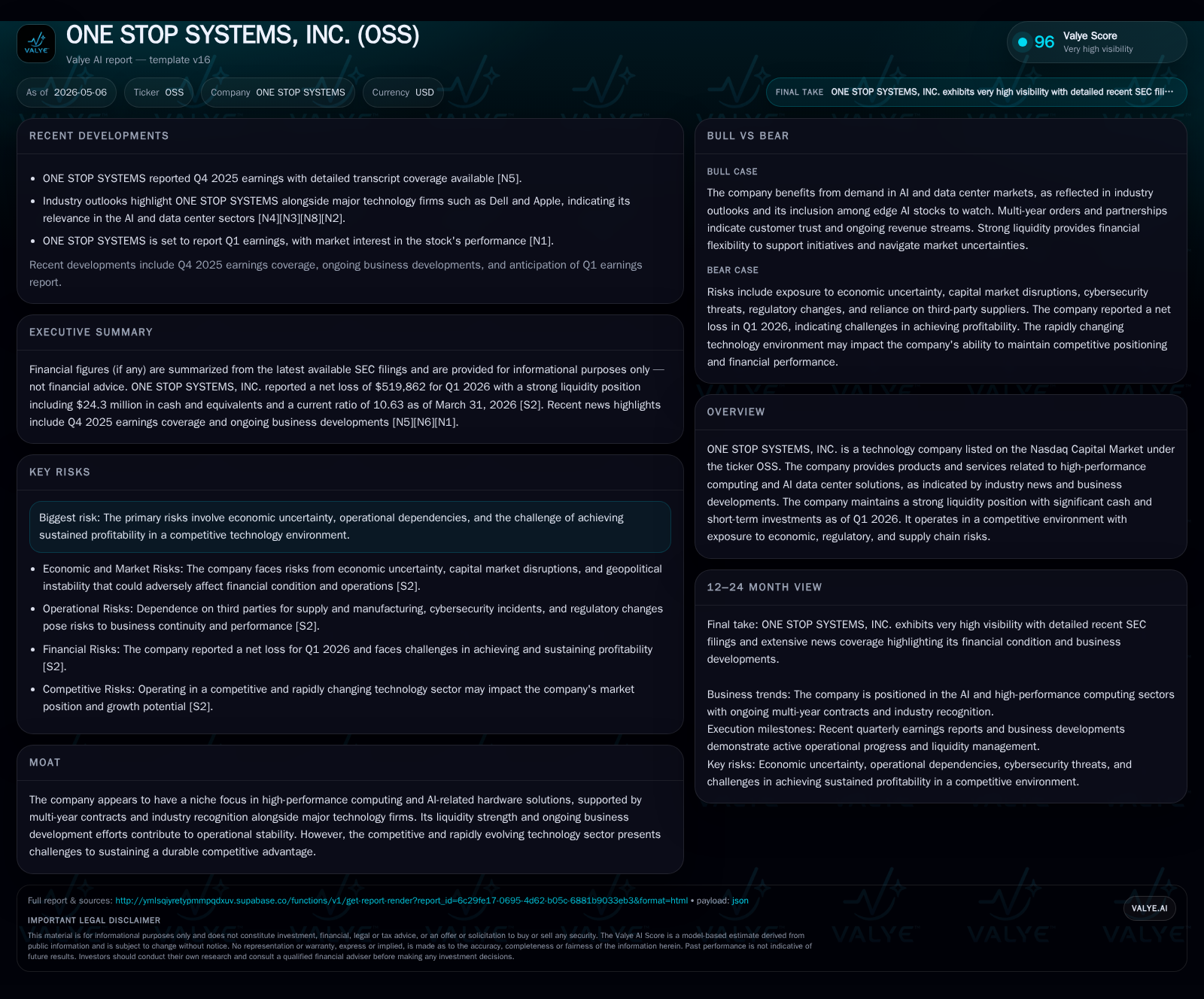
ONE STOP SYSTEMS, INC. (OSS) reported Q1 2026 operational results revealing $1.69 million in remaining performance obligations expected to be satisfied within the year, underscoring steady demand for its high-performance computing solutions. The company maintains a strong liquidity position with over $24 million cash equivalents and no debt as of March 31, 2026, enabling ongoing product innovation and market expansion. OSS operates in a highly competitive technology niche spanning AI data center hardware and ruggedized computing solutions, facing economic and regulatory challenges amid evolving customer demands.
Recent Operating Update
The latest quarterly filing dated May 6, 2026 [S2] provides the most current window into One Stop Systems' operations and financial position. As of March 31, 2026, the company reported approximately $1.69 million in remaining performance obligations under fully funded contracts expected to be completed within the calendar year. This backlog represents customers' contracted commitments wherein OSS still has performance duties to satisfy but is assured payment since contracts are fully funded. This figure reflects a steady stream of incoming revenue supporting short-term visibility into operations.
Importantly, OSS has not changed any accounting policies this quarter [S2], signaling consistency in financial reporting—an important aspect given the complexities surrounding revenue recognition in multi-component technology contracts. The management's use of estimates remains grounded in historical patterns and rational assumptions about collectible revenues and allowances [S2], maintaining conservative financial controls.
Strategically notable is OSS's divestiture of Bressner Technology GmbH finalized by end-2025 [S2], which refocuses the company exclusively on its core strength areas: high-performance computing (HPC), AI data center solutions, particularly ruggedized systems suited for demanding environments like military operations.
Business Model
ONE STOP SYSTEMS generates revenue primarily by designing, manufacturing, and selling specialized high-performance computing solutions that address computationally intensive workloads predominantly found in AI data centers and defense sectors [S1]. Customers pay for products ranging from custom-built servers to PCIe accelerator cards optimized for AI inferencing and edge deployments.
Revenue mechanics hinge on a mix of direct sales under multi-year contracts and project-based customer-funded development agreements. Deliverables typically include hardware components integrated with software drivers tailored toward specific use cases such as flight safety or enterprise HPC applications [S1]. Margins fluctuate based on product mix—with custom development programs commanding higher margin profiles but also involving more R&D investment.
Margins benefit from embedded intellectual property like pending patents capitalized into intangible assets totaling over $73k in capitalization costs during 2025 [S2], indicating ongoing innovation efforts that provide differentiation. The business model requires continuous reinvestment in R&D to maintain relevance amid rapid technology evolution.
Customer retention tends to be high given the complexity of integration with mission-critical systems enhancing switching costs. However, contract sizes can be lumpy reflecting project cadence peculiarities common to defense procurements and enterprise IT refresh cycles.
Industry Structure & Competitive Position
OSS operates at the intersection of AI accelerators, rugged HPC hardware manufacturing, and edge computing solutions—a niche but increasingly vital segment of the broader semiconductor ecosystem. Typical competitors range from large OEMs with scale advantages to specialized system integrators focusing on military-grade compute platforms.
The market is characterized by rapid innovation cycles driven by demands for more powerful yet energy-efficient processing capabilities tailored for AI workloads [N3]. Regulatory scrutiny around defense-related technology exports also shapes competitive dynamics by creating barriers to entry yet adding compliance costs.
OSS’s strategic acquisitions historically (CDI acquisition in 2018) and recent divestitures reflect attempts to optimize portfolio coherence towards segments where it can exert technological leadership [S1], [S28]. Its geographic footprint includes North America with a manufacturing base supplemented by European distribution partnerships facilitating reach into defense markets.
While not immune to commoditization pressures typical of hardware production, OSS attempts differentiation through tight vertical integration between design engineering and customized manufacturing aimed at mission-critical applications requiring ruggedness and reliability.
Growth Drivers
Rising AI Compute Demand: Continued exponential growth in AI workloads fuels demand for specialized accelerators that OSS focuses on providing. These include server-level GPUs combined with proprietary PCIe card designs optimized for inferencing tasks [N4].
Expansion into Military & Defense: The company's focused efforts since 2023 to capture defense budgets via customized rugged compute platforms serve as a premium growth avenue insulated somewhat from civilian market swings [S28].
Edge Computing Penetration: Growing adoption of edge deployments requiring compact yet powerful compute nodes presents new market opportunities leveraging OSS’s modular architectures.
Multi-Year Contracts & Customer Funded Development: Such engagements ensure recurring revenue streams while enabling collaborative innovation driving product advancement aligned tightly with customer needs [S2].
Risks & Constraints
Economic & Geopolitical Uncertainty: Tariffs, inflationary pressures, interest rate volatility, plus prolonged geopolitical conflicts inject uncertainty into capital spending patterns impacting order timing [S7].
Supply Chain Risks: Dependence on third-party suppliers for critical components creates vulnerability especially during semiconductor bottlenecks common across tech supply chains [S1].
Competitive Intensity: Larger incumbents with greater resources may engage in aggressive pricing or rapid feature upgrades potentially eroding OSS’s niche advantages.
Profitability Challenges: Despite solid backlog visibility, sustaining consistent profitability remains difficult due to investment-intensive R&D combined with fluctuating order volumes intrinsic to specialized project-based sales.
What To Watch Next
Key upcoming operational markers include:
- Quarterly updates on bookings against backlog levels validating ongoing contract wins within anticipated sectors [S2].
- Any announcements related to new defense contractor partnerships or expanded military programs indicating deeper sector penetration.
- Progress on developing next-generation HPC or accelerator modules showcasing technology leadership.
- Financial guidance adjustments clarifying path toward sustainable operating profitability amidst investment cycles.
- Supply chain stability signals which could impact delivery timelines or input costs adversely.
Financial Profile Summary
Latest financial snapshot
| Metric | Value | Period |
|---|---|---|
| Cash & equivalents | $24mm | |
| 2026-03-31 | ||
| Total debt | 0 USD | |
| 2026-03-31 | ||
| Net debt | $-24mm | |
| 2026-03-31 | ||
| Current assets | $49mm | |
| 2026-03-31 | ||
| Current liabilities | $5mm | |
| 2026-03-31 | ||
| Current ratio | 10.63x | |
| 2026-03-31 |
Source: SEC companyfacts cache [F1].
As of March 31, 2026 end of Q1:
- Cash & equivalents stand at approximately $24.3 million with no reported debt outstanding [F1], highlighting substantial liquidity headroom.
- Current assets exceed $49 million versus current liabilities near $4.65 million yielding a very strong current ratio exceeding 10x—indicative of excellent short-term financial flexibility [F1].
- The company reports net positive working capital supportive of ongoing operational investments without immediate capital raises requirements [F1].
- There remain uncertainties tied to potential impacts from financial services disruptions but management notes no adverse events currently affecting operations alongside planning conservatively for economic volatility [S2].
In sum, ONE STOP SYSTEMS maintains a financially conservative posture paired with strategic focus on lucrative niches within AI compute hardware markets supported by defensible backlog coverage and robust cash resources enabling continued innovation investment.
Disclaimer: This analysis is based solely on publicly available SEC filings as of May 6, 2026 and supplementary industry news sources without offering any investment advice or recommendations.
Disclaimer: This is research-only, informational analysis and not investment advice. It may include AI-generated interpretation and general industry context. Always verify important details using primary sources.

Comments