
Taysha Gene Therapies Advances Rett Syndrome Program with Strong Financial Foundation
Taysha reports clinical progress on TSHA-102 and maintains robust balance sheet supporting next-stage development.
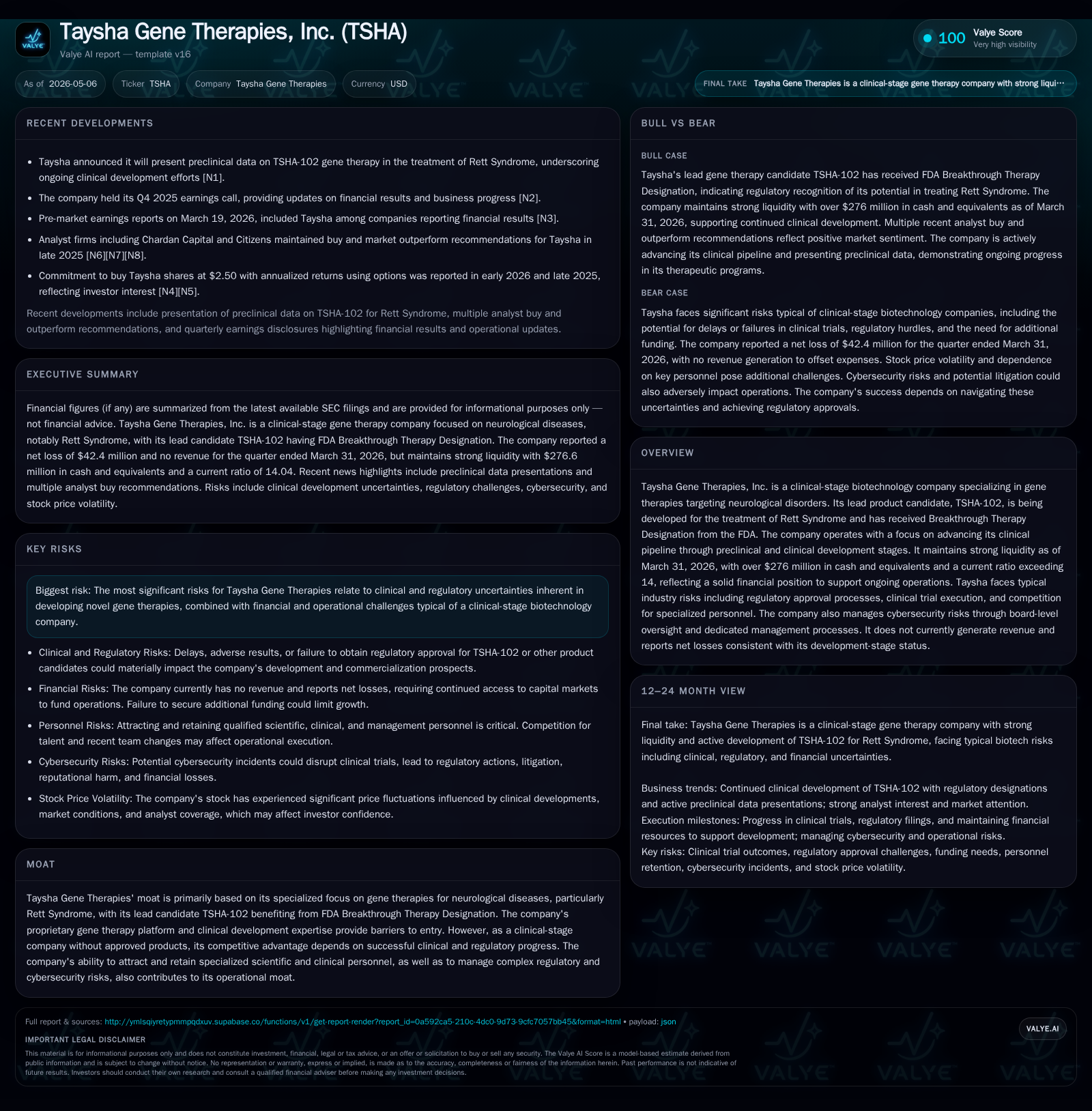
In its latest quarterly filing dated May 6, 2026, Taysha Gene Therapies highlighted advancement in its lead gene therapy candidate TSHA-102 targeting Rett Syndrome, supported by FDA Breakthrough Therapy Designation. The company’s financial position remains strong with over $276 million in cash and equivalents and a current ratio above 14, positioning it well to fund ongoing clinical operations. Taysha’s focused gene therapy platform addresses high unmet needs in neurological disorders, backed by specialized development capabilities. Key growth catalysts include upcoming clinical data readouts and potential regulatory submissions, while risks persist around clinical trial execution, regulatory approvals, and talent retention.
Latest Quarterly Update Highlights Progress and Financial Stability
Taysha Gene Therapies’ most recent quarterly report filed on May 6, 2026 ([S2], [S3]) confirms continued clinical advancement of TSHA-102, its lead gene therapy candidate for Rett Syndrome. The company reiterated its commitment to progressing this program through pivotal studies with the FDA-designated Breakthrough Therapy status providing an enhanced regulatory dialogue pathway. This designation generally affords more frequent interactions with the agency and facilitates expedited review processes.
Financially, Taysha stands on solid footing as of March 31, 2026 with $276.6 million in cash and equivalents against relatively low current liabilities totaling about $20.1 million ([F1]). Total debt is modest at $50 million leading to a net cash position exceeding $226 million ([F1]). Such fiscal discipline should provide a sufficient runway to support ongoing clinical trials without near-term capital raises.
Targeted Gene Therapy Platform and Product Pipeline Overview
Taysha operates as a clinical-stage biotechnology company specializing in AAV-based gene therapies tailored to treat rare neurological disorders ([S1]). Its business model revolves around developing transformative therapies that address monogenic neurological conditions characterized by high unmet medical need – Rett Syndrome being the flagship indication.
TSHA-102 functions by delivering a functional copy of the MECP2 gene via an adeno-associated virus vector to correct the genetic deficiency that causes Rett Syndrome. This approach exemplifies a precision medicine strategy precisely targeting disease etiology at the molecular level—a hallmark advantage over symptomatic treatments.
The company’s proprietary gene therapy platform harnesses scientific expertise in vector design, manufacturing scale-up protocols, and CNS-targeted delivery technology. Maintaining control of this integrated platform underpins barriers to entry given the complexity inherent in manufacturing clinically compliant viral vectors for neurological applications.
Competitive and Regulatory Landscape in Neurological Gene Therapy
Within the rare neurological gene therapy segment, competition remains emerging but intense among specialized biotech firms deploying AAV technologies. Regulatory landscapes are evolving paralleling the nascent nature of CNS-directed gene therapies. The FDA’s Breakthrough Designation for TSHA-102 signifies recognition of its potential but also entails heightened scrutiny demands around safety endpoints given historical challenges in CNS viral vector therapies ([S1], [S5]).
Manufacturing complexity compounds competitive hurdles; reliable scale-up of GMP-grade vectors with batch consistency is a persistent bottleneck industry-wide. This generally elevates switching costs for partners and customers seeking validated therapies.
Exclusivity dynamics rely heavily on robust intellectual property protections around vector design and delivery mechanisms combined with exclusivity periods granted by orphan drug status where applicable.
Growth Prospects Driven by Clinical Milestones and Enhanced Pipeline
The near-term growth trajectory hinges critically on delivering positive data readouts from ongoing Phase 1/2 studies evaluating TSHA-102's safety and efficacy in Rett patients ([S2], [N1]). Positive results could trigger advancement into pivotal registration studies or support accelerated approval filings.
Label expansion into related monogenic neurological disorders presents an opportunity leveraging platform scalability—potentially broadening commercial impact beyond Rett Syndrome. Furthermore, success in this arena may catalyze strategic partnerships or licensing arrangements amplifying development resources and market reach.
R&D productivity improvements observed through expanded patient enrollment rates or optimized vector manufacturing efficiencies would translate directly into faster time-to-market metrics.
Key Risks: Clinical, Regulatory, Talent, and Operational Challenges
Taysha confronts typical but significant risks endemic to early-stage gene therapy developers ([S1], [S5], [S11]). Clinical development risks include unforeseen adverse events or inadequate efficacy signals potentially leading to trial delays or termination.
Regulatory challenges are non-trivial; maintaining compliance amid evolving guidance on gene editing safety standards alongside navigating global jurisdictional variances increases complexity. Furthermore, cybersecurity oversight has emerged as a formal board-level responsibility due to increased data sensitivities involved in clinical trials ([S1]).
Human capital risks revolve around retaining specialized scientific staff essential for executing complex manufacturing processes and advancing pipeline development. Given competitive biotech labor markets, attrition could impair operational continuity.
Financially, while liquidity appears healthy presently, delays in milestone achievements could necessitate additional capital raising which might dilute existing shareholders or complicate strategic initiatives.
Upcoming Catalysts: Clinical Data Readouts and Regulatory Filings
Investors and observers should monitor several critical upcoming milestones:
- Presentation of new preclinical data relating to TSHA-102's pharmacodynamics and safety profile (highlighted in Nasdaq news April 28, 2026 [N1]).
- Enrollment progression updates from ongoing Phase 1/2 trials will serve as measurable markers of study velocity.
- Anticipated regulatory communications from the FDA regarding pivotal trial design requirements or acceptance of marketing applications as TSHA approaches later-stage developmental inflection points ([S3]).
- Potential announcements of collaborations or licensing deals that could enhance capital resources or accelerate commercialization pathways.
These catalyst events will not only test operational execution but also validate the strategic direction anchored in neurological gene therapy specialization.
Recent Financial Position Illustrating Strong Runway for Development
Latest financial snapshot
| Metric | Value | Period |
|---|---|---|
| Cash & equivalents | $277mm | |
| 2026-03-31 | ||
| Total debt | $50mm | |
| 2026-03-31 | ||
| Net debt | $-227mm | |
| 2026-03-31 | ||
| Current assets | $282mm | |
| 2026-03-31 | ||
| Current liabilities | $20mm | |
| 2026-03-31 | ||
| Current ratio | 14.04x | |
| 2026-03-31 |
Source: SEC companyfacts cache [F1].
A focused view on Taysha's balance sheet at quarter-end March 31, 2026 reveals considerable strength enabling sustained development activities without immediate financing pressure:
| Metric | Value |
|---|---|
| Cash & Equivalents | $276.6 million (3/31) |
| Total Debt | $50.0 million (3/31) |
| Current Ratio | 14.04 |
| Revenue | $9.77 million |
| Operating Loss | -$110.5 million |
| Net Loss | -$109.0 million |
| ([F1]) |
Revenue streams remain nascent reflective of no approved products yet; operating losses reflect substantial R&D investments fueling pipeline progression but are supported by ample liquidity reserves. The net cash position estimated at approximately $226.6 million after debt indicates readiness to fund multiple upcoming clinical phases ensuring operational stability over the medium term.
This analysis synthesizes publicly available SEC filings dated through May 2026 alongside corroborative news sources emphasizing Taysha Gene Therapies’ potent combination of cutting-edge developmental progress in a challenging biotech niche bolstered by robust financial discipline. While risks remain inherent given developmental uncertainties characteristic of pioneering gene therapies for complex neurological diseases like Rett Syndrome, Taysha’s focused platform technology combined with meaningful regulatory designations establish a competitive foundation warranting close monitoring of forthcoming milestones.
This memorandum is intended solely for informational purposes without any recommendation or investment advice.
Disclaimer: This is research-only, informational analysis and not investment advice. It may include AI-generated interpretation and general industry context. Always verify important details using primary sources.

Comments