
Cambium Networks Corp Faces Operational Headwinds Amid Financial Pressures
The latest quarterly filing reveals increasing liquidity challenges and Nasdaq delisting, compounding operational risks that constrain Cambium’s strategic flexibility.
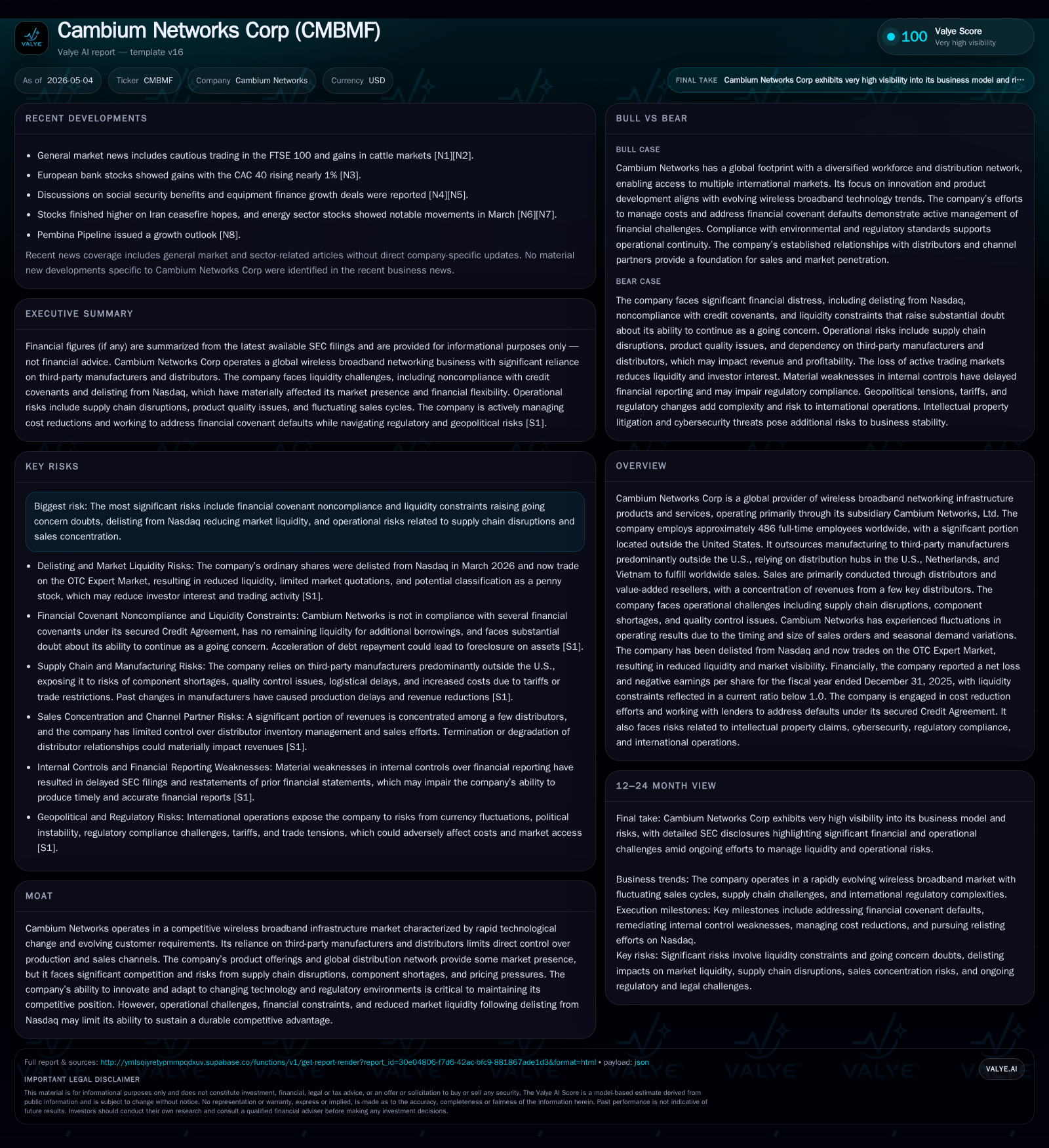
Cambium Networks’ 10-Q filing for Q1 2026 highlights critical liquidity strains, ongoing covenant breaches, and the recent Nasdaq delisting determination, intensifying short-term survival pressures. The company’s business model hinges on outsourced manufacturing and distributor-driven sales of wireless broadband infrastructure, a mix that simultaneously facilitates broad geographic reach and exposes it to supply chain fragility and revenue concentration risks. In a competitive wireless infrastructure market marked by rapid technology shifts and component shortages, Cambium faces headwinds in sustaining innovation amid financial constraints. Near-term growth is tied to expanding channel partnerships and next-generation product adoption but is hampered by operational and market access challenges. Key risk factors include potential acceleration of debt repayment due to defaults, dependency on few distributors, and regulatory compliance costs. Monitoring covenant waivers, refinancing efforts, and order trends will be critical indicators of whether Cambium can stabilize its footing.
Latest Quarterly Developments and Market Implications
Cambium Networks’ latest quarterly report filed April 30, 2026 ([S2]) paints a stark picture of operational strain compounded by severe financial pressure. Most notably, the filing confirms continued insolvency risks tied to ongoing defaults on financial covenants under its credit facility. Despite attempts at negotiations with its lender (Bank of America), the company remains out of compliance with several contractual financial ratios as well as timely SEC filing requirements ([S4], [S5], [S6]). This has culminated in formal default status raising near-term questions around potential acceleration of debt repayment obligations to $68.4 million outstanding as of mid-2024 [F1]. The lender retains rights to foreclose on substantially all assets should Cambium be unable to satisfy amounts owed.
Concurrently, Cambium disclosed the unavoidable outcome that the Nasdaq Hearings Panel determined to delist its ordinary shares from Nasdaq due to repeated listing standard violations ([S3]). Although appeal processes are underway (per prior filings), this delisting substantially diminishes public market liquidity and complicates future capital access.
Operationally, the company continues experiencing fluctuations driven by seasonal demand variability and supply chain disruptions impacting product deliveries — particularly evident in inconsistent sales order timing reported in quarterly results ([S2]). These cumulative developments spotlight significant near-term risks that threaten business continuity absent quick resolution or substantial financial restructuring.
Cambium Networks’ Business Model and Product Ecosystem
Cambium chiefly generates revenue through sale of wireless broadband networking infrastructure equipment largely sold under its subsidiary Cambium Networks Ltd ([S1]). Its products include fixed wireless broadband radios targeting both unlicensed sub-7 GHz bands and licensed point-to-point solutions in the mid-band spectrum like Citizens Broadband Radio Service (CBRS) in the U.S., alongside emerging millimeter-wave technologies (60 GHz cnWave) designed for enterprise applications ([S1], [S17]).
Manufacturing is fully outsourced to third-party providers principally offshore, while global distribution relies heavily on value-added resellers (VARs) and distributors located strategically across hubs in the U.S., Netherlands, and Vietnam ([S1], [S19]). Sales concentration is skewed: three largest distributors accounted for approximately 32%-34% of revenues recently ([S17]). This indirect channel approach creates switching-cost dynamics dependent upon sustained distributor relationships but leaves Cambium exposed to distributor or end-customer attrition risk.
Strategically, reliance on outsourced manufacturing aids capital efficiency but elevates vulnerability amid component shortages or supplier quality issues frequently encountered in semiconductor-dependent telecom hardware markets ([S25]). Product innovation cycles are pivotal given wireless infrastructure’s fast pace; Cambium endeavors to keep pace via iterative new product introductions tailored for evolving network operator needs while managing cost pressures ([S1], [S16]).
Industry Dynamics and Competitive Positioning
The wireless broadband infrastructure sector commands brisk technological shifts characterized by intense competition from sizeable incumbents like Ericsson, Nokia, as well as specialized players including Ubiquiti, Tarana Wireless, and Ceragon Networks competing in overlapping spectrum niches ([S23], [S26]). Intellectual property complexities dominate competitive interactions. Cambium’s patent portfolio is relatively limited versus larger peers making defensive leverage difficult against infringement claims prevalent in Wi-Fi innovations ([S23]).
Alongside competitive intensity, supply chain challenges remain persistent. Global semiconductor scarcity combined with logistical bottlenecks — container shortages, shipping delays — inflate costs and complicate delivery commitments ([S25]). Regulatory overlays such as RoHS compliance for hazardous substances also impose incremental R&D and production costs potentially straining margins further ([S28]).
On a geopolitical front, exposure to international operations spanning Europe, Asia-Pacific, Middle East & Africa entails currency volatility risk plus certification delays linked to regional standards differing across markets — factors which could delay product launches or reduce competitiveness ([S19]).
Growth Drivers: Innovation, Market Penetration, and Channel Strategy
Despite adversities, Cambium pursues growth primarily through technology advancement — rolling out next-generation broadband products designed for private wireless networks or enterprise uses leveraging mmWave frequencies ([N1], [S1]). Geographic expansion into emerging markets aims at tapping growing broadband demand outside the U.S., leveraging existing distribution hubs for scale efficiencies.
Broadening the base of distributors beyond the top concentrated few offers potential revenue diversification although it remains constrained by current financial stress limiting investment capacity ([S17]). Ongoing product development remains critical not only for technological relevance but also as a lever for pricing power amid commoditizing components.
Customer adoption is influenced heavily by channel partner effectiveness since end-user relationships are indirect; thus vendor support services, training programs for VARs/distributors become strategic priorities for retention ([S17]). However, current cost deferrals may impair these initiatives impacting long-term growth.
Risks and Constraints: Financial Covenants, Supply Chain, and Market Access
Supply chain vulnerabilities persist including component shortages — particularly affecting chipset availability — with delays increasing warranty risks or quality control expenses ([S25], [S24]). Concentration risks also exist: heavy revenue dependence on a handful of distributors means any relationship disruption could materially dent cash inflows amidst limited visibility into underlying end-customer demand patterns ([S17]).
Regulatory complexities around environmental compliance (such as RoHS/WEEE directives) impose ongoing costs with uncertain future amendments necessitating product redesigns possibly adding unexpected expenses ([S14], [S28]).
Execution success against these markers will provide clearer sightlines into whether Cambium can arrest deterioration or requires restructuring actions.
Financial Snapshot: Liquidity, Debt, and Profitability Overview
Latest financial snapshot
| Metric | Value | Period |
|---|---|---|
| Current assets | $91mm | |
| 2025-12-31 | ||
| Current liabilities | $137mm | |
| 2025-12-31 | ||
| Current ratio | 0.66x | |
| 2025-12-31 |
Source: SEC companyfacts cache [F1].
| Metric | Value | Date |
|---|---|---|
| Current Ratio | 0.66 | |
| 2025-12-31 | ||
| Total Debt | $68.4 Million | |
| 2024-06-30 | ||
| Operating Income | -$27.96 Million | |
| 2025-12-31 |
The depressed current ratio below unity evidences tight short-term liquidity strained by $137 million in current liabilities outpacing $90 million in current assets ([F1]). Negative operating income signals ongoing losses reflective of operational difficulties discussed above.
This financial profile underscores why management faces material doubt about continuing as a going concern without swift mitigation or infusion of new capital resources ([S6]).
Disclaimer: This is research-only, informational analysis and not investment advice. It may include AI-generated interpretation and general industry context. Always verify important details using primary sources.

Comments