
Twin Disc Boosts Margins Through Strategic Integration and Market Expansion
The company’s recent quarter reflects margin expansion fueled by acquisition contributions, operational efficiency, and global market growth.
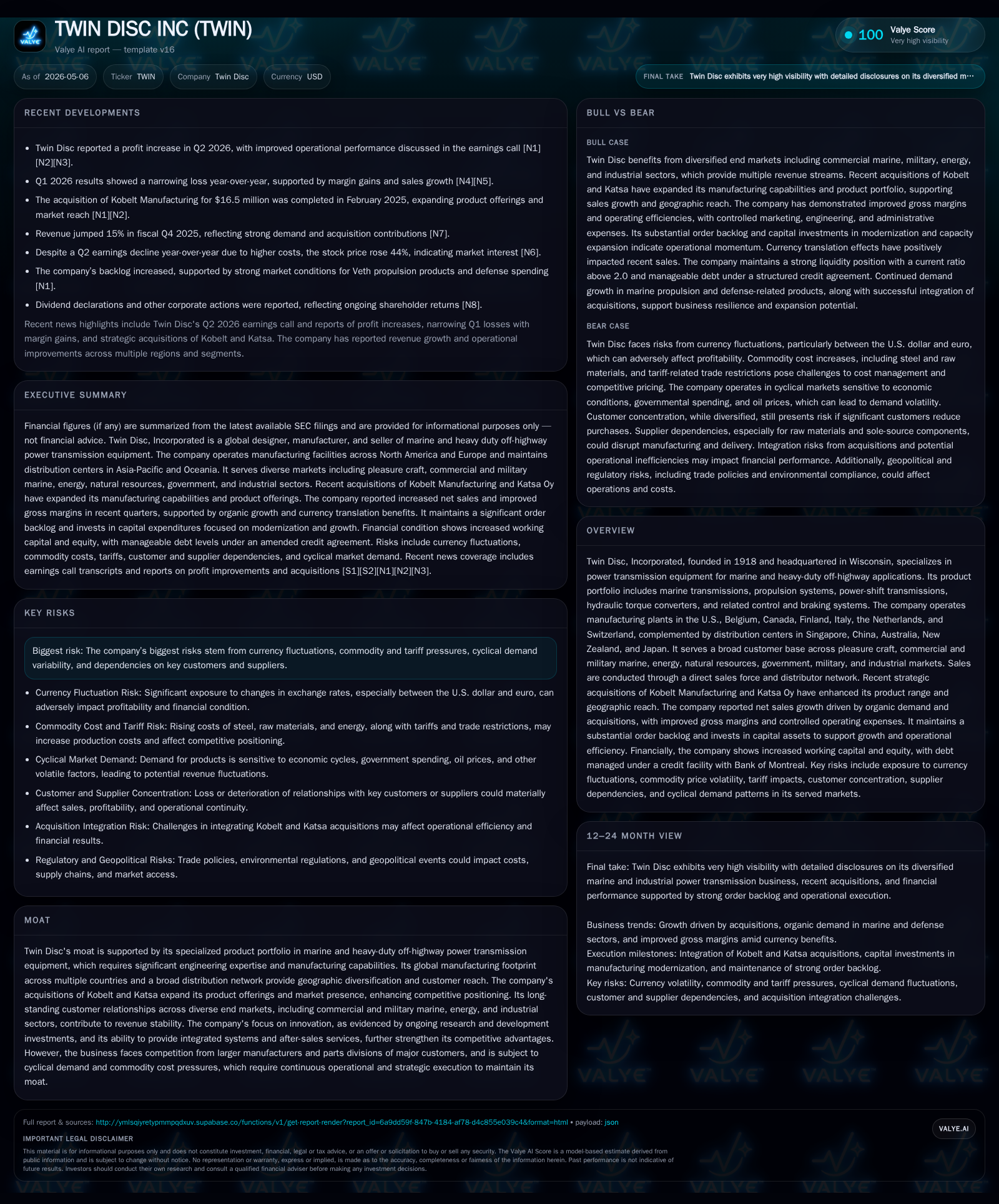
Twin Disc’s Q3 fiscal 2026 results show a 19% year-over-year sales increase supported by organic growth and favorable currency translation. Gross profit margins improved to 28.1%, driven by operational execution and integration of the Kobelt and Katsa acquisitions. The firm’s manufacturing segment, particularly its Veth propulsion operations in Europe, is underpinning revenue strength amid mixed conditions in distribution. With a diversified global footprint and enhanced product portfolio, Twin Disc navigates cyclical end markets while expanding its aftermarket service offerings. Elevated interest expenses reflect acquisition-related financing, but liquidity remains robust with a current ratio above 2.0.
Q3 Fiscal 2026 Operating Highlights: Margin Gains and Sales Growth
Twin Disc's latest quarterly results emphasize strong operational execution amid strategic integration of acquisitions acquired in fiscal 2025. Net sales for the quarter ended March 27, 2026, increased by 19% year-over-year to $96.7 million, bolstered significantly by a favorable foreign exchange impact of approximately $7.5 million due to euro strengthening against the U.S. dollar alongside underlying organic growth across several end markets [S2]. The company’s backlog expanded robustly to $179.5 million by quarter-end, up from $150.5 million at the prior fiscal year-end, indicative of strengthened demand primarily for its Veth marine propulsion systems and increasing defense-related orders originating from the European operations [S11].
Gross profit margins improved to 28.1% for the quarter from 26.7% the previous year’s comparable period — this enhancement reflects successful cost reduction initiatives, volume leverage particularly at the Veth operation in the Netherlands, and the absence of non-cash inventory write-downs that had impacted prior periods relating to product rationalization enacted post-Katsa acquisition [S2]. While marketing, engineering, and administrative (ME&A) expenses rose modestly by $1.5 million (+7.6%), these costs declined as a percentage of sales to 21.7%, aided by currency benefits partially offsetting inflationary cost pressures and acquisition-related investments predominantly attributable to Kobelt’s integration costs [$0.3M] [S2].
Twin Disc’s Integrated Business Model: Advanced Power Transmission Solutions
Established over a century ago in Wisconsin, Twin Disc has built an integrated business model centered on designing, manufacturing, and selling specialized power transmission equipment for marine applications and heavy-duty off-highway vehicles [S1]. The product suite includes marine transmissions, advanced propulsion drives (like azimuth thrusters), hydraulic torque converters, power-shift transmissions, controls systems, industrial clutches, and braking mechanisms — all engineered for demanding commercial marine vessels, military platforms, energy exploration equipment, government projects, and industrial use cases.
The company leverages a broad manufacturing footprint spanning the U.S., Belgium, Canada (Kobelt), Finland (Katsa), Italy, the Netherlands (Veth), and Switzerland supplying global mega yacht and patrol boat markets through component-rich propellers and propulsion technologies [S1]. This geographical diversification supports resiliency against localized economic fluctuations or supply chain disruptions while enabling proximity to key customer bases.
Revenue generation is driven by direct sales teams supplemented by an extensive distributor network covering Singapore, China, Australia/New Zealand, Japan, Europe, Canada, and North America — facilitating tailored customer engagement within pleasure craft segments as well as complex commercial marine vessels requiring integrated propulsion solutions [S1]. Aftermarket services constitute a significant part of Twin Disc’s approach; notably Katsa enhances this capability through spares delivery, reverse engineering expertise, gearbox refurbishment services enhancing customer retention via recurring-value propositions.
Competitive Dynamics in Marine and Off-Highway Transmission Equipment
Twin Disc operates within a niche yet capital-intensive sector demanding deep engineering expertise for power transmission components whose failures can be costly operationally and safety-wise on vessels or industrial platforms. Its longstanding presence fosters trusted relationships across commercial marine operators and military clients requiring high customizability combined with robustness.
Post-acquisition expansions with Kobelt and Katsa have strategically boosted Twin Disc's competitive moat by broadening its control systems offering (including steering/braking) and augmenting European market penetration with high-quality gearboxes serving critical defense applications, [S1]. Such offerings are differentiated versus commoditized parts due to extensive R&D investments focused on enhancing system efficiency and reliability alongside integrated digital control capabilities marrying mechanical propulsion components with computerized management.
Competition arises both from large industrial conglomerates producing parts but lacking highly integrated propulsion solutions as well as regional manufacturers targeting niche geographies or sectors. Twin Disc’s multi-continent manufacturing footprint mitigates supply chain risks especially given recent raw materials shortages affecting steel forgings critical for core transmission components — a recurrent constraint impacting industry-wide capacity levels across developed market suppliers [S1]. The company's ability to innovate around electronic vessel management systems further raises switching costs for customers reliant on seamless system interoperability.
Growth Catalysts: Market Penetration, Product Innovation, and Global Footprint
Key drivers underpinning Twin Disc's growth include accelerating adoption of its Veth propulsion technology globally as commercial marine demand recovers post-pandemic alongside rising military expenditure stimulus mainly in Europe supporting defense-related aftermarket services derived from Katsa's refurbished gearbox offerings [S11],. Incremental revenue contributions from Kobelt strengthen penetration into Canadian offshore sectors while extending control system solutions into broader oil & gas industrial markets.
Product innovation remains central — ongoing engineering investment adds new features improving fuel efficiency and enabling remote diagnostics which resonate well with customers seeking lifecycle cost reductions amid volatile fuel prices [S2],. The firm is actively scaling manufacturing capacity at Netherlands-based Veth facilities responding to record order volumes guaranteeing near-term delivery commitments.
Additionally, Twin Disc’s streamlined inventory management efforts aim at reversing last year’s buildup attributable partly to shipping delays,[S1] driving improved working capital turns as fiscal 2026 concludes.[S11] Currency tailwinds related primarily to euro appreciation versus USD continue providing nominal revenue uplift but also expose margin levers when materials costs shift conversely.
Risk Factors and Operational Constraints to Monitor
Persistent risks include currency volatility particularly between the U.S dollar and euro influencing reported performance given substantial euro-denominated costs/revenues creating earnings translation effects[S1]. The cyclical nature of oil & gas markets continues impacting demand patterns for relevant hydraulic torque converters used on offshore rigs; recent softness in China's oilfield transmissions has pressured Asia-Pacific distribution revenues[S18].
Tariff regimes remain an operative concern dampening North American shipments of European-sourced marine equipment exacerbating distribution segment softness[S18], suggesting sensitivity to evolving trade policies or geopolitical tensions may constrain revenue gains.
Supply chain challenges also persist with potential steel shortages risking production schedules for key components—castings/forgings—where lead times lengthen industry-wide impairing flexibility during demand spikes[S1]. Dependence on select key customers within commercial/military segments magnifies vulnerability should economic downturns or budget reallocations occur unexpectedly.
Order backlog trends represent an essential forward indicator—particularly growth tied to Veth propulsion orders amid commercial marine recovery phases plus expanding defense procurement cycles.[S11] Close attention to fluctuations in tariff impacts or raw material availability affecting shipment cadence will also clarify execution risk near term.
Management commentary around capital expenditure plans aimed at modernization initiatives signals continued focus on operating leverage enhancements,[S11], which may influence future margin trajectories alongside pricing mix optimization resulting from higher-margin aftermarket activity expansion.
Current Financial Position: Liquidity, Debt, and Cost Structure
Latest financial snapshot
| Metric | Value | Period |
|---|---|---|
| Total debt | $45mm | |
| 2026-03-27 | ||
| Net debt | $45mm | |
| 2026-03-27 | ||
| Current assets | $260mm | |
| 2026-03-27 | ||
| Current liabilities | $124mm | |
| 2026-03-27 | ||
| Current ratio | 2.09x | |
| 2026-03-27 |
Source: SEC companyfacts cache [F1].
As of March 27, 2026—the close of Q3 FY26—Twin Disc reported total debt approximating $45.1 million against current assets amounting to $260.4 million delivering a current ratio of about 2.09 underscoring solid liquidity reserves supporting operational needs[F1]. Net debt aligns closely with total debt given stable cash balances near $16 million predominantly held overseas.[F1], [S2]
Interest expense climbed modestly by approximately $0.6 million year-to-date ($2.4 million total) reflecting increased revolver balances used primarily to finance Kobelt/Katsa acquisitions completed in fiscal years ’24–’25[S2]. Pursuant to the Credit Agreement, the Bank made a Term Loan to the Company in the principal amount of $15.0 million, consisting of an assignment of a term loan under the Prior Credit Agreement from BMO to the Bank with a remaining principal of $8.5 million and an additional advance of $6.5 million. The maturity date of the Term Loan is April 1, 2027, and the Company is required to make principal installments on the Term Loan of at least $0.75 million per quarter[S2].
Disclaimer: This is research-only, informational analysis and not investment advice. It may include AI-generated interpretation and general industry context. Always verify important details using primary sources.

Comments