
908 Devices Advances Handheld Chemical Analysis with Robust Q1 Momentum
The company’s latest quarterly filing highlights strategic technology acquisitions and operational progress underpinning growth in portable chemical analysis.
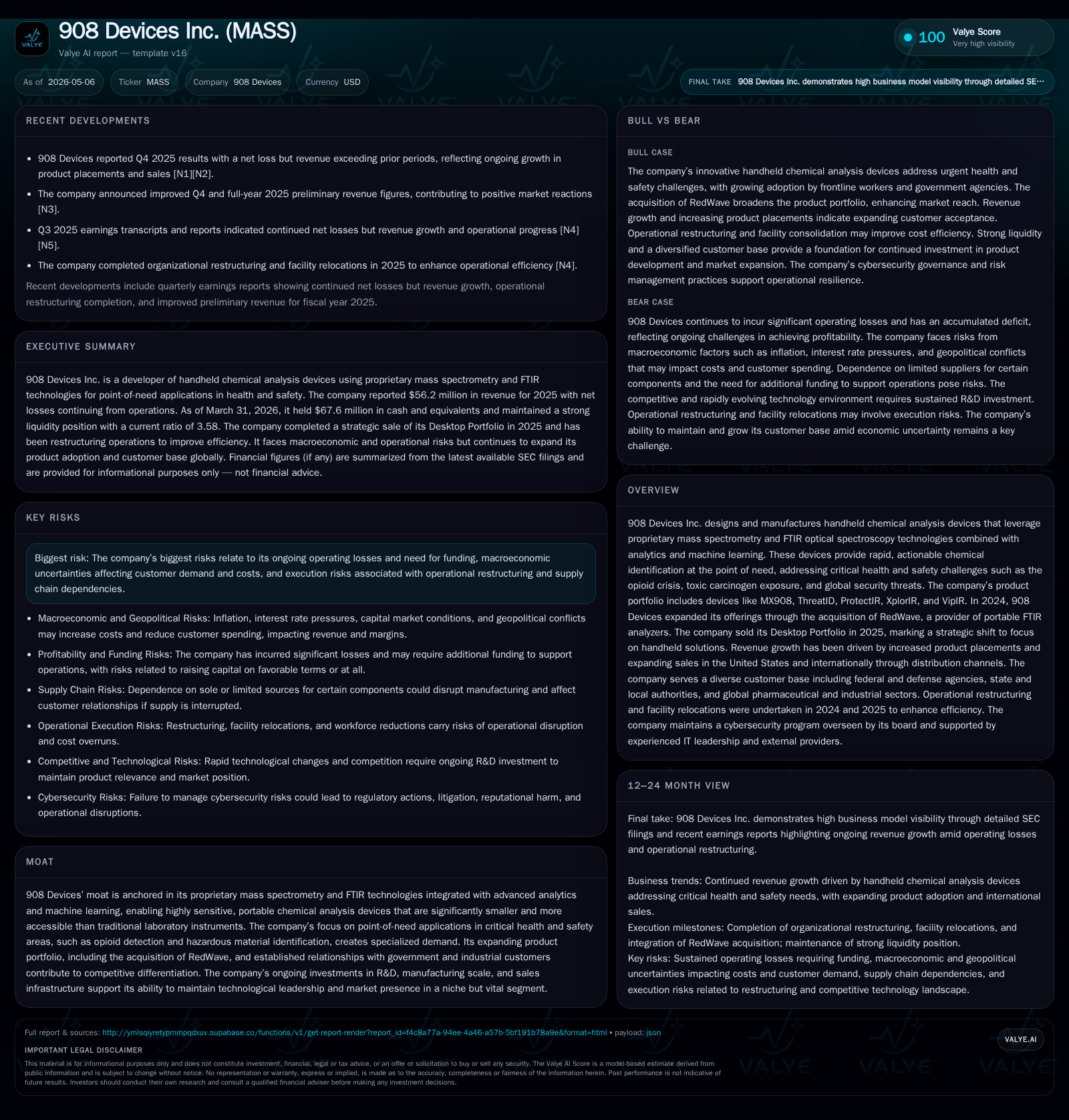
908 Devices Inc. reported steady operational progress in Q1 2026, marked by completing the NIRLAB acquisition to enhance its FTIR spectroscopy capabilities and continuing its focus on handheld mass spectrometry devices. This strategic pivot away from desktop solutions toward point-of-need, portable chemical analyzers strengthens its positioning in critical health and safety markets. The company's proprietary tech integration with machine learning underpins differentiated offerings amid evolving industry demand and complex regulatory environments. While operational losses persist, the firm maintains a solid liquidity buffer, with cash reserves supporting near-term growth initiatives and R&D investments.
Q1 2026 Operating Update Highlights
908 Devices' May 6, 2026 quarterly filing (10-Q) underscores key strategic developments shaping the near-term outlook. The company finalized the acquisition of Switzerland-based NIRLAB SA on May 4, enhancing its footprint in portable Fourier Transform Infrared (FTIR) spectroscopy technology [S2], [S3]. This complements its legacy mass spectrometry handheld devices, notably broadening the FTIR product lineup crucial for chemical identification at the point of need.
Alongside this acquisition, 908 Devices has affirmed its continued transition away from desktop analytical instruments — a business sold off in 2025 — concentrating efforts exclusively on handheld platforms aligned with expanding health, safety, and security applications [S2], [S1]. Operational restructuring activities, including consolidating manufacturing operations primarily into Danbury, Connecticut, and relocating headquarters to Burlington, Massachusetts have been substantially completed as of mid-2025, leading to anticipated cost efficiencies [S1], [S19].
Importantly, no material changes were noted to risk factors during the quarter relative to prior disclosures highlighting capital intensity and market uncertainties [S2], maintaining management’s steady messaging around navigating macroeconomic pressures carefully.
Focused Business Model and Product Innovation
908 Devices operates a specialized model centered on designing and commercializing handheld chemical analyzers that merge proprietary mass spectrometry with FTIR optical spectroscopy technologies fortified by embedded analytics and machine learning algorithms, [S1]. These devices enable rapid chemical identification outside traditional lab environments — at the "point-of-need" — rapidly informing decisions in critical areas such as opioid drug detection, hazardous materials screening, toxic carcinogen detection, and global security threat mitigation.
Revenue is principally generated through the sale of these hardware devices complemented by service contracts, software analytics subscriptions, and development collaborations. Product placement volume expands revenues as more frontline users integrate these handheld instruments into enforcement or industrial workflows. Pricing dynamics hinge on technological sophistication combined with meeting stringent regulatory standards demanded by government agencies—key customers that bolster resilience against commoditization risks [S11].
Post-2025 divestiture of desktop products signaled a deliberate narrowing to these niche handheld platforms. Strategic acquisitions like RedWave (2024) and now NIRLAB further deepen the FTIR portfolio—enabling faster adoption among diverse customer segments building on proven mass spec offerings such as MX908 and ThreatID, [S1]. International expansion unfolds mainly via distribution partnerships that accelerate reach beyond U.S. governmental clients into allied industrial sectors.
Competitive Positioning and Industry Dynamics
The core competitive advantage for 908 Devices lies in its seamless integration of distinct analytical modalities—mass spectrometry coupled with FTIR spectroscopy—and an AI-driven software layer that enhances data interpretation speed and accuracy. This unique combination delivers significantly smaller form factors than traditional lab-bound instruments while preserving sensitivity and specificity essential for high-stakes applications.
Barriers to entry stem from both technological complexity—proprietary intellectual property protecting hardware designs—and regulatory compliance hurdles faced by customers deploying hazardous substance detection tools. Government contracts form a large portion of usage cases due to urgent public health imperatives like the opioid crisis or national security needs requiring rapid deployment technologies [S1], allowing sustained pricing power supported by long sales cycles and relationship depth.
Continuous R&D investments bolster innovation pipelines ensuring offerings stay ahead technologically. Manufacturing scale benefits attained through centralizing production facilities amplify margin improvement prospects once volume throughput grows sufficiently [S24], [S19]. Meanwhile, competition remains fragmented but cautious given specialized tech requirements.
Growth Catalysts in Health & Safety Applications
Key sustainable demand drivers include increasing frontline need for swift chemical threat identification amidst rising opioid-related emergencies and chemical exposure incidents globally. Regulatory mandates requiring enhanced screening capabilities encourage end-user adoption across law enforcement, border protection, environmental monitoring, and industrial hygiene fields.
Acquisition-fueled expansion of FTIR-based handheld analyzers opens fresh market niches where rapid infrared spectral analysis can rival or surpass mass spec depending on use case sensitivity required. Greater focus on international distribution networks diversifies revenue sources while tapping growing global concerns over illicit substances and toxic threats [S3].
Contingent earn-out terms tied to milestone revenues from recent deals signal heightened managerial confidence that these complementary technologies are commercially scalable—providing upside potential if integration continues seamlessly [S3]. Simultaneously, incremental device placements materially enhance recurring services revenue prospects from software updates and maintenance contracts.
Risks and Operational Constraints
808 Devices continues facing several challenges illuminated in SEC filings: persistent operating losses indicate a path to profitability remains distant absent significant revenue ramp; reliance on external financing looms given capital-intensive R&D paths; macroeconomic volatility may constrain buyer spending cycles notably within government end-markets sensitive to budget shifts or geopolitical tensions [S1],.
Supply chain dependencies pose another headwind as some critical components rely on sole or limited suppliers; any disruption can delay manufacturing schedules impacting customer deliveries [S22]. Execution risks related to integrating acquisitions while managing organizational restructuring necessitate disciplined project management to avoid eroding margins or distracting management focus.
No new risk factors emerged this quarter reinforcing that these structural headwinds remain central watchpoints with clear visibility as financial statements reveal steady cash burn combined with healthy liquidity cushions but ongoing need for capital access [S26].
Key Upcoming Milestones and Market Signals
Attention should center on tracking achievement of revenue-based contingent earn-outs linked to NIRLAB acquisition targets by year-end 2027—a concrete barometer of successful commercial roll-out [S3]. Monitoring Q2 sales growth figures alongside distribution channel expansions internationally will illuminate acceptance trends outside core U.S. government verticals.
Further product launches or enhancements integrating cross-technology capabilities remain potential catalysts albeit contingent upon ongoing R&D cycle completions. Updates on operational metrics such as manufacturing throughput improvements post-facility consolidation will provide insight into cost efficiency gains feeding gross margin progression.
Market feedback evolving around device usage effectiveness against emergent public safety threats could also supersede raw financial metrics as dominant valuation drivers over mid-term horizons.
Financial Overview: Liquidity and Capital Structure
Latest financial snapshot
| Metric | Value | Period |
|---|---|---|
| Cash & equivalents | $67.56mm | |
| 2026-03-31 | ||
| Current assets | $142.0mm | |
| 2026-03-31 | ||
| Current liabilities | $39.66mm | |
| 2026-03-31 | ||
| Current ratio | 3.58x | |
| 2026-03-31 |
Source: SEC companyfacts cache [F1].
908 Devices ended Q1 2026 with cash & equivalents totaling $67.56 million complemented by current assets of $142 million against current liabilities of $39.66 million resulting in a robust current ratio of approximately 3.58x—indicative of solid short-term liquidity coverage rooted in prudent working capital management [F1].
This capital structure stance allows funding continuity for planned operating expenses including sustained R&D ($15.6M spent in recent comparable periods) which remains critical for technology leadership while SG&A showed signs of modest moderation supporting leaner go-to-market efforts [$38.5M vs prior] [S23], [S24].
DISCLAIMER: This analysis is based solely on publicly available information including SEC filings through May 6, 2026. It does not constitute investment advice or recommendations. Readers should consider additional sources when forming opinions about the company’s prospects or valuation.
Disclaimer: This is research-only, informational analysis and not investment advice. It may include AI-generated interpretation and general industry context. Always verify important details using primary sources.

Comments