
Bioventus Emerges with Peripheral Nerve Stimulation and Debt Refinancing Tailwinds
Bioventus’s Q1 2026 update highlights the commercial ramp of new peripheral nerve stimulation products alongside improved liquidity from recent debt refinancing.
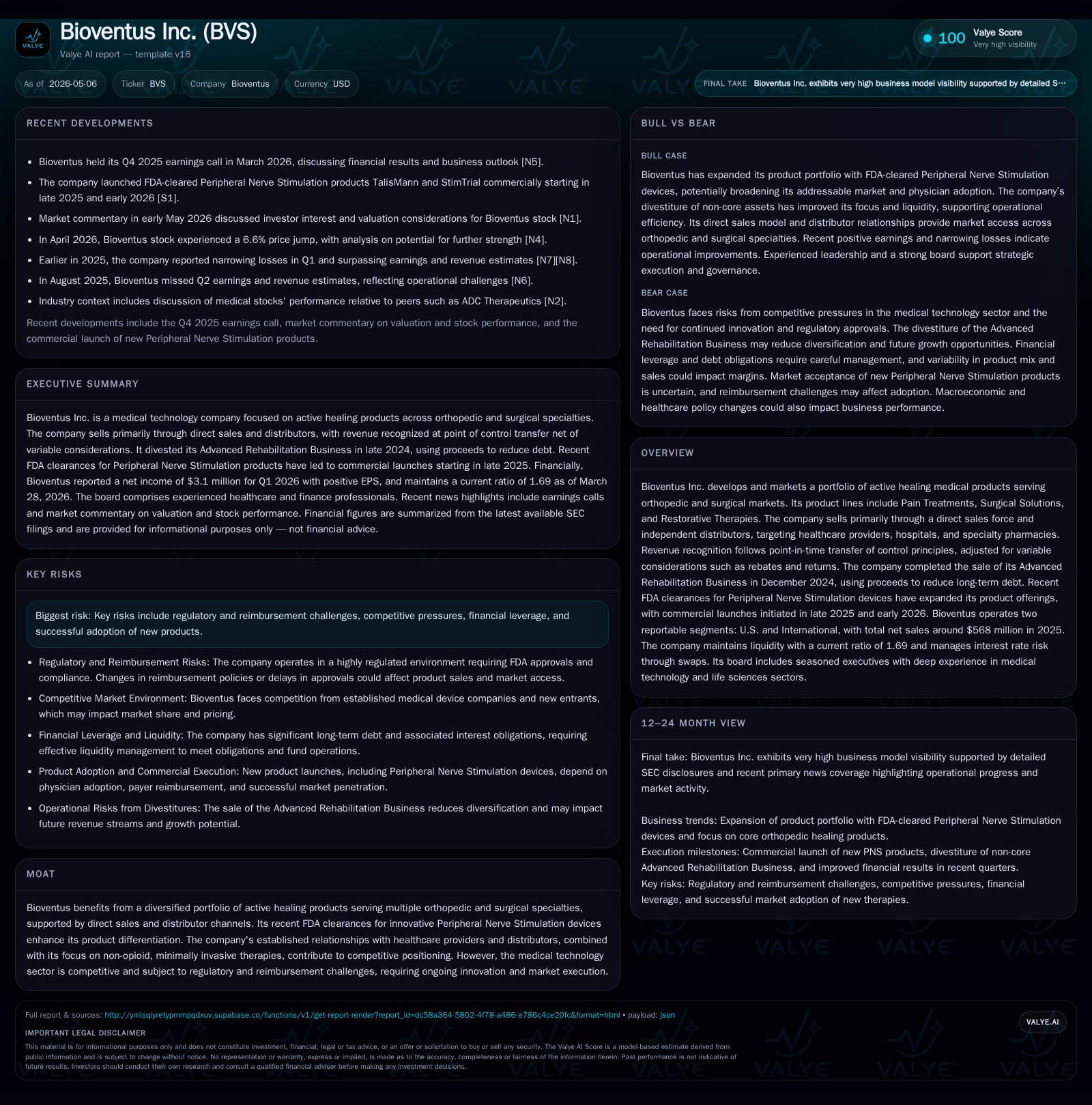
In the first quarter of 2026, Bioventus Inc. initiated commercial launches of its recently FDA-cleared Peripheral Nerve Stimulation (PNS) devices, marking a pivotal step in expanding its non-opioid pain management portfolio. This product rollout, coupled with the benefits of a July 2025 credit agreement that refinanced legacy debt and extended maturities to 2030, enhances the company’s competitive positioning and financial flexibility. While the orthopedic medical device market remains competitive and subject to reimbursement complexities, Bioventus’s diversified product offering and strengthened balance sheet underpin its growth prospects.
Q1 Operating Highlights: Product Launches and Market Expansion
The latest quarterly filing dated May 6, 2026 reveals that Bioventus has taken tangible steps toward commercializing its newly FDA-cleared Peripheral Nerve Stimulation (PNS) devices designed to address both acute and chronic pain indications [S2][S3]. This launch phase commenced in late 2025 with initial commercial sales reported in Q1 2026. The introduction of these non-opioid neuromodulation therapies marks a significant diversification within Bioventus’s Pain Treatments line beyond their established hyaluronic acid (HA) injections for knee osteoarthritis and platelet-rich plasma (PRP) systems.
Alongside product innovation, the company indicates ongoing international market development via distributor partnerships complementing its dominant direct sales model in the U.S. Though initial revenue impact from PNS products is nascent given early-stage rollout timing, the filings emphasize expected growth contribution as sales execution scales through targeted orthopedic and surgical specialties.
Bioventus Business Model: Multi-Modal Healing Solutions and Channel Dynamics
Bioventus’s business model centers on delivering active healing solutions across orthopedic care pathways spanning Pain Treatments (HA injections, PRP systems including XCELL launched fully in August 2025), Surgical Solutions (Ultrasonic bone resection tools and bone graft substitutes), and Restorative Therapies (focused largely on low-intensity pulse ultrasound for fracture care) [S1]. This multi-modal approach allows the company to engage multiple physician call points including sports medicine specialists, total joint reconstructive surgeons, spine surgeons, neurosurgeons, podiatrists, and trauma physicians.
Revenue generation primarily hinges on selling proprietary medical devices and therapeutics via two channels: a direct sales force responsible for building clinical adoption among healthcare practitioners and specialty pharmacies for Pain Treatments products; plus independent distributors that serve hospital customers for Surgical Solutions segments like Ultrasonics [S1]. This hybrid channel strategy provides broad market access while retaining control over customer engagement critical to education-dependent products.
Revenue recognition follows point-in-time transfer of control principles adjusted for rebates or returns provisions common in healthcare supply chains. Pricing dynamics benefit from differentiated clinical profiles—such as targeted knee OA therapy versus surgical adjuncts—with potential margin expansions tied to scale efficiencies as new innovation launches mature.
Industry Positioning: Competitive Differentiation Through Innovation and Distribution
Operating within the highly competitive orthopedic medical device sector requires continuous innovation amid rigorous regulatory standards. Bioventus leverages its diversified portfolio — notably augmented by recent FDA clearances in Peripheral Nerve Stimulation — to differentiate itself from peers more focused solely on instrumentation or biologics. Its commitment to non-opioid pain solutions aligns favorably with healthcare trends toward opioid alternatives in pain management.
Established provider relationships cultivated through a dedicated direct sales force contribute defensible switching costs and clinical trust. Channel breadth through distributors expands reach internationally where direct field deployment would be less efficient. Furthermore, integration of emerging technologies like PNS addresses acute gaps within existing treatment paradigms enhancing therapeutic relevance.
Reimbursement uncertainty remains a contextual challenge especially for novel neuromodulation devices which require payer validation post-FDA clearance. Compliance with evolving coding rules alongside sustained clinical evidence development will be crucial for pricing power preservation.
Growth Drivers: PNS Product Rollout, Geographic Penetration, and Clinical Expansion
Key growth vectors center on expanding Peripheral Nerve Stimulation usage which aims at addressing unmet needs in both acute procedural pain and chronic neuropathic conditions [S1][S2]. Early commercialization efforts currently underway set the stage for broader adoption as reimbursement pathways stabilize. The cross-synergistic presence alongside HA injections and PRP therapies strengthens bundled offerings.
Internationally, increased penetration through independent distributors targeting fractured markets complements organic U.S. direct-sales growth across orthopedics segments like sports medicine and spine surgery. Moreover, planned expansions into fresh fracture healing indications within Restorative Therapies suggest measurable upside driven by clinical trial outcomes ongoing since late 2024.
Market demand drivers appear structurally driven—aging demographics boosting orthopedic procedures combined with growing preference for minimally invasive active healing modalities foster sustainable innovation-driven volume expansions.
Risks and Constraints: Reimbursement Challenges, Competition, and Leverage Considerations
Despite promising operational moves, risks persist primarily around regulatory uncertainties for novel PNS devices impacting timely payer coverage decisions which could slow adoption velocity [S1][S2]. Competitive intensity remains significant given numerous players focusing on pain management technologies alongside generic biologics diminishing pricing headroom.
Financial leverage constitutes another watchpoint; total debt approximates $182.5 million based on best available data from mid-2021 while net liquidity includes cash & equivalents of $35.8 million as at Q1 end [F1]. The company’s current ratio stands at a healthy 1.69x as of March 28, 2026, reflecting reasonable short-term liquidity [F1].
Moreover, any dilution risk arising from potential equity raises if further capital is required remains an implicit constraint alongside market volatility impacting funding conditions.
Outlook and What to Watch: Early Adoption Metrics and Financial Guidance
Investors should monitor sequential quarterly revenue performance particularly related to Peripheral Nerve Stimulation devices reflecting incremental sales traction post-launch detailed in subsequent earnings commentary [S3]. Progress reports on fracture care clinical expansion programs also offer visibility on pipeline maturation timelines.
Attention should focus on international segment revenue growth reflecting distributor channel scaling efforts plus gross margin evolution as product mix shifts toward higher-margin innovations. Additionally, tracking liquidity metrics relative to operating cash flows will indicate balance sheet robustness amidst investments required to sustain competitive advantages.
Lastly, management's outlook updates—if forthcoming—on sales guidance or product approval milestones will be critical demand signals shaping medium-term growth expectations.
Latest Financial Snapshot
Latest financial snapshot
| Metric | Value | Period |
|---|---|---|
| Cash & equivalents | $36mm | |
| 2026-03-28 | ||
| Current assets | $250mm | |
| 2026-03-28 | ||
| Current liabilities | $148mm | |
| 2026-03-28 | ||
| Current ratio | 1.69x | |
| 2026-03-28 |
Source: SEC companyfacts cache [F1].
| Metric | Amount (USD) |
|---|---|
| Cash & Equivalents | $35.8 million |
| Current Assets | $249.8 million |
| Current Liabilities | $148.1 million |
| Current Ratio | 1.69 |
| Total Debt | $182.5 million (*) |
| Net Income (FY2025) | $22.7 million |
(*) Total debt figure is best-effort from mid-2021 with no newer confirmed update; current liquidity and working capital ratios indicate reasonable short-term financial flexibility [F1]
This snapshot underscores reasonable liquidity positioning complemented by manageable working capital ratios reflective of steady operational discipline amid growth investments.
This analysis synthesizes Bioventus Inc.’s latest quarterly disclosures with prior annual reporting context to provide an integrated view of its business trajectory centered around innovative peripheral nerve stimulation expansion balanced against financial manageability considerations within an orthopedic medtech competitive framework.
Disclaimer: This report is for informational purposes only and does not constitute investment advice or an offer to buy or sell securities.
Disclaimer: This is research-only, informational analysis and not investment advice. It may include AI-generated interpretation and general industry context. Always verify important details using primary sources.

Comments