
Cambium Networks Reveals Strategic and Financial Crossroads in Q1 Update
Cambium Networks' latest quarterly filing highlights intensified liquidity pressures, ongoing supply chain challenges, and strategic shifts amid a competitive wireless broadband landscape.
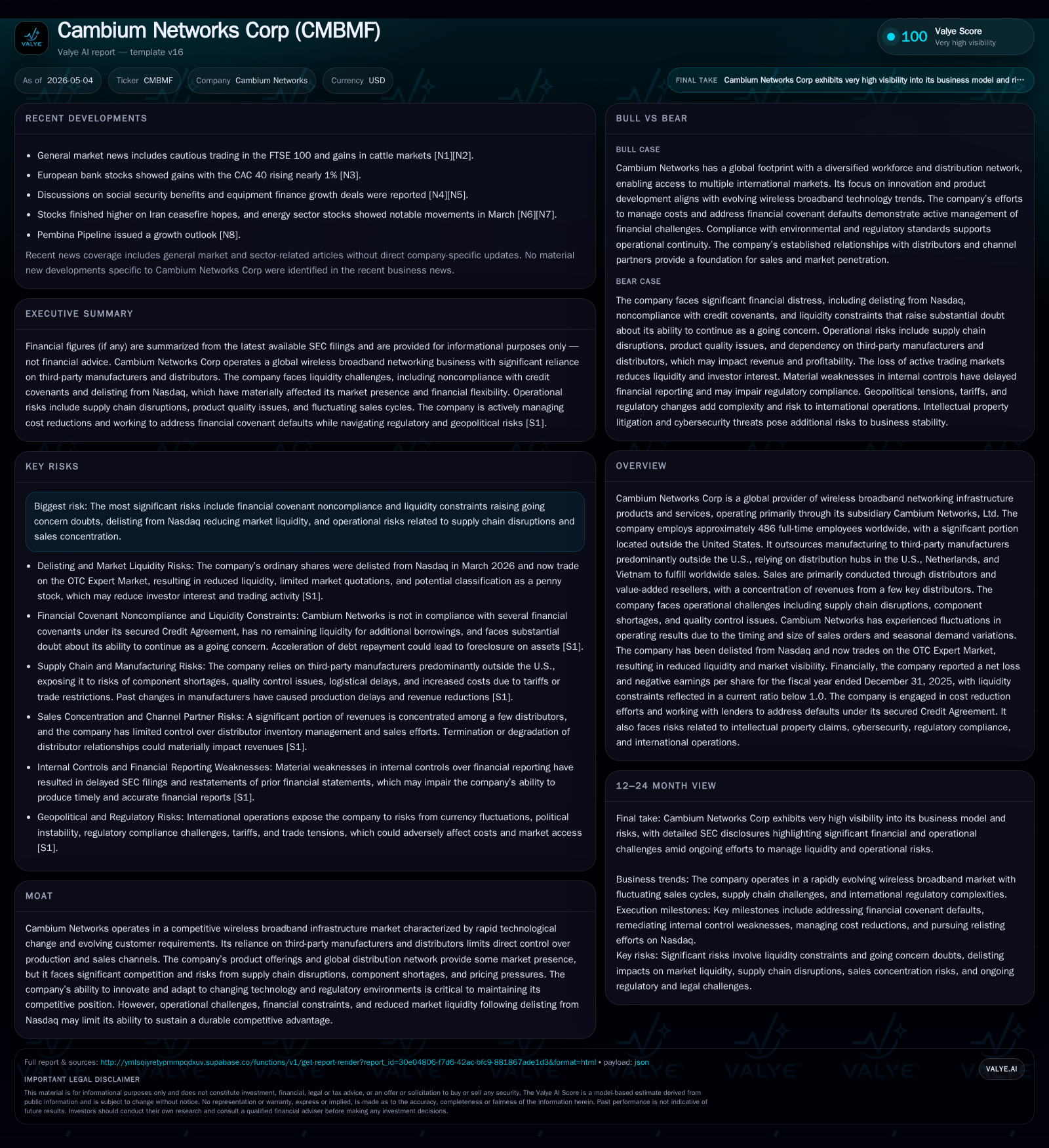
In its Q1 2026 report, Cambium Networks disclosed persistent defaults on credit covenants, raising going concern questions while simultaneously grappling with supply chain disruptions and operational delays. The company’s outsourced manufacturing model and concentrated distributor sales exacerbate its vulnerabilities. While new wireless technology adoption offers growth avenues, financial constraints and Nasdaq delisting risks loom large. Careful monitoring of covenant waivers, sales trends, and internal control remediation will be critical in assessing Cambium’s near-term trajectory.
Latest Quarterly Update Signals Elevated Financial and Operational Risks
Cambium Networks’ Q1 2026 10-Q filing marks a critical juncture for the company as it reports ongoing noncompliance with financial covenants under its credit agreement. These breaches have placed the company in default status, exposing it to significant risks including potential acceleration of $68.4 million in outstanding debt scheduled to mature in November 2026 [S2][S4][S5]. Management disclosed active engagement with the lender to negotiate resolutions but highlighted uncertainty over regaining compliance. This precarious financial position is compounded by a formal Nasdaq delisting notice received in March 2026 following prolonged failure to meet listing standards, notably timely SEC filings—a factor further suppressing Cambium’s market access and investor liquidity [S3][S18].
Operationally, Cambium continues to struggle with supply chain disruptions and component shortages impacting product delivery schedules. Its heavy dependence on third-party manufacturers predominantly located outside the U.S., alongside distribution hubs dispersed between the U.S., the Netherlands, and Vietnam, introduces latency and quality control complexities that impede agility in meeting fluctuating demand [S1][S19]. These bottlenecks feed into uneven revenue recognition tied to distributor order timing.
Business Model and Product Offering Overview
Cambium Networks operates by developing wireless broadband networking infrastructure equipment that is sold primarily through an indirect channel comprising distributors and value-added resellers (VARs), rather than directly engaging end customers [S1]. The company outsources manufacturing activities globally, relying on third-party vendors for production capacity which limits its direct control over lead times and quality assurance processes. This outsourcing strategy enables cost management flexibility but renders Cambium susceptible to supplier performance variability.
The revenue model hinges on product volume shipments driven by network operators upgrading or expanding wireless access solutions—including fixed wireless broadband (FWB) products across sub-7 GHz bands as well as mmWave technologies—and emerging licensed spectrum solutions [S1][F1]. Notably, top-tier distributors account for roughly one-third of revenues, reflecting concentrated buyer risk where contract terminations or diminished orders from these partners could severely disrupt cash flow [S17]. The presence across multiple distribution centers also adds logistical complexity but aims at enhancing global fulfillment capabilities.
Industry Dynamics and Competitive Positioning
Cambium’s competitive arena features several specialized players such as Ubiquiti, Tarana Wireless, Airspan Networks (in Citizens Broadband Radio Service bands), Ericsson, Nokia, Baicells Technologies, among others that compete across various segments including unlicensed Wi-Fi bands and licensed point-to-point or point-to-multipoint wireless solutions [S9][S23]. This sector is characterized by rapid technology evolution requiring constant innovation investment to maintain relevance.
The company faces intense pricing pressure due to commoditization trends heightened by supply chain-induced cost volatility. Additionally, frequent patent litigation activity typical in the Wi-Fi ecosystem induces operational risk exposure and cost uncertainty. Regulatory mandates including environmental compliance (e.g., EU’s RoHS/WEEE directives) add incremental complexity without yet significantly burdening profitability but requiring ongoing adjustments to product design and sourcing practices [S14][S28].
Growth Opportunities and Enablers
Structural demand drivers include increasing global demand for affordable high-speed wireless broadband access—especially in underserved regions—and migration towards next-generation connectivity standards such as Wi-Fi 7 or expanded CBRS deployments [S1]. Cambium’s established global distributor networks provide channels for broadening penetration geographically.
Innovation remains critical despite constrained resources due to financial stress; cost reduction initiatives have necessitated deferral or scaling back of some research programs potentially slowing product refresh cycles [S4][S5]. Effective leveraging of existing channel relationships may provide some near-term growth levers if market conditions stabilize.
Key Risks and Constraints on Expansion
The company’s default status on credit facility covenants significantly narrows operational latitude by restricting capital allocation choices—in effect mandating strict cost containment potentially at the expense of essential R&D investment supporting future competitiveness [S4][S5]. Liquidity constraints impose practical limits on working capital needed for inventory build-up to smooth order fulfilment.
Nasdaq delisting reduces visibility to institutional investors while raising questions about long-term access to equity capital markets. Combined with a highly concentrated distributor base—where loss or weakening of a few major partners could precipitate sharp revenue declines—and unpredictable supply chain dynamics aggravated by geopolitical tensions (e.g., tariffs or export restrictions), these factors conspire to confine growth prospects within a narrow corridor absent swift remediation [S17][S26].
Furthermore, legacy internal control weaknesses causing delayed SEC filings threaten regulatory compliance consistency impacting stakeholder confidence [S6]. The legal landscape poses additional downside risk from intellectual property disputes commonplace in this technology sector [S9][S20].
Near-Term Catalysts and Monitoring Milestones
Investors should closely track developments around covenant waiver negotiations with lenders ahead of the credit agreement maturity date looming in Q4 2026 —a definitive liquidity stress test point [S2][S4]. Quarterly sales trends reported through indirect channels will shed light on demand stability or erosion amid ongoing operational challenges.
Progress on internal controls remediation efforts influencing timely regulatory reporting will be critical for restoring transparency and market trust—a prerequisite for potential relisting or alternative financing arrangements [S6][S3]. Updates from key distributors regarding order pipelines can signal changes in end-user adoption patterns helping forecast revenue trajectory.
Financial Snapshot: Liquidity, Leverage, and Covenant Compliance
| Metric | Value | Period |
|---|---|---|
| Current assets | $91mm | |
| 2025-12-31 | ||
| Current liabilities | $137mm | |
| 2025-12-31 | ||
| Current ratio | 0.66x | |
| 2025-12-31 |
Source: SEC companyfacts cache [F1].
Management commentary aligns closely with this picture; their disclosures confirm cash flow challenges forcing deferral of spend initiatives alongside exploring capital solutions including potential refinancing or restructuring options while working intensively with lenders on covenant matters [S4][S5].
This report is an analytical summary based solely on public regulatory filings dated through May 2026 related to Cambium Networks Corp. It is intended for informational purposes without offering investment advice.
Disclaimer: This is research-only, informational analysis and not investment advice. It may include AI-generated interpretation and general industry context. Always verify important details using primary sources.

Comments