
Cambium Networks Surfaces Challenges and Strategic Responses in Latest Quarter
Cambium’s latest 10-Q reveals critical supply chain disruptions, financial covenant breaches, and the company’s strategic efforts to stabilize operations amid industry pressures.
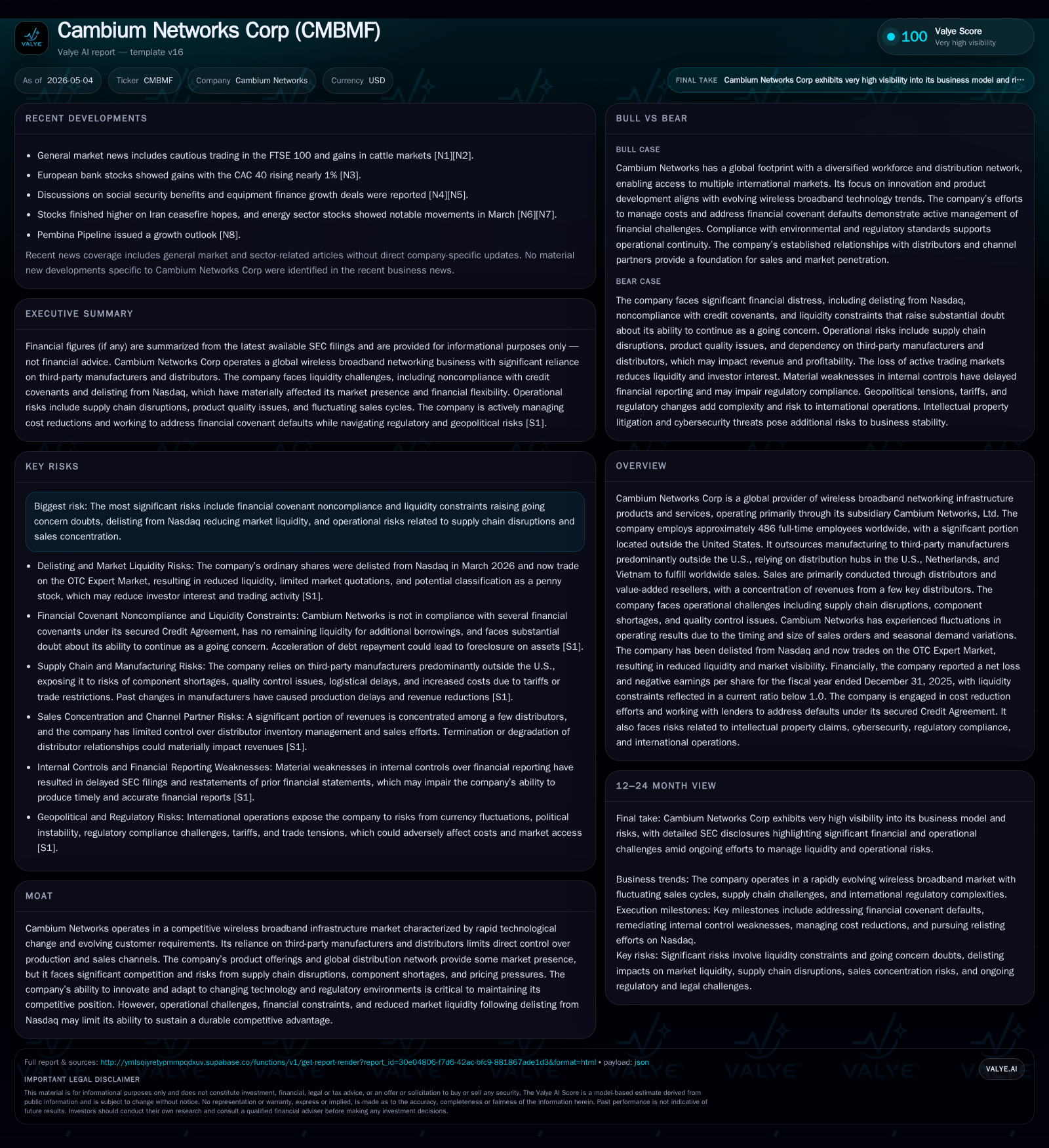
Cambium Networks reported significant operational headwinds in its April 2026 quarterly filing, notably supply chain bottlenecks and delayed shipments impacting seasonality. The company remains out of compliance with financial covenants, intensifying liquidity pressures and raising doubts about its going concern status. Its business model relies heavily on outsourced manufacturing and distributor channels, which amplifies exposure to component shortages and sales concentration risks. While innovation and geographic distribution expansion provide growth avenues, substantial risks persist around liquidity, production consistency, and market competition.
Latest Quarterly Operating Update: Immediate Pressures and Performance
Cambium Networks’ 10-Q filing dated April 30, 2026 ([S2]) paints a detailed picture of pressing operational challenges that are materially shaping near-term performance. The company continues to wrestle with global supply chain disruptions causing delays in component availability. These bottlenecks have led to timing mismatches in sales orders where fluctuating demand seasonality combines with variable order sizes to produce quarter-to-quarter volatility. Management disclosed ongoing noncompliance with several restrictive covenants including timely SEC filings. This failure has triggered defaults with their lender, exacerbating liquidity constraints and raising substantial doubt over the company’s ability to continue as a going concern.
The situation has catalyzed urgent engagement with the lender aimed at negotiating waivers or restructuring terms, but no definitive resolution was confirmed in this quarter’s disclosure. The looming maturity of amounts due under the credit facility in November 2026 places further pressure on management to execute corrective actions promptly ([S4], [S5], [S6]). Furthermore, Cambium’s delisting from Nasdaq announced earlier reinforces the worsening market perception and constrains capital access ([S3]).
Business Model Overview: Wireless Broadband Solutions Architecture
Cambium operates primarily through its subsidiary Cambium Networks Ltd., specializing in wireless broadband networking infrastructure products – including fixed wireless broadband equipment across licensed and unlicensed spectrum bands ([S1]). The company has adopted an asset-light strategy leveraging third-party offshore manufacturing partners chiefly in Asia to produce hardware components. These finished goods flow through distribution hubs located strategically in the U.S., Netherlands, and Vietnam enabling worldwide order fulfillment ().
Revenue generation hinges largely on sales through distributors and value-added resellers (VARs), who represent the interface to network operators and service providers globally ([S1],). A notable risk emerges from this structure: sales concentration is material as over 30% of revenues stem from the top three distributors, making Cambium sensitive to their purchasing patterns or relationship fluctuations ([S17]). Moreover, distributor agreements lack minimum purchase commitments or exclusivity clauses, limiting Cambium’s visibility into end-user demand trends or channel inventory – thereby amplifying forecasting challenges.
This indirect selling approach dilutes direct control over pricing power and customer service touchpoints but offers scale efficiencies in deploying products across international markets without heavy internal sales footprint expansion.
Product and Service Quality Amid Supply Chain Constraints
Despite Cambium's emphasis on relentless innovation within its product portfolio ([S1]), recent filings repeatedly emphasize the adverse effects of ongoing component shortages disrupting production cadence (,[S25]). The outsourcing model means quality control must be closely managed through third-party manufacturers who may face their own capacity or supplier constraints.
Logistics complexity also arises from reliance on third-party warehousing and distribution providers responsible for inventory accuracy and timely shipments to channel partners ([S10],[S25]). Any shortcomings here risk delayed deliveries that could erode customer satisfaction or brand reputation. This is particularly critical given that service providers expect consistent network equipment rollout schedules for planned deployments.
Product mix shifts mandated by redesigns due to unavailable preferred components further add cost pressures or complicate manufacturing scalability ([S25]). Such factors collectively temper the achievable gross margins on Cambium’s solutions.
Industry Competitive Environment and Market Positioning
Within the wireless broadband infrastructure space—a rapidly evolving technology domain—Cambium faces formidable competitors ranging from specialized innovators like Ubiquiti Networks to large-scale incumbents such as Nokia, Ericsson, Airspan Networks, and Ceragon ([S1],,[S26]). Competitors often hold deeper patent portfolios which confer leverage in intellectual property disputes or technology licensing negotiations ([S23]).
Regulatory complexity also characterizes the landscape: navigating spectrum allocations (unlicensed sub-7 GHz versus Citizens Broadband Radio Service at 3.5 GHz), compliance with environmental laws (RoHS/WEEE directives) and adapting product architectures accordingly creates ongoing R&D demands ([S14],[S28]). Delisting from Nasdaq has further reduced Cambium's public capital market profile hindering its ability to raise funds competitively—thus impacting investment capacity relative to peers ([S3],).
The competitive intensity drives pricing pressure risks compounded by distributor preference shifts towards rival solutions offering perceived superior features or price points ([S17]). Cambium’s success depends on balancing innovation velocity while maintaining supply reliability—an increasingly difficult feat amid global component shortages.
Growth Catalysts: Innovation, Distribution Expansion, and Market Penetration
Historically, new product introductions tied closely to emerging network operator requirements have been key revenue growth drivers for Cambium ([S1],). The firm's push into millimeter wave (60GHz) product lines alongside traditional fixed wireless broadband segments aims at expanding addressable markets.
Geographic diversification efforts through expanded distribution hubs underpin scalable global penetration—with half of revenues sourced outside the U.S. as of 2025 ([S19]). Strategic investments targeting Asia-Pacific, EMEA regions seek to mitigate overreliance on particular markets.
Further concentration of sales among few distributors increases vulnerability if channel relationships degrade or lose major end customers.
Legal risks also emerge from ongoing intellectual property litigations common in telecommunications hardware space alongside indirect reputational impact resulting from repeated SEC filing delays owing to material internal control weaknesses reported since late 2024 ([S7],[S16]).
Monitoring Key Milestones: What Investors Should Watch Next
Future developments worth scrutinizing include:
- Updates on negotiations or resolutions pertaining to credit covenant breaches—any agreement extension or refinancing moves will be pivotal ([S2],[S3])
- Progress restoring timely SEC filings indicating improved internal control remediation efforts should reduce compliance risk pressure ([S2])
- Improvements in supply chain stability evidenced by normalized production/revenue timing patterns reflecting mitigation of component sourcing issues
- Announcements regarding contract wins with key distributors or network operators signaling sustained demand traction despite competitive dynamics.
- Development pipeline activity revealing successful commercialization of differentiated solutions supporting future growth targets.
These milestones collectively form critical checkpoints for assessing Cambium’s capacity to navigate current turbulence toward operational normalization.
Financial Status Summary: Liquidity, Leverage, and Profitability Snapshot
Latest financial snapshot
| Metric | Value | Period |
|---|---|---|
| Current assets | $91mm | |
| 2025-12-31 | ||
| Current liabilities | $137mm | |
| 2025-12-31 | ||
| Current ratio | 0.66x | |
| 2025-12-31 |
Source: SEC companyfacts cache [F1].
A snapshot of Cambium's financial condition as of its last fiscal year ending December 31, 2025 shows:
| Metric | Value | Date |
|---|---|---|
| Current Assets | $90.7 million | |
| 2025-12-31 | ||
| Current Liabilities | $137.4 million | |
| 2025-12-31 | ||
| Total Debt | $68.4 million | |
| 2024-06-30 | ||
| Operating Income | -$27.96 million | |
| 2025-12-31 | ||
| Net Income | -$38.54 million | |
| 2025-12-31 |
These figures reveal a current ratio near 0.66 indicating notable short-term liquidity strain amid liabilities surpassing assets significantly. Net debt remains elevated reflecting ongoing leverage pressures combined with sustained operating losses highlighting cash consumption challenges ([F1]). The constrained financial flexibility underscores the urgency behind cost containment measures management has pursued alongside seeking lender cooperation for covenant cure strategies.
Disclaimer: This analysis is based solely on information available as of May 2026 from SEC filings, company facts [F1], and referenced news sources. It is intended as an informational review without investment advice or recommendations.
Disclaimer: This is research-only, informational analysis and not investment advice. It may include AI-generated interpretation and general industry context. Always verify important details using primary sources.

Comments