
Talkspace Enters Definitive Merger Agreement with Universal Health Services, Signaling Strategic Shift
Talkspace's March 2026 merger agreement with Universal Health Services marks a key transition as it prepares to become a wholly owned subsidiary, reflecting evolving dynamics in digital mental health services.
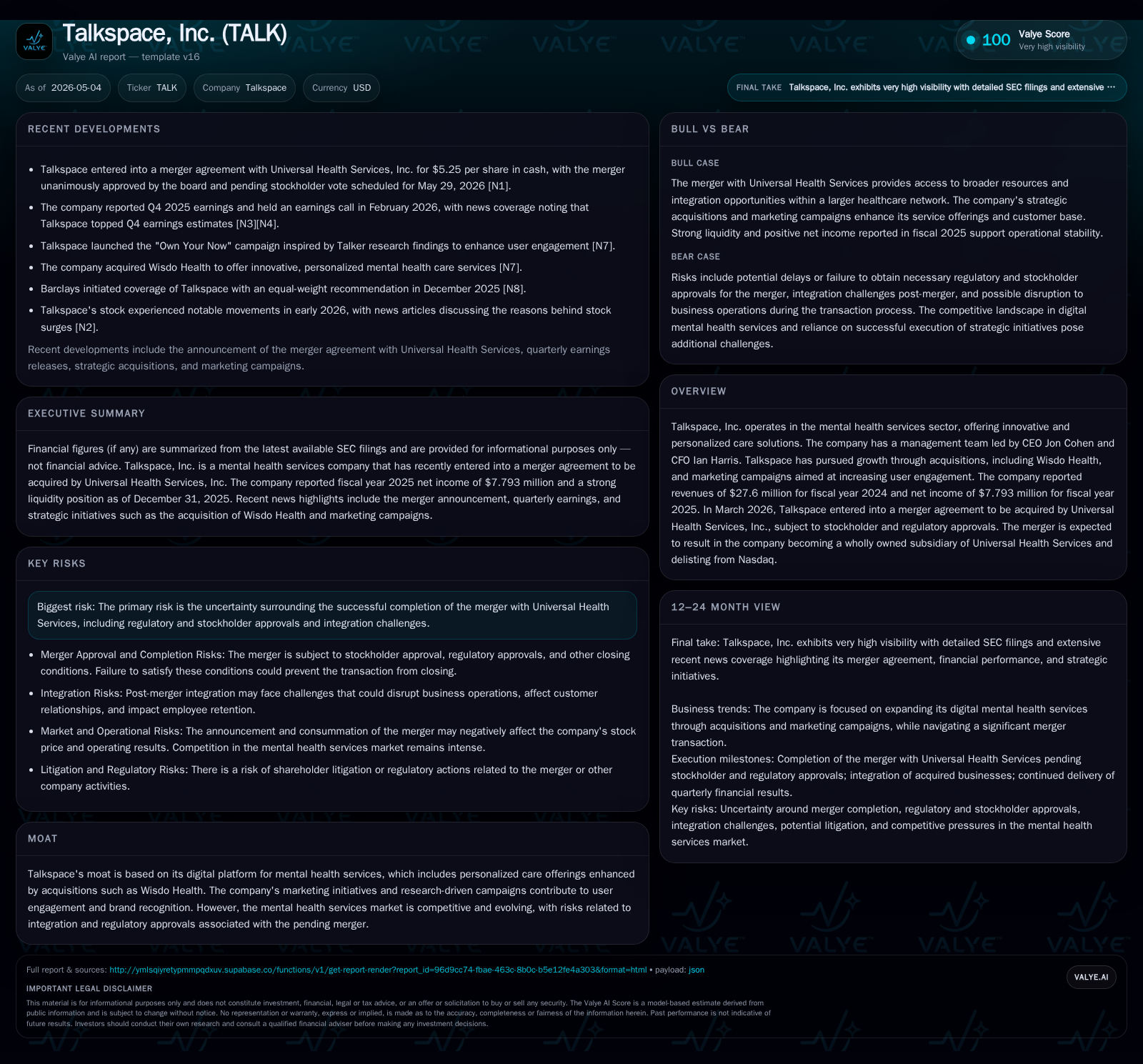
In March 2026, Talkspace agreed to be acquired by Universal Health Services (UHS), which will result in Talkspace becoming an indirect wholly owned subsidiary and delisting from Nasdaq. The transaction follows recent quarterly disclosures that highlight Talkspace’s subscription-based digital therapy platform and strategic acquisition of Wisdo Health to enhance peer support capabilities. Growth drivers include platform innovation, expansion into employer and payer markets, and integration of AI tools for personalized care. Risks center on merger execution, regulatory approvals, integration complexities, and competitive pressures. Financially, the company maintains strong liquidity with $37.4 million in cash and minimal debt, alongside improving profitability metrics [S3][S2][F1].
Recent Merger Agreement Marks Strategic Ownership Transition
On March 9, 2026, Talkspace entered into a definitive merger agreement with Universal Health Services (UHS), under which Talkspace will become an indirect wholly owned subsidiary following the closing of the transaction [S3][S16]. Each share of Talkspace common stock will convert into $5.25 in cash at the effective time of the merger, subject to customary closing conditions including stockholder approval and regulatory clearances such as federal antitrust laws and state healthcare regulations [S3][S23][S25]. Upon closing, Talkspace’s securities will be delisted from the Nasdaq Global Select Market [S3], ending its public trading status.
The agreement includes standard "no-shop" provisions limiting competing bids but permits termination for superior offers subject to substantial termination fees payable to UHS if invoked [S25]. While this transaction validates the strategic value of Talkspace’s digital mental health platform within a larger healthcare ecosystem, risks remain around regulatory approval timing and successful integration without disrupting ongoing business operations or losing key management focus and personnel [S6].
Business Model: Subscription-Based Digital Mental Health Platform
Talkspace primarily generates revenue through subscriptions for its digital therapy services delivered via an online platform connecting users with licensed therapists through text, video, or audio communication channels [S1]. Its customer base includes individual consumers alongside partnerships with employers and healthcare plans seeking accessible mental health solutions.
The October 2025 acquisition of Wisdo Health adds an AI-driven social health and peer support dimension to Talkspace’s offerings designed to increase patient engagement beyond traditional teletherapy modalities [S19][S24]. This move reflects a strategic emphasis on enhancing client interaction throughout the care continuum.
Service quality is anchored on combining licensed clinician access with AI-enabled personalized care pathways. Marketing efforts target increased user adoption backed by research highlighting efficacy and convenience; renewal rates and engagement metrics are critical KPIs driving unit economics [S1].
Industry Context: Competitive Pressures and Regulatory Environment
Operating in a rapidly growing yet fragmented digital mental health market, Talkspace faces competition from direct-to-consumer platforms such as BetterHelp, employer wellness programs, and integrated telehealth vendors embedded within electronic health records systems. Pricing power remains limited due to payer demands for cost-effective solutions amid stringent data privacy regulations (e.g., HIPAA compliance) that increase operational costs.
Differentiation stems from Talkspace’s blended human-AI engagement strategy along with community-based peer support introduced via Wisdo Health assets. However, customer retention requires continuous investment in platform usability improvements and therapist network quality amid relatively low switching barriers.
Margins are pressured by competitive pricing models coupled with ongoing investments in user acquisition campaigns. Additionally, cross-state licensure requirements for therapists introduce regulatory complexity when expanding geographically [S1].
Growth Drivers: Innovation, M&A Synergies & Market Penetration
Key growth levers include organic subscriber growth driven by increasing societal acceptance of digital mental health care accelerated by COVID-19 normalization trends. Enhanced product features integrating AI-powered support aim to boost engagement levels and extend subscriber lifetime value.
The Wisdo Health acquisition complements organic growth by introducing community-based support features that can improve retention—a recognized challenge in behavioral health platforms [S24]. Strategic marketing initiatives target rising employer interest in mental wellness benefits as part of employee retention strategies.
Expanding penetration into employer-sponsored health plans broadens distribution channels beyond individual consumers enabling scale economies. Repeat contracts with payers leveraging outcome-based reimbursement frameworks further diversify recurring revenue streams [S1].
Risks: Regulatory Approvals & Integration Execution
Primary risks include uncertainty around merger closing due to potential delays or failure in obtaining regulatory approvals given healthcare service consolidation concerns under antitrust scrutiny [S6][S23]. Failure or postponement could negatively impact market confidence.
Integration risks involve cultural alignment challenges, IT system harmonization delays, management distraction from core operations impacting growth momentum or customer experience quality. Retention of key executives critical for transition success is uncertain post-acquisition given shifting incentives.
Potential regulatory conditions imposed as part of approval could restrict operational flexibility after closing. Competitive pressures persist as new entrants innovate rapidly; pricing compression risk may intensify absent strong differentiation. Data privacy breaches or compliance lapses could damage reputation materially.
Upcoming Milestones & Market Signals to Monitor
Investors should watch forthcoming proxy statement filings ahead of the shareholder vote which will detail merger terms including termination rights, voting agreements with major shareholders, and any conflicts of interest disclosures [S17][S18].
Regulatory updates regarding antitrust clearance will provide timing signals for anticipated closing dates. The initial post-merger earnings releases will serve as critical indicators of integration success alongside subscriber growth following Wisdo Health assimilation [S8][S9].
Disclosure on executive transitions or hiring trends may signal organizational stability or emerging risks affecting operational outlook.
Financial Snapshot: Strong Liquidity & Improving Profitability
Latest financial snapshot
| Metric | Value | Period |
|---|---|---|
| Cash & equivalents | $37.35 million | |
| 2025-12-31 | ||
| Current assets | $111.06 million | |
| 2025-12-31 | ||
| Current liabilities | $17.40 million | |
| 2025-12-31 | ||
| Current ratio | 6.38x | |
| 2025-12-31 |
Source: SEC companyfacts cache [F1].
The balance sheet shows robust liquidity with cash & equivalents totaling $37.35 million against minimal debt (~$200 thousand last reported), resulting in a current ratio exceeding 6x as of year-end 2025—indicating strong short-term financial flexibility during this ownership transition [F1].
| Metric | Value | Period Ending |
|---|---|---|
| Revenue | $27.6 million | |
| 2024-12-31 | ||
| Operating Income | $3.15 million | |
| 2025-12-31 | ||
| Net Income | $7.79 million | |
| 2025-12-31 |
This analysis is based solely on publicly available SEC filings up to May 2026 and current financial data consistent with company disclosures; it does not constitute investment advice.
Disclaimer: This is research-only, informational analysis and not investment advice. It may include AI-generated interpretation and general industry context. Always verify important details using primary sources.

Comments