
Air Lease Corp Transitions Under New Ownership with Strategic Leadership Shift
The completion of Air Lease Corp’s merger into Sumisho Air Lease Corporation ushers in a new governance regime and consolidates institutional backing, reshaping its aircraft leasing platform.
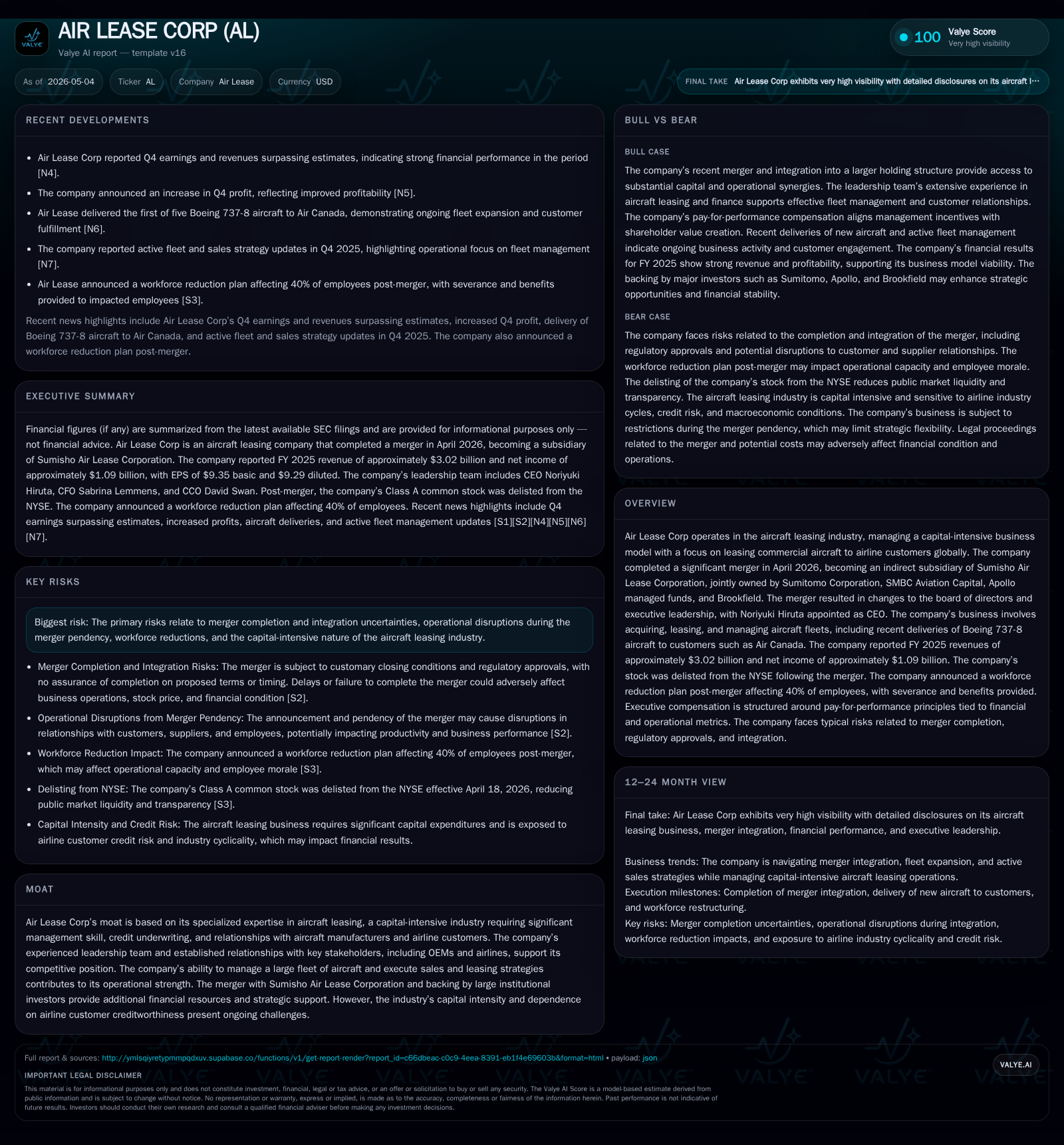
Air Lease Corp finalized its merger on April 8, 2026, becoming an indirect subsidiary of Sumisho Air Lease Corporation, an entity jointly owned by Sumitomo Corporation, SMBC Aviation Capital, Apollo funds, and Brookfield. This transaction triggered a complete board and executive overhaul, installing Noriyuki Hiruta as CEO—reflecting the integrated strategic vision under new ownership. The company’s core business of commercial aircraft leasing remains capital-intensive and reliant on strong airline customer credit profiles. Post-merger, Air Lease benefits from enhanced financial resources and operational scale but faces integration challenges including workforce reductions and operational realignment. Going forward, fleet management execution, merger synergy realization, and sector-specific demand trends will dictate growth trajectories within this competitive environment.
Merger Completion and Corporate Structure Overhaul
On April 8, 2026, Air Lease Corporation completed its strategic merger into Sumisho Air Lease Corporation (formerly Gladiatora DAC), transitioning from a publicly traded entity to an indirect subsidiary controlled by a consortium comprising Sumitomo Corporation (approximately 47.5% voting power), SMBC Aviation Capital (roughly 5%), Apollo managed funds (23.75%), and Brookfield (23.75%) [S3][S7][S11]. This restructuring was marked by immediate removal of the existing Board of Directors and appointment of new directors including Noriyuki Hiruta as CEO—a seasoned aviation leasing executive with extensive experience at Sumitomo and SMBC Aviation Capital [S1]. The NYSE delisted both Air Lease’s Class A common stock and certain medium-term notes effective April 18, formally ending its independent public listing [S3][S25].
The consolidation enhanced governance cohesiveness under the collective institutional owners who also installed David Swan as Chief Commercial Officer and Sabrina Lemmens as Chief Financial Officer—executives drawn from affiliated aviation leasing backgrounds poised to drive integration synergy [S1]. The transaction value was approximately $28.2 billion inclusive of debt assumption or refinancing, reflecting the capital intensity intrinsic to this industry segment [S12].
Business Model Dynamics and Fleet Management
Air Lease Corp’s economic engine is rooted in acquiring commercial aircraft primarily from OEMs like Boeing and Airbus followed by long-term leasing to global airline customers under structured leaseback arrangements [S1]. Revenue arises chiefly from lease rentals paid by airlines which directly reflect contract volume (number of aircraft leased), pricing mechanics aligned with aircraft type and age (notably Boeing 737-8 deliveries to major carriers such as Air Canada), usage patterns, and credit terms negotiated [S1][F1]. Managing asset lifecycle risk—including residual values—and underwriting airline creditworthiness remain critical to profitability.
This model necessitates extensive capital deployment supported by a balanced debt portfolio—with total debt reported at nearly $19.86 billion year-end 2025 mitigated by $466 million cash balances—and continuous reinvestment in fleet acquisitions [F1][S5]. The company’s approach blends new aircraft orderbook management (with current undelivered orders acquired by SMBC AC post-merger) alongside active trading and remarketing assets to optimize returns [S12][S26].
Industry Positioning amidst Capital-Intensive Competition
The aircraft leasing industry features formidable entry barriers driven by scale capital needs—multiple billions for fleet buildup—and complex credit evaluation expertise related to airline customer risk amidst cyclical industry volatility [S1]. Air Lease’s key advantage lies in its operational specialization spanning asset acquisition, technical asset management through servicing agreements administered via SMBC AC for international leases, and established OEM relationships bearing on negotiating favorable purchase terms [S17][S21].
Post-merger consolidation situates Air Lease within a powerful ecosystem leveraging capital pools managed by entities experienced in aviation finance (Sumitomo, Apollo) supporting more robust liquidity access relative to standalone competitors [S7]. Pricing power is modulated however by airline credit quality—susceptible to geopolitical shocks or fuel price volatility—which directly influences lease demand elasticity in this structurally cyclical sector [S1].
Growth Drivers Aligned With Post-Merger Strategy
Growth prospects hinge on the enlarged scope afforded by the merged balance sheet enabling accelerated fleet expansion funded through newly arranged senior notes totaling several billion dollars maturing between 2028–2036 at competitive coupon rates (~4.4%–5.5%) [S17]. Geographic reach extends through combined customer bases across North America, Europe, Asia-Pacific enhancing diversification.
Innovation initiatives under CEO Hiruta involve refinements in lease structures incorporating sustainability considerations responding to evolving regulatory environments emphasizing environmental compliance in aviation fleets [S1]. Sale-leaseback transactions with airlines recovering post-pandemic air travel volumes represent near-term activity areas leveraging sector recovery dynamics. Enhanced stewardship over orderbook transfers provides flexibility for opportunistic asset placement post consolidation [S12][S26].
Operational Risks and Merger Integration Challenges
While merger completion de-risks transactional uncertainty observed throughout late 2025 filings [S2], integration poses tangible risks: workforce reductions planned comprise a notable ~40% headcount cut affecting 64 employees with attendant severance costs stretching through Q3 2026; such contraction risks temporary disruption in client servicing functions pivotal for lease administration continuity [S14][S25].
Furthermore, reliance on airline lessee creditworthiness exposes the firm to macroeconomic headwinds including fuel shocks or travel disruptions which could impair lease renewals or trigger early terminations [S1][S2]. Regulatory approvals proved complex pre-close highlighting ongoing diligence demands for future cross-border transactions. Debt portfolio constraints necessitate vigilant covenant compliance given sizable leverage despite some deleveraging actions around loan repayments totaling $3 billion pre-merger close [S5].
Forward-Looking Milestones and Strategic Watchpoints
Critical near-term focal points comprise monitoring operational stabilization under new governance complemented by full realization of targeted synergies articulated during merger announcement phases [S3][S7]. Upcoming announcements regarding fleet renewal programs—especially those involving next-generation Boeing models—are anticipated as key demand markers.
Financially, attention centers on performance against newly assumed credit agreements governing $4 billion+ revolving credit facilities and multi-tranche senior note liabilities requiring disciplined liquidity management and access to capital markets if refinancing needed beyond 2030 horizons [S17][S26]. As a non-public subsidiary now, external guidance remains limited necessitating reliance upon periodic releases for performance visibility.
Macroeconomic signals around global air traffic recovery trends will serve as bellwethers for lease utilization rates and pricing resiliency impacting volume growth potential.
Current Financial Snapshot and Capital Structure Summary
Latest financial snapshot
| Metric | Value | Period |
|---|---|---|
| Cash & equivalents | $466mm | |
| 2025-12-31 | ||
| Total debt | $19.9bn | |
| 2025-12-31 | ||
| Net debt | $19.4bn | |
| 2025-12-31 |
Source: SEC companyfacts cache [F1].
| Metric | Value (USD) |
|---|---|
| Revenue | $3.02 billion |
| Net Income | $1.09 billion |
| Cash & Equivalents | $466 million |
| Total Debt | $19.86 billion |
| Net Debt | Approx. $19.4 billion |
At December 31, 2025 year-end preceding merger execution, Air Lease reported revenues hitting approximately $3.02 billion alongside net income near $1.09 billion supported by rigorous lease portfolio management [F1]. The company maintained a significant gross debt load nearing $20 billion offset marginally by cash balances underscoring ongoing reliance on leverage inherent to capital-intensive aircraft leasing operations [F1]. Prior to closing the merger deal in April 2026, approximately $3 billion in loan obligations were repaid signaling beginning deleveraging efforts under new ownership frameworks [S5].
This analysis is based exclusively on documented SEC filings and current publicly available data without extrapolation beyond provided evidence. No investment advice or recommendations are offered herein.
Disclaimer: This is research-only, informational analysis and not investment advice. It may include AI-generated interpretation and general industry context. Always verify important details using primary sources.

Comments