
NWPX Infrastructure Expands Footprint Amid Rising Demand for Water Infrastructure Renewal
Latest quarterly filing highlights operational strength and growth driven by infrastructure replacement needs and strategic acquisitions.
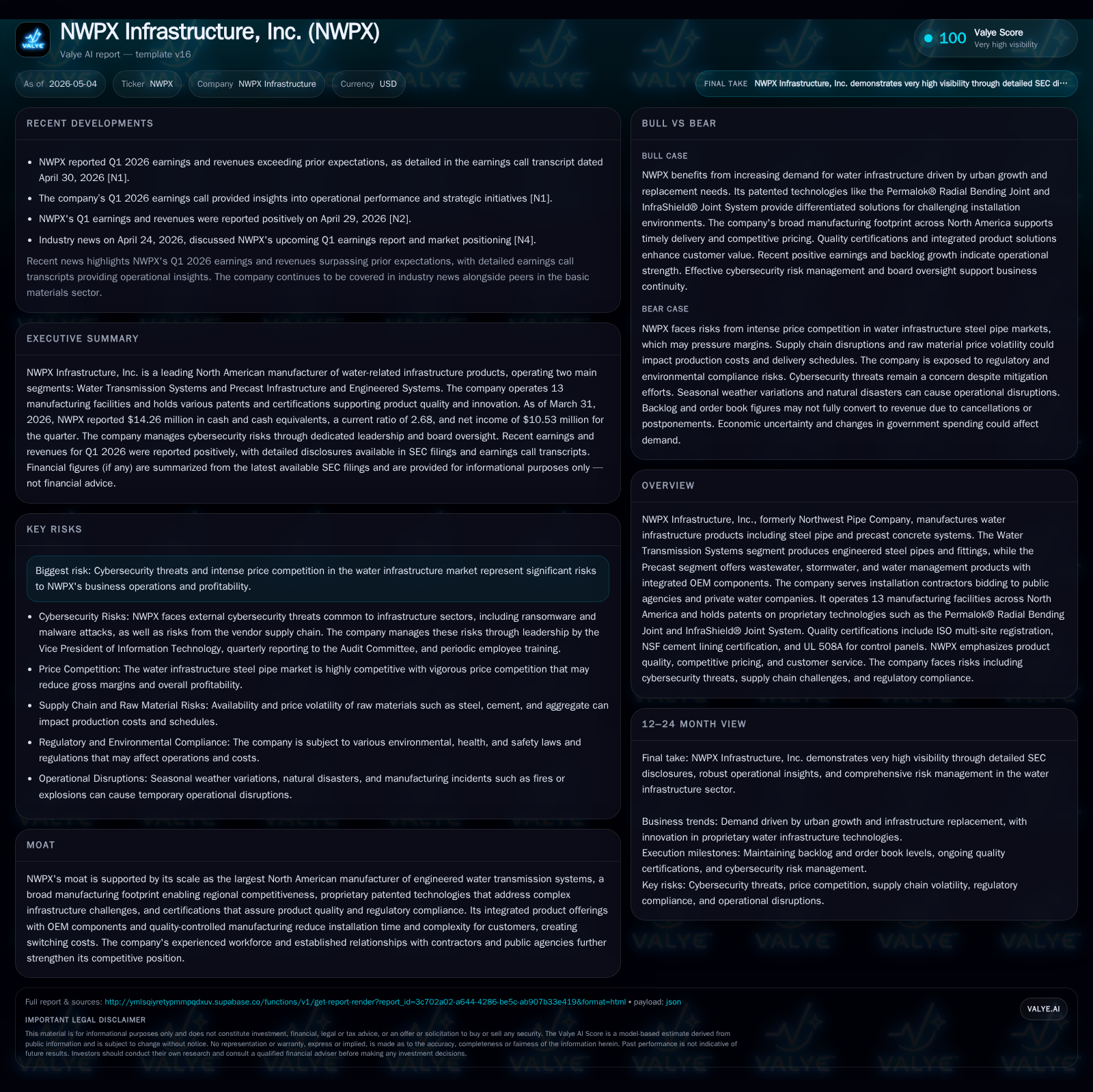
NWPX Infrastructure, Inc.'s Q1 2026 report confirms steady demand for its engineered steel pipe and precast concrete water infrastructure products, underpinned by critical aging water systems in North America. The company’s geographically diversified manufacturing footprint and patented technologies bolster its competitive moat against intense price competition. Strategic expansion through the acquisition of Boughton's Precast expands regional coverage in key growth markets. Risks persist from cybersecurity threats and regulatory uncertainty, though robust quality certifications and customer service support stability. Financially, NWPX maintains a solid liquidity position with a current ratio above 2.5 and net cash balance facilitating operational flexibility.
Recent Operating Update
The latest quarterly filing dated April 30, 2026 [S2] provides the most current operating insights into NWPX Infrastructure's business dynamics. The company reported robust order flow consistent with ongoing infrastructure replacement demand during aging water systems across the U.S. While specific segment revenue or profit details for Q1 have not been publicly itemized in the excerpts available, commentary from the accompanying April 29 earnings call release [S3][N1][N2] confirms earnings and revenue beats estimates, signaling operational resilience.
A notable strategic development was the acquisition completed earlier in 2026 of Boughton’s Precast facility in Pueblo, Colorado [S7]. This single-plant acquisition broadens NWPX's footprint in the stormwater and sanitary sewer product line within a growing regional market, complementing its existing Texas- and Utah-based precast operations.
The company maintains active engagement with federal infrastructure programs such as the EPA’s Water Finance Center and U.S. Department of Agriculture initiatives, positioning itself to capitalize on IIJA-backed spending targeted at upgrading critical drinking water systems.
Business Model
NWPX generates revenue through manufacturing and selling two principal product lines:
Water Transmission Systems (WTS): Engineered steel pipes, pipe fittings, and interlocking joint systems designed mainly for large-diameter, high-pressure pipeline uses. The WTS segment caters primarily to contractors bidding on public agency projects or private utilities.
Precast Infrastructure and Engineered Systems: This segment offers wastewater management products including reinforced concrete pipes (RCP), manholes, culverts, vaults, lift stations, oil-water separators, biofiltration units, among others—many incorporating OEM components fully integrated at manufacturing sites to reduce installation time.
Contractors are the primary direct customers who secure project bids from public or private entities. Pricing depends on competitive tenders influenced by material costs, project scope complexity, and delivery timelines. Volume fluctuations are tied closely to municipal budgets, regulatory-driven mandates for infrastructure upgrades, urban population growth necessitating new water capacity, and climate-induced events impacting stormwater management needs.
Margins rely on maintaining efficient manufacturing operations across NWPX's extensive network of thirteen North American facilities strategically located to minimize freight costs—a critical factor due to heavy bulk products—and leveraging patented technology that offers installation advantages.
Industry Structure and Competitive Position
The water infrastructure sector is fragmented yet intensely competitive especially within steel pipe manufacturing where price wars are commonplace [S21]. Geographic proximity to project sites is essential due to freight costs; NWPX's multi-site production in Oregon, California, Texas, West Virginia, Missouri, and Mexico allows it to compete effectively regionally.
Key competitors include West Coast Pipe in the western U.S. and southwestern Canada; Thompson Pipe Group, American SpiralWeld Pipe, and Mid America Pipe Fabricating & Supply operate more dominantly east of the Rockies.
NWPX differentiates itself through proprietary joint technologies such as Permalok® Radial Bending Joint—enabling steel pipes to curve smoothly during trenchless tunneling—and InfraShield® Joint System that mitigates seismic deformation without altering field installation processes [S19]. Quality certifications including ISO multi-site registration across production plants further reinforce its reputation for reliability amid stringent engineering standards.
The company's integration of OEM components within precast products reduces jobsite complexity—a significant value-add in fast-paced construction environments—and builds switching costs with contractors preferring hassle-free turnkey solutions.
Growth Drivers
Aging Infrastructure Replacement Demand
Much of America's water network built mid-20th century is reaching or exceeding useful life expectancy (75–100 years), resulting in frequent failures—estimated at ~240,000 annual main breaks causing $2.6 billion in repairs [S1]. This structural driver sustains medium-to-long term investment into upgrade or replacement pipelines where NWPX's engineered pipes fulfill critical roles.
Federal Investment Programs
Legislative endorsements like IIJA allocate substantial funds toward improving clean drinking water access via state/local grants administered through agencies such as EPA’s Water Finance Center [S7]. These initiatives facilitate capital projects favoring reliable vendors with broad geographic reach—advantaging NWPX's footprint expansion strategies including recent acquisitions.
Urbanization & Climate-Driven Regulations
Population growth in certain metro regions elevates demand for new infrastructure installation while climate change exacerbates flooding/stormwater management challenges that intensify precast product usage particularly in arid western states needing drought-resilient systems.
Technology Innovation & Product Differentiation
Patented joint solutions providing installation flexibility or seismic resistance increase contractor adoption rates by reducing labor/time costs onsite. Continual R&D investment aimed at welding automation and inspection enhances efficiency allowing NWPX to remain competitively priced despite raw material inflation pressures.
Risks & Watchpoints
Cybersecurity Threats
As an infrastructure supplier handling sensitive project data tied to public utilities [S1], cybersecurity remains an ongoing risk requiring vigilant protection measures overseen by executive leadership and board committees employing third-party assessments—any breaches could disrupt operations or damage customer trust.
Price Competition & Input Cost Volatility
Steel pipe markets experience vigorous bidding competition which can squeeze margins especially during periods of raw material cost spikes or logistics disruptions [S22]. Maintaining scale advantages through multiple plants helps mitigate some exposure but does not eliminate cyclic margin pressures.
Regulatory & Budgetary Uncertainty
Municipal spending delays or cuts driven by political decisions or macroeconomic conditions could affect project starts/timing harming sales visibility. Also evolving trade policies affecting cross-border supply chains (e.g., tariffs) add complexity.
Execution of Acquisitions & Integration Challenges
Expanding via bolt-on acquisitions like Boughton’s Precast requires smooth operational integration to realize projected synergies; missteps could impair financial metrics or distract management focus.
What To Watch Next
- Quarterly backlog updates signaling sustained booking momentum particularly post-acquisition integration progress.
- Impact analysis of potential upcoming federal/state funding legislation influencing capital expenditure cycles across served geographies.
- Updates on any cybersecurity incidents or technology rollout successes affecting operational continuity.
- Pricing trends relative to steel input cost fluctuations informing margin outlooks.
- New patent filings or product launches enhancing technological lead among competitors.
Financial Profile Snapshot (Q1 2026)
Latest financial snapshot
| Metric | Value | Period |
|---|---|---|
| Cash & equivalents | $14mm | |
| 2026-03-31 | ||
| Total debt | $12mm | |
| 2025-12-31 | ||
| Net debt | $-3mm | |
| 2025-12-31 | ||
| Current assets | $299mm | |
| 2026-03-31 | ||
| Current liabilities | $112mm | |
| 2026-03-31 | ||
| Current ratio | 2.68x | |
| 2026-03-31 |
Source: SEC companyfacts cache [F1].
| Metric | Value (USD) | Period Ended |
|---|---|---|
| Cash & Equivalents | 14,262,000 | |
| 2026-03-31 | ||
| Total Debt | 11,500,000 | |
| 2025-12-31 | ||
| Current Assets | 299,163,000 | |
| 2026-03-31 | ||
| Current Liabilities | 111,544,000 | |
| 2026-03-31 | ||
| Current Ratio | 2.68 | |
| 2026-03-31 | ||
| Net Debt (Approx.) | -2,762,000 | |
| 2025-12-31 |
This snapshot reveals a strong liquidity buffer with current assets far exceeding liabilities supporting operating needs even amid volatile market conditions [F1]. The company’s net cash position suggests conservative leverage usage enabling flexibility for capital investments or further acquisitions.
Disclaimer: This analysis is provided solely for informational purposes without any express or implied investment advice.
Disclaimer: This is research-only, informational analysis and not investment advice. It may include AI-generated interpretation and general industry context. Always verify important details using primary sources.

Comments