
Apollo Commercial Real Estate Finance Advances Portfolio Management After $8.6 Billion Asset Sale
ARI’s recent $8.6 billion loan portfolio sale to Athene signals a strategic shift toward balance sheet optimization and disciplined capital management.
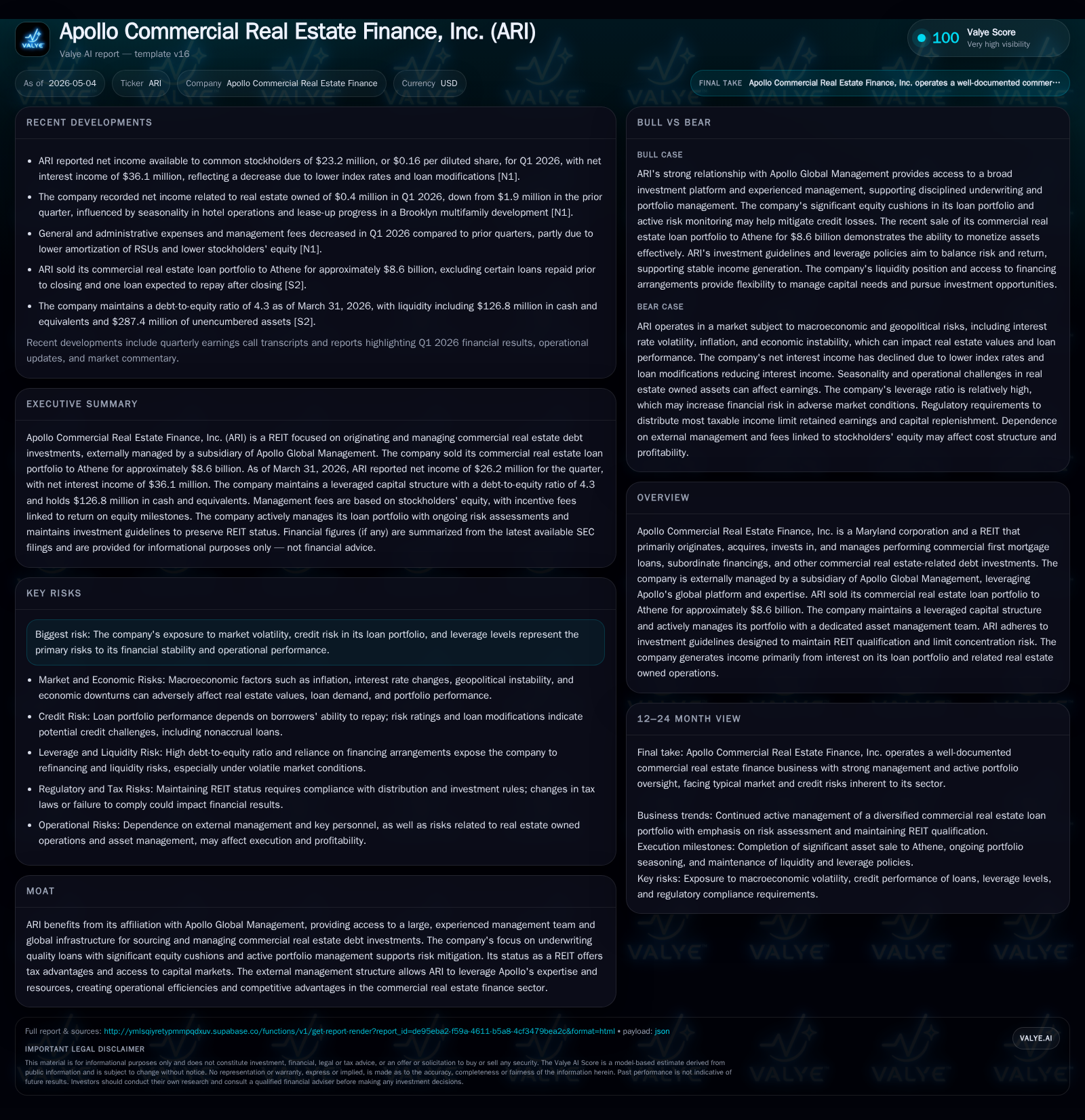
In Q1 2026, Apollo Commercial Real Estate Finance, Inc. (ARI) undertook a substantial asset sale, offloading approximately $8.6 billion in commercial real estate loans to Athene, reshaping its capital structure and liquidity position. The company actively repurchased nearly 2.9 million common shares, signaling confidence amid operational recalibration. ARI’s external management by an Apollo subsidiary leverages global sourcing and underwriting expertise, focusing on commercial mortgage loans with strong equity cushions for risk mitigation. While credit and market volatility risks persist, the REIT’s investment guidelines, disciplined leverage policies, and access to diverse financing sources underpin its competitive positioning in commercial real estate finance.
Q1 2026 Operating Update: Repurchases and Portfolio Rebalancing
Apollo Commercial Real Estate Finance completed a landmark transaction shortly after the end of Q1 2026: the sale of its entire commercial real estate loan portfolio—excluding a small residual balance—to Athene for approximately $8.6 billion in cash consideration [S2], [S3]. This transaction fundamentally altered ARI's balance sheet composition by significantly reducing its loan assets.
Concurrently in Q1 2026, ARI repurchased nearly 2.9 million shares of common stock at a weighted-average price of $10.52 per share [S2], marking a notable step given no repurchases occurred in the prior year’s comparable quarter. This move suggests confidence from management amidst operational shifts centered on portfolio streamlining.
Additionally, ARI recorded a net decrease of $3.3 million in its General CECL Allowance during the quarter [S2], indicating improving credit metrics attributable to seasoning effects offsetting the impact of new loan originations.
Critical accounting judgments around asset valuation persist—especially fair value assessments under ASC 360 relating to real estate held for sale—as ARI continues to apply replacement cost measures in estimating the fair value of real estate assets [S2].
Business Model and Asset Quality: The Core of ARI’s Earnings
As a Maryland REIT externally managed by an Apollo subsidiary with substantial real estate expertise, ARI primarily earns income from interest generated by performing commercial first mortgage loans alongside subordinate financings and related real estate owned operations [S1]. The company operates within well-defined investment guidelines aimed at maintaining REIT tax status while controlling concentration risk.
ARI's external management model allows it to tap into Apollo’s broad infrastructure with assets under management nearing $940 billion as of late 2025 [S1]. This platform provides superior deal sourcing capability across geographies, while experienced underwriting teams emphasize structuring loans with robust equity cushions—a weighted-average origination LTV ratio near 59% excluding highest risk tier loans underpins this philosophy [S11].
The active asset management team continuously monitors individual loans through comprehensive risk rating frameworks that assess financials, collateral characteristics, sponsorship quality, and market dynamics in tandem on a case-by-case basis [S11].
Market Context: Competitive Positioning within Commercial Real Estate Finance
ARI's affiliation with Apollo Global Management confers meaningful competitive advantages including access to capital markets, operational efficiencies via specialized external management fees scaled to equity values, and broad securitization options, [S1]. The company faces competition from other publicly traded mortgage REITs but differentiates on disciplined underwriting standards anchored by experienced sponsor evaluation.
Leverage policies guide ARI to maintain typical debt coverage ratios between two and three times equity for mortgage loans while generally avoiding leverage on subordinate financing due to structural leverage inherent therein [S4], offering nuanced control over risk exposure relative to peers.
Regulatory frameworks governing REIT operations—including mandated distribution thresholds (≥90% taxable income) and restrictions preventing registration under the Investment Company Act—shape ARI’s capital allocation strategy [S1], necessitating prudent balance sheet stewardship in volatile markets.
Growth Drivers: Capitalizing on Apollo’s Global Expertise and REIT Advantages
Post-portfolio sale liquidity has allowed ARI to redeploy capital actively; during Q1 2026 alone ARI committed almost $300 million to new loans along with approximately $339 million in add-on funding to existing borrowers [S23]. This demonstrates ongoing pipeline depth enabled by Apollo's global sourcing capabilities.
Further expansion potential resides in unencumbered asset bases comprising approximately $287 million plus an additional $26 million available under construction financing secured by Brooklyn multifamily developments [S5]. Such capacity not only supports targeted growth initiatives but also enhances flexibility amid fluctuating capital markets.
The company's ability to refinance maturing debt proactively—evidenced by prior consolidation into a single senior secured term loan extending out to 2030—also augments long-term funding stability critical for growth continuity [S4], [S17].
Risk Profile: Credit, Market Volatility, and Leverage Oversight
Despite robust underwriting practices, risks remain material given exposure to macroeconomic headwinds including inflationary pressures, geopolitical uncertainties affecting financial markets globally, and sector-specific valuation shifts impacting collateral values, [S2], [S19].
ARI monitors credit quality through periodic loan risk ratings averaging moderate risk level (rating '3') based on comprehensive assessments spanning cash flow stability to sponsor strength [S14]. The slight net reduction in the General CECL Allowance portfolio reserve during Q1 reflects an amelioration of credit concerns but warrants vigilance going forward given cyclical sensitivities.
Leverage policies aim to restrict total debt relative to equity though March-end figures show a modest increase in debt-to-equity ratio from 4.1 to 4.3 driven by portfolio mix changes pre-paydown events following the asset sale [S4]. Corporate obligations consist of roughly $1.2 billion face value complemented by over $6.5 billion in secured debts as well as financing tied directly to real estate owned properties totaling about $440 million at quarter-end [S4], illustrating reliance on varied secured sources aligned with asset-liability duration matching principles.
ARI’s Series B-1 Preferred Stock carries cumulative quarterly dividends at a fixed 7.25% annual rate with limited conversion features restricting shareholder flexibility; these preferred dividends create priority cash flow demands influencing capital deployment decisions [S2], [S18].
Outlook and Key Milestones: What Investors Should Monitor Next
Going forward, focus will center on sustaining dividend distributions consistent with REIT requirements while balancing liquidity needs amid capital recycling post-asset sale [S17]. Monitoring leverage trends after repayment of corporate debt using sale proceeds will be key alongside active utilization of available credit facilities for opportunistic investments or refinancing purposes.
Upcoming earnings announcements provide opportunities for management guidance updates regarding pipeline development efficiency, new originations pace relative to repayments, CECL reserve evolution reflecting macro credit trends, as well as any adjustments to share repurchase programs or equity issuance plans suggested by market conditions or strategic priorities [N1], [S3].
Given CRE sector sensitivity to economic cycles and interest rates fluctuations, ongoing assessment of market demand drivers—including leasing fundamentals and borrower solvency—and regulatory changes affecting REIT operations will remain critical for sustained growth trajectory validation.
Financial Snapshot: Leverage, Liquidity, and Capital Deployment
As of March 31, 2026, ARI reported cash and equivalents of approximately $126.8 million [F1]. Corporate debt obligations include approximately $1.2 billion face value of corporate debt, $6.5 billion of secured debt arrangements, and $439.8 million of debt related to real estate owned, held for investment [S2].
Dividends declared on common stock remained steady at $0.25 per share quarterly while Series B-1 Preferred Stock dividends were maintained at $0.45 per share quarter-to-quarter representing contractual cumulative yield obligations placing defined constraints on distributable cash flow profiles [S18].
In summary, ARI enters its next phase equipped with enhanced liquidity freed from significant legacy exposures owing to recent asset sales plus continued access through diversified financing vehicles backed by seasoned management leveraging Apollo’s ecosystem expertise—the financial framework underpins both cautious navigation of CRE markets’ cyclicality alongside disciplined pursuit of sustainable returns through selective lending operations.
This analysis is based solely on publicly filed SEC documents dated April–May 2026 plus recent news transcripts as cited. It does not constitute investment advice or recommendations.
Disclaimer: This is research-only, informational analysis and not investment advice. It may include AI-generated interpretation and general industry context. Always verify important details using primary sources.

Comments