
Casella Waste Systems Expands Mid-Atlantic Footprint Through Targeted Acquisitions While Driving Operational Efficiency
Casella outlines growth via acquisitions and technology investments amid steady collection pricing and regulatory challenges.
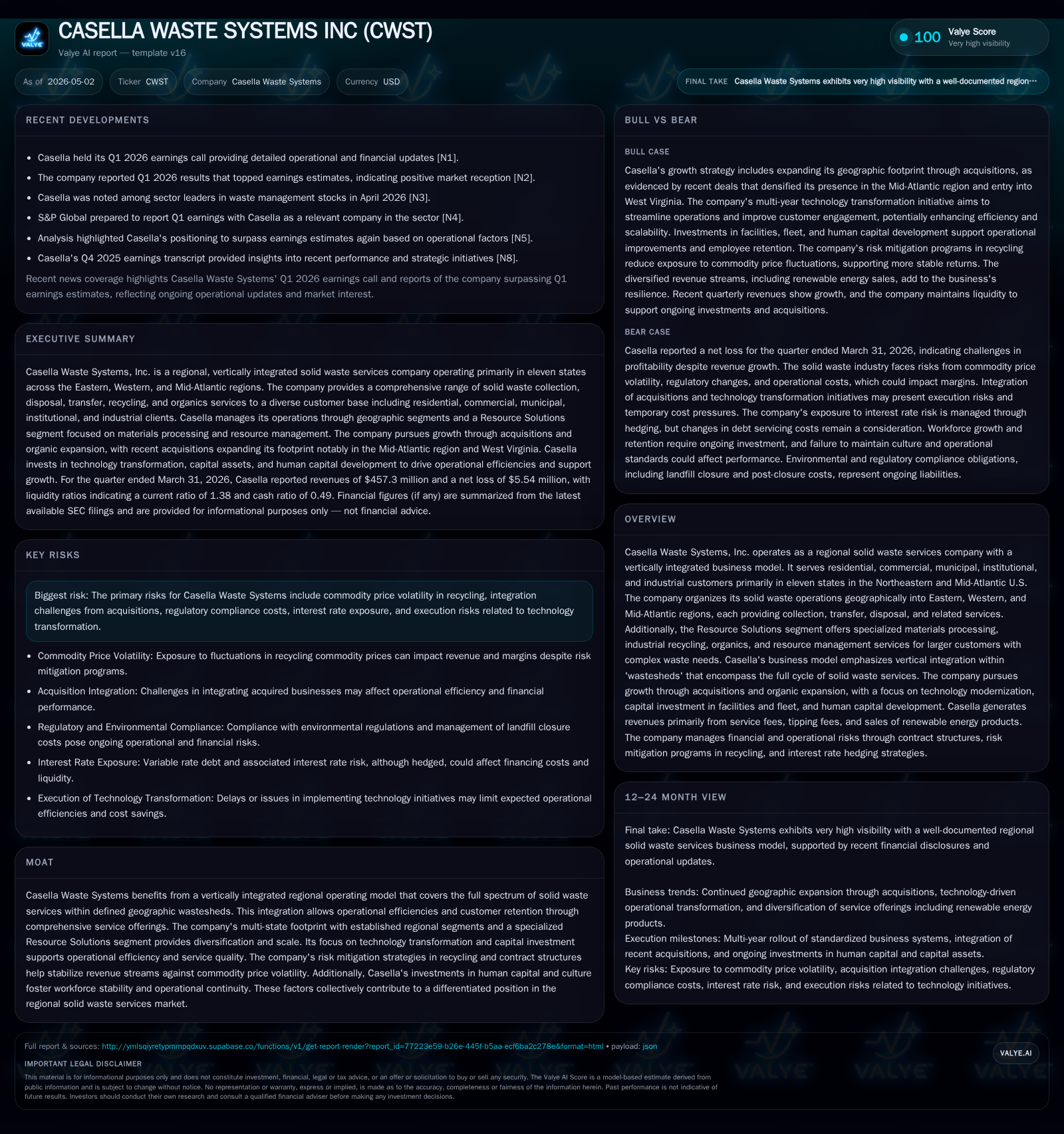
In Q1 2026, Casella Waste Systems completed three strategic acquisitions, notably expanding its presence in eastern Massachusetts and the Mid-Atlantic region. The company leverages a vertically integrated business model within defined geographic wastesheds, combining collection, transfer, disposal, and resource solutions to maintain operational efficiency and customer retention. Growth is propelled by disciplined capital allocation across acquisitions and organic expansion alongside technology modernization efforts. Risks persist from commodity price volatility in recycling, integration complexities, and regulatory compliance costs.
Recent Operating Update
Casella Waste Systems reported its latest operating developments in the Q1 2026 Form 10-Q filed May 1, 2026 [S2]. During the quarter ending March 31, 2026, Casella closed on three acquisitions funded via cash on hand complemented by borrowings under its revolving credit facility. The most notable was Star Waste Systems Holdings, LLC and affiliates operating in eastern Massachusetts and southern New Hampshire — key markets adjacent to the company's existing Mid-Atlantic footprint. Additional acquisitions were completed extending collection operations into West Virginia and a transfer station operation in southwestern Pennsylvania.
These transactions reflect Casella’s continued strategy of geographic densification by acquiring strategically adjacent assets while expanding its regional presence. This approach supports economies of scale within discrete wastesheds where Casella offers integrated collection through disposal services.
Financially, Casella maintained strong liquidity with cash and cash equivalents totaling approximately $127 million at quarter-end while managing total debt near $1.13 billion (net debt roughly $1 billion) as detailed in their balance sheet summary [F1][S2]. The company remains compliant with all credit agreement covenants.
Business Model
Casella operates as a regional solid waste service provider primarily serving residential, commercial, municipal, institutional, and industrial customers across eleven Northeastern and Mid-Atlantic states. Core operations are segmented geographically into Eastern, Western, and Mid-Atlantic regions encompassing collection services, transfer station management, landfill disposal, transportation logistics, and associated environmental services.
The company’s vertical integration within defined wastesheds is central to its competitive moat. By owning or operating at every step — from curbside collection through landfill or specialized processing — Casella captures multiple revenue streams per customer relationship. This integration facilitates operational efficiencies such as optimized route management, consolidated facility use, cross-utilization of fleet assets, and seamless service delivery that enhances customer retention by creating switching costs.
Complementing traditional solid waste streams is the Resource Solutions segment targeting larger clients with complex environmental needs including industrial recycling programs, organics diversion into composting or renewable energy inputs, and broader resource management consultancy. This segment aligns well with sustainability trends emphasizing circular economy principles.
Revenue mechanics rely on contractually stable pricing regimes in collection services combined with volume drivers tied to population density and commercial activity within operating regions. Disposal throughput is linked to both collection volumes as well as third-party waste receipts at transfer stations/landfills. Pricing power has historically been durable owing to limited landfill capacity constraining new entrants within established wastesheds.
Industry Structure and Competitive Position
The solid waste sector tends toward regional oligopolies due to high barriers from capital-intensive infrastructure needs (landfills/transfer stations), stringent environmental regulations limiting landfill permits or expansions, and local governmental contracts often awarding multi-year terms. Competitors are typically large waste management firms with footprints either overlapping or abutting Casella's territories.
Casella differentiates itself through focused regional scale enabling deep market penetration without sacrificing operational control that can dilute returns seen in broader national models. Their emphasis on leveraging technology for back-office consolidation and digital customer engagement ahead of many peers demonstrates foresight toward cost containment and service enhancement.
Moreover, their active management of commodity risk via contract structures within recycling services mitigates revenue volatility associated with fluctuating recyclable material prices — a notable challenge industry-wide.
Growth Drivers
Strategic Acquisitions
Casella has a consistent track record of accretive acquisitions targeting operators that add contiguous geographic coverage or complementary service capabilities. In Q1 2026 alone the company expanded significantly in Massachusetts/New Hampshire while broadening collection assets deeper into West Virginia/Pennsylvania areas — all within their targeted Mid-Atlantic region [S2].
Organic Price Realization & Operational Initiatives
The company achieved a roughly 5% price increase in collection services for fiscal year 2025 which helps offset inflationary cost pressures particularly wages fueled by labor market tightness [S1]. Concurrently they pursue operational initiatives like route optimization using automated vehicles systems plus enhanced safety programs reducing downtime.
Technology Transformation Program
Their enterprise-wide Lead to Cash project aims to standardize revenue recognition workflows across acquired units while digitizing customer interactions — expected to reduce overheads and improve billing accuracy over time [S1]. This multi-year program also supports post-acquisition system harmonization increasing speed-to-benefit realization.
Resource Solutions Expansion
By growing offerings tailored to industrial/institutional customers focused on sustainable resource management practices including organics diversion and advanced recycling technologies Casella taps into a structurally growing mandate towards corporate environmental stewardship [S1].
Risks / Watchpoints / Growth Constraints
Commodity price fluctuations represent ongoing risks particularly impacting the profitability of recycling streams despite contractual mitigants. Acquisition integration complexity similarly remains a watchpoint given recent deals adding scale rapidly could strain managerial bandwidth or delay synergies realization.
Regulatory compliance costs continue as evolving state-level mandates push for higher environmental standards potentially raising operating expense baselines. Further landfill capacity constraints could either pressure permitting or necessitate outsized capital investment in new facilities impacting return profiles.
Interest rate exposure is relevant given the company’s leverage position (~$1B net debt) backed by Credit Facility maturing 2029 but subject to variable rate components tied to Term SOFR plus margin increments depending on leverage ratios [S2][F1]. Execution risks around realizing full benefits from technology initiatives also merit close monitoring.
What to Watch Next
Key milestones include:
- Integration progress on Star Waste Systems Holdings LLC along with recently acquired Mid-Atlantic assets measured by synergy capture timelines,
- Rollout status updates on Lead to Cash digital transformation across remaining regions through calendar years 2026–27,
- Pricing trends sustainment post-fiscal 2025 increases amidst inflation uncertainties,
- Regulatory environment changes especially concerning landfill permit renewals or green mandates impacting operational costs,
- Recycling commodity market stabilization influencing Resource Solutions segment margins,
- Quarterly financial results for signs of margin improvement driven by operational gains,
- Debt covenant compliance particularly net leverage ratios relative to Credit Facility thresholds.
Financial Profile Brief Context
Latest financial snapshot
| Metric | Value | Period |
|---|---|---|
| Cash & equivalents | $127mm | |
| 2026-03-31 | ||
| Total debt | $1,127mm | |
| 2026-03-31 | ||
| Net debt | $1,000mm | |
| 2026-03-31 | ||
| Current assets | $360mm | |
| 2026-03-31 | ||
| Current liabilities | $260mm | |
| 2026-03-31 | ||
| Current ratio | 1.38x | |
| 2026-03-31 |
Source: SEC companyfacts cache [F1].
As of March 31, 2026 Casella reported cash & equivalents of approximately $127 million against total debt near $1.13 billion implying net debt near $1 billion with a current ratio measured at around 1.38 times [F1][S2]. The credit agreement includes an $800 million Term Loan Facility due September 2029 bearing an interest rate close to 5.218%.
Fiscal discipline evident in balanced capital spending prioritizes return-driven projects including fleet modernization alongside facility upgrades aimed at enhancing safety and efficiency parameters [S1].
This analysis synthesizes disclosures from Casella Waste Systems’ filings through May 2026 without offering investment recommendations or forecasts. Readers should consider underlying industry cyclicality alongside structural trends present in integrated regional solid waste providers during due diligence.
Disclaimer: This is research-only, informational analysis and not investment advice. It may include AI-generated interpretation and general industry context. Always verify important details using primary sources.

Comments