
Prologis Strengthens Global Logistics Leadership with Robust Q1 Performance
Latest quarterly results affirm Prologis’s scale advantage and strategic flexibility in a dynamic logistics real estate market.
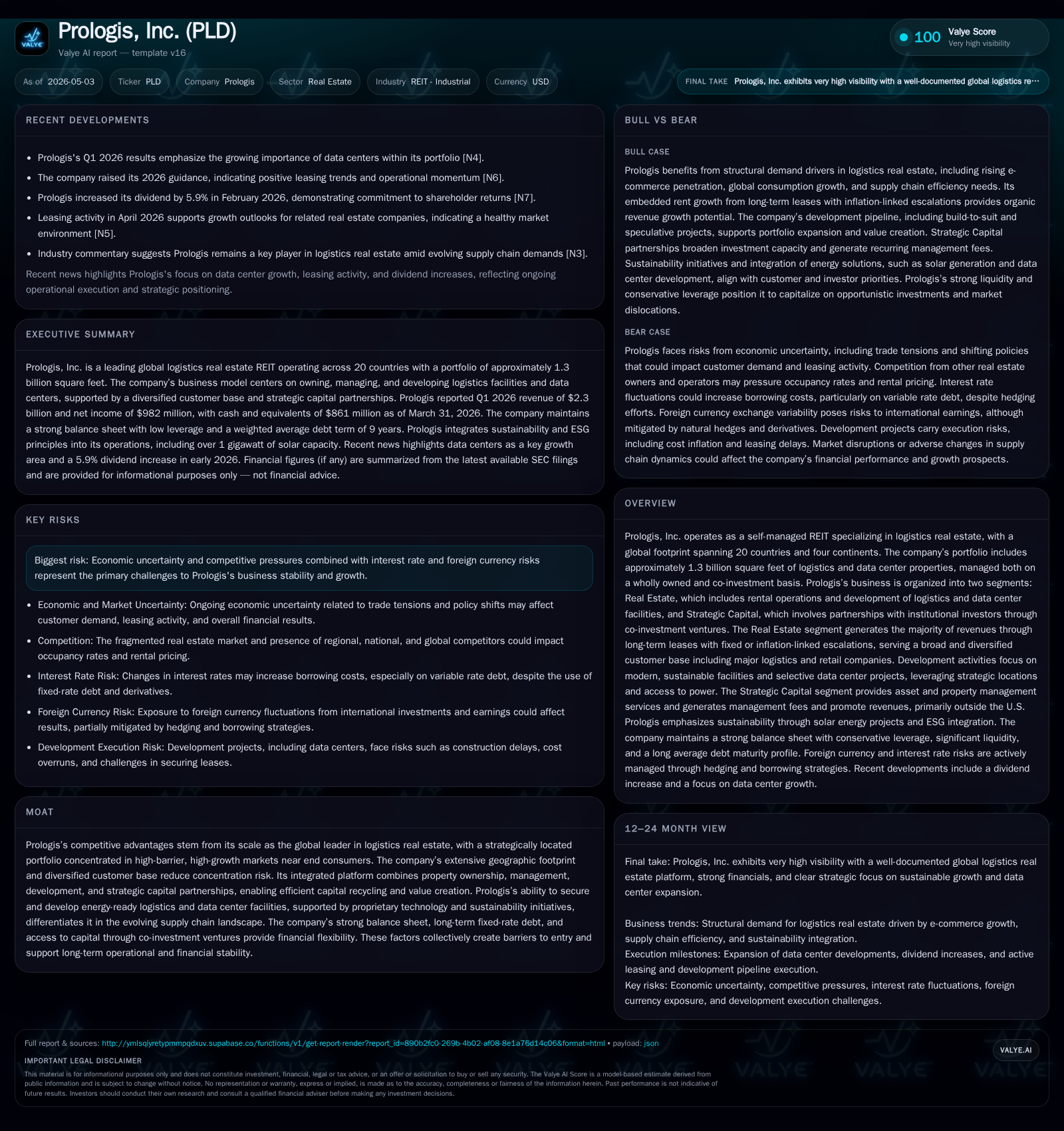
Prologis released its April 2026 10-Q, demonstrating sustained portfolio occupancy above 95%, healthy leasing spreads, and continued capital market activity that underpin its global industry leadership. The company’s integrated business model combining real estate operations and strategic capital partnerships supports resilient revenue streams anchored by long-term leases and high-growth development projects. While macroeconomic volatility and interest rate shifts remain watchpoints, Prologis’s strong balance sheet and diversified footprint position it favorably to capture evolving logistics demand worldwide.
Latest Quarterly Operating Highlights
Prologis’s Q1 2026 Form 10-Q filing reinforces its dominant position in global logistics real estate through several near-term operational indicators. The company maintained occupancy levels above 95%, consistent with the stable fundamentals reported at the end of 2025. New lease commencements have shown substantial rent escalations despite recent concerns over rental growth pressures elsewhere in the market. This reflects lasting positive rollover spreads driven by prior years’ market rent appreciation embedded in existing contracts [S2][S1].
Development activity remains tightly focused on high-return build-to-suit projects—which accounted for approximately 60% of the $2.9 billion consolidated starts in the prior year—ensuring alignment with customer-specific supply chain demands rather than speculative multi-tenant builds. This approach underpins stable cash flow prospects and reflects demand for efficient and sustainable facilities incorporating energy-saving technologies like LED lighting and rooftop solar installations [S1].
On the capital front, Prologis issued new senior notes at attractive coupons during April 2026 as documented in recent 8-K filings, evidencing active capital management to support funding needs while optimizing cost of capital amid evolving credit markets [S3].
How Prologis Generates Value: Business Model and Product Offering
Prologis primarily generates revenue from its Real Estate segment composed of rental operations and development activities that represent roughly 90%-95% of consolidated revenues. Customers pay rents governed mainly by long-term operating leases with fixed or CPI-linked escalations, providing predictable income streams resilient to short-term volatility. The weighted average lease term remains robust at about 70 months, anchoring cash flow visibility for the foreseeable future [S1].
The Strategic Capital arm supplements earnings by partnering with institutional investors through co-investment vehicles where Prologis leverages its expertise to manage assets while benefiting from fee income and partial equity stakes. These open-ended funds enable recurring growth opportunities without concentrating balance sheet risk entirely on Prologis itself, facilitating capital recycling into higher-return developments or acquisitions [S1].
The product offering ranges from state-of-the-art logistics warehouses supporting e-commerce fulfillment to specialized data centers reflecting increasing digital infrastructure demand. Sustainability features such as the Prologis Essentials platform—including SolarSmart solar solutions and LED lighting retrofits—add value differentiation by helping tenants reduce environmental impact while controlling operating costs [S1].
Navigating Competitive Advantages in Global Logistics Real Estate
Prologis’s competitive moat stems overwhelmingly from scale and strategic location concentration near vital consumer markets across North America, Europe, Latin America, and Asia-Pacific regions. With approximately 1.3 billion square feet under ownership or management across more than 20 countries, its footprint aggregates localized insights with a global platform effect that smaller competitors find challenging to replicate [S1].
Further advantages arise from an integrated business model combining property ownership with development capabilities and a sophisticated strategic capital framework. This integration enhances operating efficiencies while enabling agile capital deployment across cycles through partnerships rather than solely balance-sheet funded growth.
Investment in proprietary technology supports superior asset management and sustainability initiatives that increasingly influence tenant decisions around provider selection. Moreover, having a diversified customer base exceeding 6,500 tenants spanning various industry sectors reduces concentration risk and fosters consistent occupancy levels even amid economic headwinds [S21].
Growth Catalysts: Leasing Activity, Development Pipeline, and Strategic Capital
Three core pillars drive Prologis’s growth trajectory:
Leasing Momentum: The prior year saw impressive leasing velocity—about 112 million square feet signed—reflecting entrenched demand for modern logistics space optimized for e-commerce distribution networks. Embedded mark-to-market lease uplifts remained meaningfully positive at circa +18%, fueling same-store NOI gains even if headline rents moderate temporarily [S1].
Targeted Development: The company prioritizes build-to-suit projects matching specific tenant requirements over speculative developments, mitigating vacancy risk while increasing rent premiums achievable due to customization features. The addition of data center facilities expands exposure into a rapidly growing segment requiring specialized building standards intertwined with logistics supply chains [S1][N12].
Expansion of Strategic Capital Ventures: By growing assets under management in unconsolidated co-investment structures valued at tens of billions USD (over half a billion square feet), Prologis scales fee-generating businesses alongside direct property income. These vehicles allow flexible capital recycling cycles contributing both fees and equity appreciation potential without excessive leverage risk concentration on the primary balance sheet [S1].
Together these drivers suggest organic revenue expansion complemented by accretive development contributions underpinning funds-from-operations (FFO) growth.
Risks and Challenges: Economic Headwinds, Interest Rates, and Currency Exposure
Prologis acknowledges ongoing macroeconomic uncertainty remains a key risk factor potentially dampening tenant demand or slowing anticipated rent growth realization due to policy shifts or trade disruptions noted in recent SEC filings [S2][S23][S1].
Interest rate variability poses another challenge despite proactive mitigation: nearly all ($33.8 billion) debt is at fixed rates while minimal ($1.4 billion) represents variable rate exposure mainly hedged through derivatives minimizing earnings volatility linked to rate moves. Sensitivity analysis indicates a modest earnings impact from reasonable rate shocks but warrants ongoing vigilance given the size of total indebtedness [$35.2B total debt] [F1][S2][S18].
Currency fluctuations impact consolidated results since around 8.6% of consolidated revenue is foreign currency denominated; however, strategies including borrowing in local currencies create natural hedges complemented by FX instruments which buffer translation-related earnings variances albeit not hedge-accounted formally leading to some income statement volatility when settlement occurs [S2][S23].
Competition remains fierce from regional players offering competitively priced space especially in non-core locations; sustaining pricing power relies on continual investment in facility quality, sustainability features, and flexible delivery models matching evolving supply chain requirements [S25].
Key Upcoming Milestones and Market Indicators to Monitor
Investors should track quarterly leasing volumes continuing into mid-2026 quarters as an indicator of tenant appetite amid inflation concerns and supply chain shifts. Progress completion rates for build-to-suit developments provide insight into capex deployment efficiency underpinning future NOI accretion.
Updates on strategic capital expansion activities—including launches or fundraises within co-investment ventures—signal scalable growth beyond balance-sheet constraints enhancing fee income visibility.
Macro variables such as trade policy developments or logistics network adaptations influenced by geopolitical events will also directly affect underlying demand trends guiding market rents; hence these external factors warrant careful observation alongside internal execution metrics [N2][N12].
Current Financial Position: Balance Sheet Strength and Capital Management
Latest financial snapshot
| Metric | Value | Period |
|---|---|---|
| Cash & equivalents | $861mm | |
| 2026-03-31 | ||
| Total debt | $35.2bn | |
| 2026-03-31 | ||
| Net debt | $34.3bn | |
| 2026-03-31 |
Source: SEC companyfacts cache [F1].
As of March 31, 2026 (latest quarter end), Prologis held $861 million in cash & equivalents providing tangible liquidity amid evolving credit conditions [F1]. Total debt stood near $35.2 billion delivering net leverage around $34.3 billion after cash adjustments consistent with historically conservative gearing policies given asset size.
The weighted average interest rate on fixed debt was approximately between 2.7%–3.4%, stemming from staggered maturities averaging around nine years duration which minimizes refinancing pressure near term.
Recent bond issuances detailed in April event filings totaling over $2 billion extend maturity profiles while locking attractive fixed coupon costs supportive of lowering average borrowing expenses further going forward [S3][S26][S27].
This solid capital structure paired with substantial undrawn capacity within global credit facilities increases financial flexibility to capitalize on opportunistic acquisitions or accelerate development programs without incurring undue funding strain.
This analysis synthesizes publicly available SEC filings through April 30, 2026 ([S1]-[S28]), current quarterly companyfacts data ([F1]), supplemented by recent market commentary ([N2], [N12]) without any speculative forecasts or investment recommendations.
Disclaimer: This is research-only, informational analysis and not investment advice. It may include AI-generated interpretation and general industry context. Always verify important details using primary sources.

Comments