
United Therapeutics Advances Rare Disease Therapies with Steady Operational Momentum
Latest quarterly results confirm United Therapeutics’ continued execution on its niche pulmonary hypertension therapies amid evolving regulatory and market challenges.
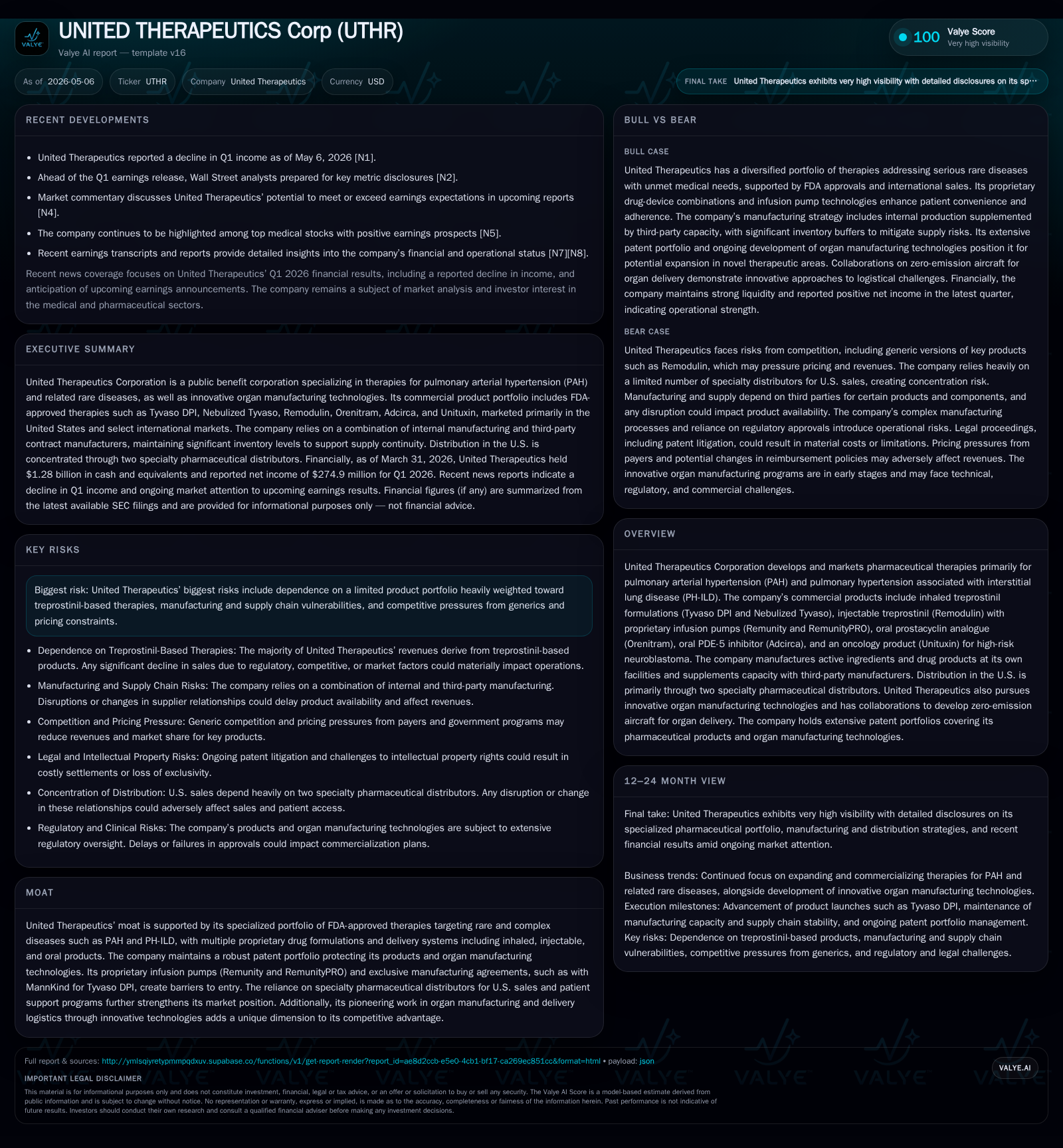
In its Q1 2026 filing, United Therapeutics reaffirmed stable commercial performance for its portfolio of treprostinil-based therapies and its oncology product while managing supply chain complexities and regulatory pressures. The company’s business model leverages proprietary multi-modal drug delivery technologies and an integrated manufacturing footprint to target rare diseases with high barriers to entry. Growth prospects hinge on clinical pipeline advancements, geographic expansion, and pioneering organ manufacturing innovations. Nonetheless, concentration risks around a limited therapeutic class, pricing pressures, and ongoing litigation require close monitoring. Financially, UTHR maintains a strong liquidity position with minimal leverage, supporting continued investment in innovation.
Latest Quarterly Operating Update
The company reiterated effective management of supply chain logistics despite some pressures in raw material sourcing and device component availability. Importantly, United Therapeutics confirmed no material disruptions impacting deliveries to patients or specialty distributors addressing the U.S. market [S2]. Additionally, recent event disclosures (8-K) reinforced ongoing regulatory compliance initiatives and corporate governance stability [S3].
Wall Street expectations ahead of the quarterly release anticipated modest earnings growth driven by established product demand though tempered by pricing headwinds in government reimbursement programs [N1][N3][N7].
Business Model and Product Portfolio Insight
United Therapeutics operates on a highly specialized pharmaceutical business model focused primarily on treatments for pulmonary arterial hypertension (PAH) and pulmonary hypertension associated with interstitial lung disease (PH-ILD). Revenue generation hinges on proprietary formulations of treprostinil delivered via multiple patented modalities: inhaled dry powder cartridges (Tyvaso DPI), inhaled nebulizer solutions (Nebulized Tyvaso), continuous subcutaneous or intravenous injections (Remodulin), supported by innovative Remunity infusion pumps that facilitate drug delivery adherence [S1]. Oral options like Orenitram provide extended-release prostacyclin analogues offering additional patient convenience.
The portfolio’s diversity in delivery methods addresses different patient preferences and clinical needs, improving compliance—a critical factor in managing chronic rare diseases characterized by complex treatment regimens. The company enjoys exclusive manufacturing rights for Tyvaso DPI cartridges through collaboration agreements with MannKind Corporation, ensuring supply chain control over this key inhaled product component [S1].
UNITED THERAPEUTICS supplements internal production capabilities with select third-party manufacturers to balance capacity demands. U.S. distribution is heavily reliant on a pair of specialty pharmaceutical distributors who are integral in patient support services including co-pay assistance—a growing imperative given the complex payer landscape [S1]. Likewise, the oncology product Unituxin expands the therapeutic breadth while addressing a distinct rare disease demographic.
This tight integration of innovative drug delivery systems combined with proprietary device technologies creates meaningful switching costs that sustain customer retention and justify premium pricing structures within a difficult reimbursement environment.
Competitive Environment and Industry Dynamics
Within the rare disease space targeting PAH and PH-ILD populations—markets characterized by small patient pools but high unmet medical needs—United Therapeutics stands out due to its comprehensive suite of FDA-approved therapies protected by patents across both active ingredients and delivery devices. Competitors face significant hurdles replicating these multi-faceted offerings adding robustness to UTHR’s moat [S1][S5].
Nonetheless, generic entrants are beginning to challenge certain segments of the portfolio as patents expire or face legal contestation particularly related to oral formulations of treprostinil or PDE-5 inhibitors like Adcirca. Pricing pressures are amplified by increasing legislative scrutiny exemplified by recent federal initiatives aimed at drug cost transparency and rebate reform (including the proposed GLOBE / GUARD regulations), which could constrain future revenue growth if enacted uncompromisingly [S5][S6][S17].
Regulatory complexity adds another layer; UTHR’s participation in government programs such as Medicaid Drug Rebate, 340B ceiling pricing policies, Federal Supply Schedule contracts, and Tricare necessitates constant compliance vigilance. Litigation tied to the interpretation of 340B contract pharmacy policies highlights ongoing legal risks that may affect sales practices or pricing over time [S21][S25][S26].
Geographically, while UTHR has presence beyond the US primarily through Nuventra sales for Remodulin and Nebulized Tyvaso in regions including Europe and Asia-Pacific markets, coverage variability limits scalability outside core territories.
Growth Drivers and Innovation Pipeline
United Therapeutics is advancing several mid- to late-stage pipeline candidates targeting pulmonary fibrosis indications such as idiopathic pulmonary fibrosis (IPF) and progressive pulmonary fibrosis (PPF), seeking to leverage existing expertise in pulmonary vasculature modulation beyond PAH. Clinical data releases from these programs will be key near-term catalysts validating expansion opportunities into adjacent rare lung diseases [S1].
Parallelly, the company is pioneering organ manufacturing technologies aiming to disrupt transplant medicine paradigms by generating transplantable organs ex vivo—a strategically differentiated long-term growth avenue distinct from core pharmaceutical sales volumes. Collaborations with academic medical centers bolster this innovation trajectory while providing early-stage proof points.
Further international market penetration with existing products remains an incremental catalyst albeit constrained by stringent payer frameworks abroad. Enhanced adoption driven by expanded label approvals in PH-ILD indications also supports top-line growth prospects.
Risks, Challenges, and Operational Constraints
Significant dependence on the treprostinil franchise weighs heavily on United Therapeutics’ revenue composition—exposure concentrated around this molecular class means pipeline or commercial setbacks could disproportionately impact financial outcomes. The rise of generic competitors targeting oral prostacyclin analogues or PDE-5 inhibitors may erode market share or exert downward price pressure over time [S5][S6].
Manufacturing risks persist due to reliance on complex infusion pumps requiring stringent quality controls; any production disruption could delay therapy availability harming patient continuity. Supply chain vulnerabilities heightened amid global material shortages remain a continuing concern.
From a regulatory standpoint, potential adverse enforcement actions related to Medicaid Drug Rebate program compliance or co-pay accumulator schemes threaten product accessibility through payor channels—challenges compounded by the federal government’s intensifying focus on drug price transparency laws across various states [S5][S7][S9].[footnote: These legal matters have historically resulted in significant litigation expense exposure though management does not currently anticipate material adverse effects.]
Additionally, industry-wide issues regarding reimbursement reforms as well as evolving FDA resource limitations create uncertainty around the pace of new product approvals or label expansions critical for sustaining innovation-driven growth.
Key Near-Term Milestones and Market Signals
Investor attention will center on upcoming quarterly earnings releases which serve as barometers for underlying demand trends amid shifting reimbursement landscapes [N1][N3][N7]. Clinical development readouts from pulmonary fibrosis candidates will be pivotal for validating pipeline advancement potential.
Regulatory decisions regarding expanded indications for inhaled formulations or novel delivery system enhancements will significantly influence commercial uptake trajectories. Progress updates on organ manufacturing initiatives represent longer-horizon strategic checkpoints closely watched by stakeholders seeking differentiation beyond commoditized biopharmaceutical products.
Monitoring developments related to 340B contract pharmacy litigation outcomes also remains important due to their implications for managed care negotiations.
Financial Health and Liquidity Overview
Latest financial snapshot
| Metric | Value | Period |
|---|---|---|
| Cash & equivalents | $1.28B | |
| 2026-03-31 | ||
| Current assets | $2.87B | |
| 2026-03-31 | ||
| Current liabilities | $599M | |
| 2026-03-31 | ||
| Current ratio | 4.79x | |
| 2026-03-31 |
Source: SEC companyfacts cache [F1].
United Therapeutics exhibits solid financial footing as evidenced by approximately $1.28 billion in cash and equivalents at quarter-end March 31, 2026, against negligible outstanding debt ($67K last reported) resulting in a net cash position exceeding $1.27 billion—indicative of ample liquidity flexibility for operational needs and R&D investments [F1]. Current assets stand at $2.87 billion versus current liabilities of $599 million yielding a robust current ratio around 4.79 that underscores short-term balance sheet strength [F1].
| Metric | Value |
|---|---|
| Cash & Equivalents | $1.28B |
| Total Debt | $67K |
| Current Assets | $2.87B |
| Current Liabilities | $599M |
| Current Ratio | 4.79 |
This liquidity buffer positions United Therapeutics well to navigate sector-specific regulatory uncertainties while investing aggressively in innovation pipelines without undue leverage concerns.
This analysis is based solely on information publicly disclosed up through May 6, 2026 including SEC filings (10-K/10-Q/8-K) and relevant news sources without speculative assumptions or investment recommendations.
Disclaimer: This is research-only, informational analysis and not investment advice. It may include AI-generated interpretation and general industry context. Always verify important details using primary sources.

Comments