
Lineage Expands Strategic Global Cold Storage Network with Focused Growth Initiatives
Lineage’s Q1 2026 report underscores sustained portfolio scale and investments in automation and greenfield expansions to reinforce market leadership.
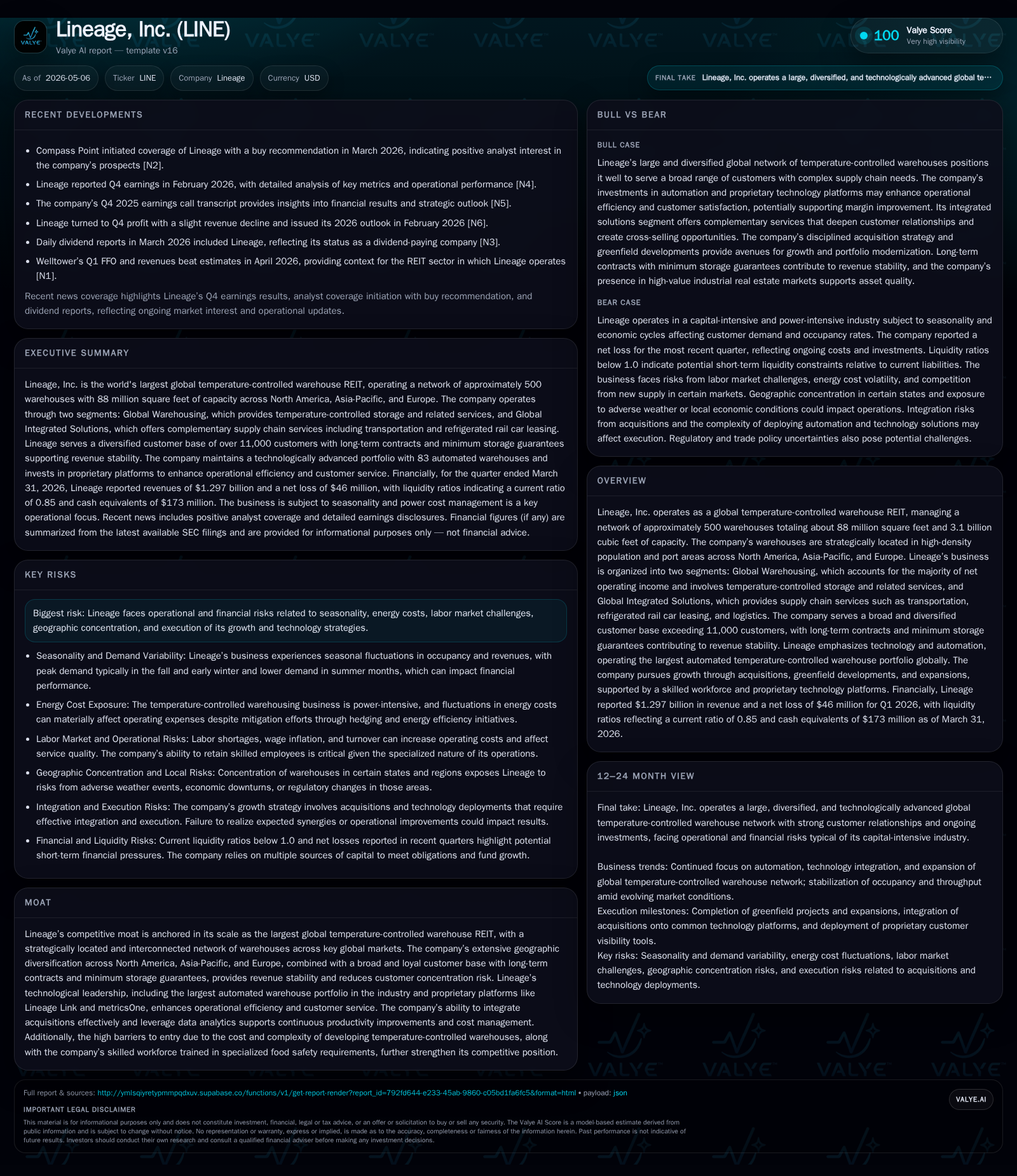
In its latest quarterly filing, Lineage, Inc. maintained operational stability across a global network of roughly 500 temperature-controlled warehouses, while accelerating investments in technology and capacity expansion projects such as greenfield developments in Dallas and automated facilities in Europe. The company’s dual-segment business model—comprising Global Warehousing and Global Integrated Solutions—benefits from long-term contracts and stable customer demand, buttressed by technological innovation that drives efficiency and service quality. Geographic diversification across critical markets and a broad customer base underpin revenue stability, while growth is supported by ongoing automation adoption and integrated logistics offerings. Risks include exposure to energy costs, labor challenges, and regional disruptions. Financially, Lineage sustains a leveraged but manageable capital structure with ample liquidity backing its development pipeline.
Latest Quarterly Operating Update and Strategic Highlights
Lineage’s first quarter 2026 SEC filings ([S2], [S3]) reveal a steady operational footing with the company continuing to manage an expansive network of approximately 500 warehouses covering nearly 88 million square feet globally. This scale remained consistent quarter-over-quarter despite broader economic headwinds that have challenged parts of the industrial real estate sector.
The company reported ongoing capital investments totaling $164 million in Q1, primarily directed toward growth-related property improvements—including a prominent greenfield development in Dallas linked to a long-term anchor customer, Tyson Foods—and IT infrastructure enhancements like the patented LinOS technology platform designed to drive operating efficiencies ([S9], [S13]). Notably, $100 million of this capital was allocated to new greenfield projects and expansions compared with $37 million during the same period last year, signaling an acceleration in growth initiatives.
Operationally, Lineage sustains strong throughput metrics—the volumetric processing of inbound/outbound pallets holding frozen or refrigerated goods—which remain critical drivers for warehouse services revenues earned on transactional handling (receiving, case picking) beyond rent or reserved space charges ([S1]). This underpins revenue resilience as minimum storage guarantees combined with diversified contract types (warehouse agreements, leases) buffer against demand cyclicality.
Business Model and Core Service Offerings
Lineage operates via two complementary segments: Global Warehousing and Global Integrated Solutions ([S1]). The vast majority of net operating income (~86%) springs from Global Warehousing where customers pay for temperature-controlled storage space either as fixed reserved contracts or variable utilization fees augmented by specialized services such as blast freezing or customized order assembly.
In addition to property rental income, warehouse service fees contribute materially—these are generated on transactional activities like pallet handling, inventory management support (import/export), repackaging, quality control inspections including government-certified storage functions. This mix provides some insulation from purely volume-based risk while enabling premium pricing for value-added solutions.
Global Integrated Solutions (~14% NOI) complements warehousing with end-to-end supply chain transport services including refrigerated railcar leasing—a unique differentiator adding stickiness to customer relationships through bundled offerings which facilitate cost reductions along the cold chain journey ([S1]). Customers benefit from a single integrator overseeing storage plus logistics, promoting cross-selling efficiency.
Technology plays a pivotal role: Lineage Link (customer-facing portal) offers real-time inventory visibility while LinOS—its internally developed operating system—utilizes advanced algorithms and AI to optimize labor allocation across facilities. As LinOS scales from initial pilots in automated warehouses to conventional sites, the company expects gains in throughput productivity and margin expansion ([S20], [S13]).
Competitive Positioning within Temperature-Controlled Warehousing
Lineage commands the largest global REIT-scale footprint in temperature-controlled warehousing focused on critical distribution hubs across North America (325 warehouses), Europe (86), and Asia-Pacific (89) ([S2]). This geographic diversification mitigates local disruption risks while providing access to dominant consumer markets adjacent to key ports.
The company's extensive portfolio—approximately 3.1 billion cubic feet of refrigerated capacity—solidifies its moat amid high barriers to entry characterized by substantial capital outlays for modern cold-chain infrastructure coupled with stringent regulatory compliance requirements ensuring product integrity. This barrier protects incumbents from low-cost new entrants.
Furthermore, Lineage’s diverse client base exceeds 11,000 customers ([S1]) spanning large food retailers, manufacturers like Tyson Foods taking up anchor space under multi-year contracts with storage minimums enhancing recurring revenue visibility. Reduced customer concentration versus competitors minimizes credit risk.
Technological sophistication distinguishes Lineage further: maintaining the largest automated warehouse footprint backed by proprietary software platform LinOS supports continuous productivity improvements and enhanced customer experience metrics such as faster turn times and improved inventory accuracy ().
From an industry standpoint, competitors often operate with smaller regional footprints or lack integrated logistics capabilities; Lineage’s combined warehousing plus integrated solutions offering creates competitive lock-in effects beneficial for client retention.
Growth Drivers: Automation, Integrated Solutions, and Capacity Expansion
Key near-term growth catalysts stem from strategic greenfield projects including the high-automation Dallas facility anchored by Tyson Foods under construction alongside expansion projects like enlargement at a Netherlands automated facility and Hobart Indiana's recent cold storage upgrade ([S2], [S13]). Capital investments here are designed not just to add capacity but also incorporate cutting-edge robotics and AI-powered workflow management improving unit economics per square foot.
Throughput gains facilitated by LinOS deployment enable better labor utilization rates—a critical employee cost lever given tight labor markets—which is expected to bolster margins over time. Further integration between the warehousing backbone and global integrated solutions segment advances upsell opportunities through seamless multi-modal transport contracts bundled with storage services.
Cross-selling has traction given the complexity food supply chains have faced post-pandemic—customers increasingly prefer providers who reduce overall channel friction through one-stop shop capabilities encompassing inventory management plus transportation logistics.
These elements combine for structural tailwinds rather than mere cyclical trends as cold chain demands rise globally fueled by consumer shifts toward fresh/frozen products requiring strict temperature controls associated with food safety standards.
Risks and Constraints: Seasonality, Energy Costs, Labor, and Geographic Concentration
Despite strengths, several risk factors warrant attention. Energy price volatility remains a significant margin pressure point since refrigeration consumes substantial power; while some costs are contractually passed through to customers, others may compress profitability if spikes occur unexpectedly ([S1]).
Labor market tightness particularly affects specialized warehouse operators skilled in cold chain handling; turnover or shortages can increase wage costs or disrupt throughput capacity during peak demand periods. Seasonality inherent in food production cycles may cause quarterly earnings variability also relative to consumption patterns.
Geographical concentration exposes Lineage to localized risks like adverse weather events impacting key hubs—storms or port disruptions can delay shipments cascading into throughput delays affecting revenues ([S1]). Although geographic spread helps reduce systemic risks overall concentrations remain notable especially around North American hubs.
Execution risks persist around large-scale greenfield developments wherein returns may fall short due to unforeseen costs or slower ramp-up; similarly integration complexities tied to acquisitions could limit expected synergies if operational harmonization lags.
Finally, identified material weaknesses in internal controls flagged by management may concern stakeholders regarding financial reporting reliability until remediated ([S1]).
Forward-Looking Considerations: Guidance, Milestones, and Market Signals
Looking ahead into 2026 guidance provided alongside Q1 disclosures ([S3]), monitoring ramp-up progress at new facilities such as Dallas automated warehouse will be pivotal alongside measuring incremental contribution from expanded integrated logistics offerings.
Throughput trends act as leading indicators for operational health given their direct link to transaction-based revenues at warehouses; improved LinOS rollout success rates could signal better cost absorption ability for fixed overheads consequently enhancing profitability metrics.
Execution milestones on planned expansions—including completion timelines for European automated expansions—and systematic adoption of technology platforms will be critical gauges for validating management’s ability to deliver on stated growth strategy without sacrificing service quality.
Investor focus should also consider how effectively acquisitions integrate given prior emphasis on disciplined consolidation to avoid dilution of cultural alignment or operational focus that might impair long-term value creation.
Latest Financial Snapshot and Capital Structure Overview
Latest financial snapshot
| Metric | Value | Period |
|---|---|---|
| Total debt | $6.3bn | |
| 2026-03-31 | ||
| Net debt | $6.1bn | |
| 2026-03-31 | ||
| Current assets | $1263mm | |
| 2026-03-31 | ||
| Current liabilities | $1490mm | |
| 2026-03-31 | ||
| Current ratio | 0.85x | |
| 2026-03-31 |
Source: SEC companyfacts cache [F1].
As of March 31, 2026, Lineage held total debt of approximately $6.29 billion against current assets near $1.26 billion yielding a current ratio below unity at 0.85—typical for asset-heavy REITs reliant on stable cash flows rather than working capital liquidity ([F1]). Net debt approximates $6.12 billion after adjusting cash balances.
Debt composition features roughly half fixed-rate instruments (52%) supplemented by variable rate tranches hedged partially (~20%), balancing interest rate exposure cautiously given macroeconomic uncertainties ([S16]).
Operating income stood at $181 million for calendar year 2025 on revenue exceeding $5.35 billion reflecting scale but also margin pressures consistent with heavy investment phase and inflationary impacts seen broadly across the industrial real estate sector ([F1]). Ongoing technology investments classified within general administrative expenses reflect management prioritization of scalable productivity improvements over short-term cost containment ([S13], [S20]).
The company pays regular dividends aligned with REIT distribution requirements; Q1 2026 declared dividend increased modestly reflecting confidence in cash flow sustainability despite external cost headwinds ([S16]).
Disclaimer: This analysis is an independent assessment based on publicly available filings as of May 2026 intended solely for informational purposes without offering investment advice or recommendations.
Disclaimer: This is research-only, informational analysis and not investment advice. It may include AI-generated interpretation and general industry context. Always verify important details using primary sources.

Comments