
Cullen/Frost Expands Texas Banking Lead Through Diversified Services and Robust Capital Management
The bank’s Q1 2026 results demonstrate strong net income growth and disciplined capital strategies, reinforcing its regional franchise in Texas.
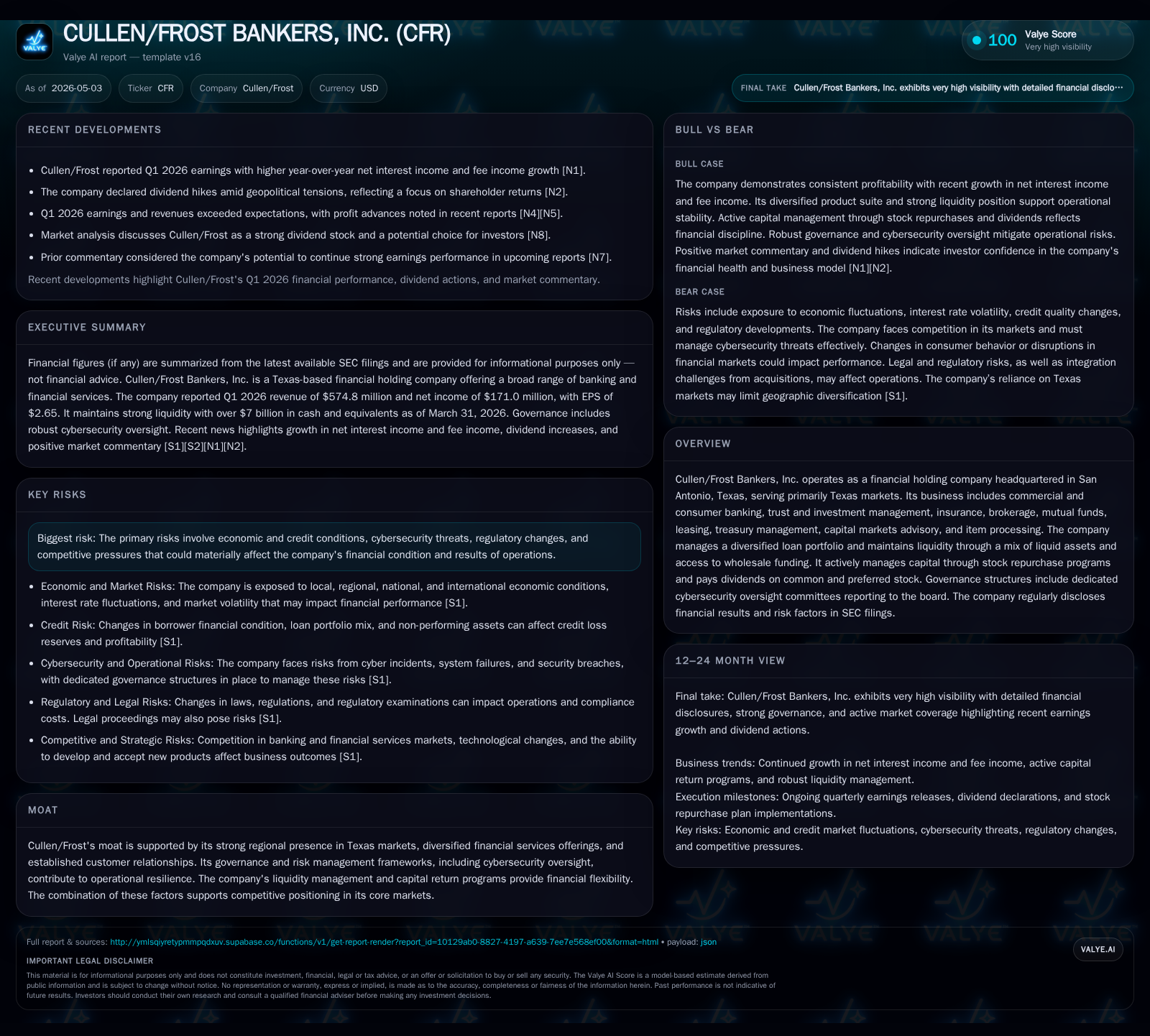
Cullen/Frost Bankers reported a notable net income increase to $171 million in Q1 2026, driven by improved net interest income and fee revenue, coupled with declining credit losses. The company’s diversified product suite, anchored in Texas markets, supports stable customer retention and operational resilience amid evolving credit and market conditions. With robust liquidity and active capital return plans, Cullen/Frost is positioned to leverage growth opportunities while managing credit and cybersecurity risks effectively.
Latest Quarterly Operating Update: Performance Highlights from Q1 2026
Cullen/Frost Bankers posted a significant improvement in profitability for the quarter ended March 31, 2026. Net income grew to $170.99 million from $150.92 million a year earlier—a robust 13% increase year-over-year [S2]. This uptick was driven primarily by higher net interest income (NII) boosted by a favorable interest rate environment and stronger fee income associated with trust and investment management and treasury services as reported on Nasdaq commentary contemporaneously with earnings release [N1], [N3].
Credit loss expense notably decreased from $13.07 million in Q1 2025 to $6.75 million this quarter, indicative of improving asset quality and management’s prudent underwriting discipline amid still-evolving economic conditions [S2]. Meanwhile, securities held to maturity recorded substantial unrealized losses totaling nearly $193 million gross ($31.5 million on residential mortgage-backed securities plus $161.9 million on municipal bonds), reflecting rising interest rates rather than fundamental credit impairments; the allowance against these securities remained nominal at around $500 thousand [S2].
Liquidity remains strong though total cash and equivalents declined sequentially from approximately $8.87 billion at December 31, 2025, to $7.14 billion at March-end driven principally by lower interest-bearing deposits aligning with market dynamics impacting deposit flows and positioning [S2]. This level of liquidity continues to provide operational flexibility for lending growth or capital returns.
Business Model and Product Quality: Regional Banking with Diversified Financial Services
Headquartered in San Antonio and focused on core Texas markets including Austin, Dallas-Fort Worth, Houston, Gulf Coast, and Permian Basin regions, Cullen/Frost operates as a financial holding company offering a comprehensive suite of services: commercial loans across multiple sectors including real estate and energy; consumer banking products; along with trust services, investment management fees; insurance; brokerage; mutual funds; leasing; treasury management; capital markets advisory; and item processing functions that support corporate clients’ operational needs [S1].
This business model generates revenue both from traditional net interest margin sources—through volume of loans funded weighted by lending spreads—and fee-based revenue streams from wealth management and ancillary banking services enhancing customer relationships.
Governance structures emphasize cybersecurity risk oversight through specialized committees—the Information Technology Risk Committee meets monthly while the Information Security Oversight Committee meets quarterly—both chaired by senior security professionals including the Chief Information Security Officer (CISO) who reports directly to the board’s Technology and Cybersecurity Committee quarterly or more frequently if incidents arise. This layered security governance embeds cybersecurity risk management firmly within operational controls underscoring resilience priorities in an increasingly digital banking environment [S1].
Industry Structure and Competitive Positioning: Texas Market Stronghold and Financial Service Spectrum
Cullen/Frost’s competitive advantage resides in its strong foothold within Texas markets combined with broad service capabilities tailored for commercial clients as well as retail customers within its footprint. The company faces competition primarily from other mid-sized regional banks such as Prosperity Bancshares along with national institutions penetrating local markets; however, CFR’s scale in principal metro areas like Dallas-Fort Worth endows it with operational efficiencies.
Moreover, longstanding client relationships strengthened by multi-product cross-selling commitments—from treasury management to brokerage offerings—create switching costs that reinforce retention. Regulatory frameworks specific to Texas banks require prudent capital levels and ongoing compliance vigilance but generally present stable operating conditions given CFR’s governance strength [S1], [N4].
Growth Drivers: Leveraging Breadth of Services and Customer Loyalty to Expand Income Streams
Key growth avenues include further expansion of fee-generating businesses—particularly trust administration and wealth advisory—as well as enhanced treasury management services leveraging digital platforms that improve client convenience and uptake among commercial accounts [S1], [N5].
Loan portfolio diversification remains under focus with measured growth in commercial mortgage-backed loans particularly energy-related exposures reflective of Texas’s economic profile balanced by sustained consumer real estate lending. The recent decline in loan loss expense suggests room for cautious portfolio expansion contingent on continued favorable credit trends.
Cybersecurity remains a persistent threat vector necessitating dedicated oversight committees at board level evidencing awareness but also indicating exposure requiring constant vigilance given heightened regulatory scrutiny around data protection obligations [S1].
Finally, competitive pressures within fast-growing Texas markets mandate continuous innovation efforts lest the bank cede share to technologically agile rivals or consolidators.
Outlook and Key Monitoring Points: Upcoming Milestones and Demand Indicators
Upcoming quarters will warrant close observation of loan originations volumes particularly across commercial real estate sectors sensitive to market cycles. Earnings momentum will depend on sustaining NII growth amid evolving rate environments juxtaposed with controlled expense trajectories.
Capital deployment activities remain active following the board-approved $300 million stock repurchase program initiated early 2026 signaling confidence in balance sheet strength along with ongoing dividend policy adherence reflecting payout capacity balanced against regulatory expectations [S3], [N8], [N9].
Additionally, frequency and depth of cybersecurity risk disclosures alongside incident response outcomes will be critical markers for operational resilience as digital banking usage expands.
Financial Profile: Liquidity, Capital Adequacy, and Recent Operating Cash Flow Dynamics
As of March 31, 2026 data shows total cash and cash equivalents at $7.14 billion down sequentially from year-end levels but maintaining comfortable buffers for liquidity needs amid changing deposit trends including an important component of interest-bearing deposits dropping from over $8 billion late last year to approximately $6.5 billion currently [S2]. Securities held to maturity carry unrealized losses but no impairment provisions supporting stable credit allowance positions.
Net cash provided by operating activities increased supported by improved earnings quality coupled with lower provisioning charges—which may bolster free cash flow generation potential going forward if trends persist—offering scope for continued shareholder returns alongside reinvestment for growth initiatives without excessive leverage accumulation or funding stress signals evident at present reporting date [S2].
This analysis synthesizes data from Cullen/Frost Bankers' latest SEC filings aligned with public market commentary as of early May 2026. It aims to provide an informed examination of operating developments framing current strategic position without offering investment advice or price targets.
Disclaimer: This is research-only, informational analysis and not investment advice. It may include AI-generated interpretation and general industry context. Always verify important details using primary sources.

Comments