
Everest Group Advances Portfolio Rationalization While Reporting Strong Q1 Profit
In Q1 2026, Everest Group reported a significant earnings beat while advancing its strategic divestiture of its Canadian retail insurance business, underscoring a focus on portfolio optimization amid premium pressure.
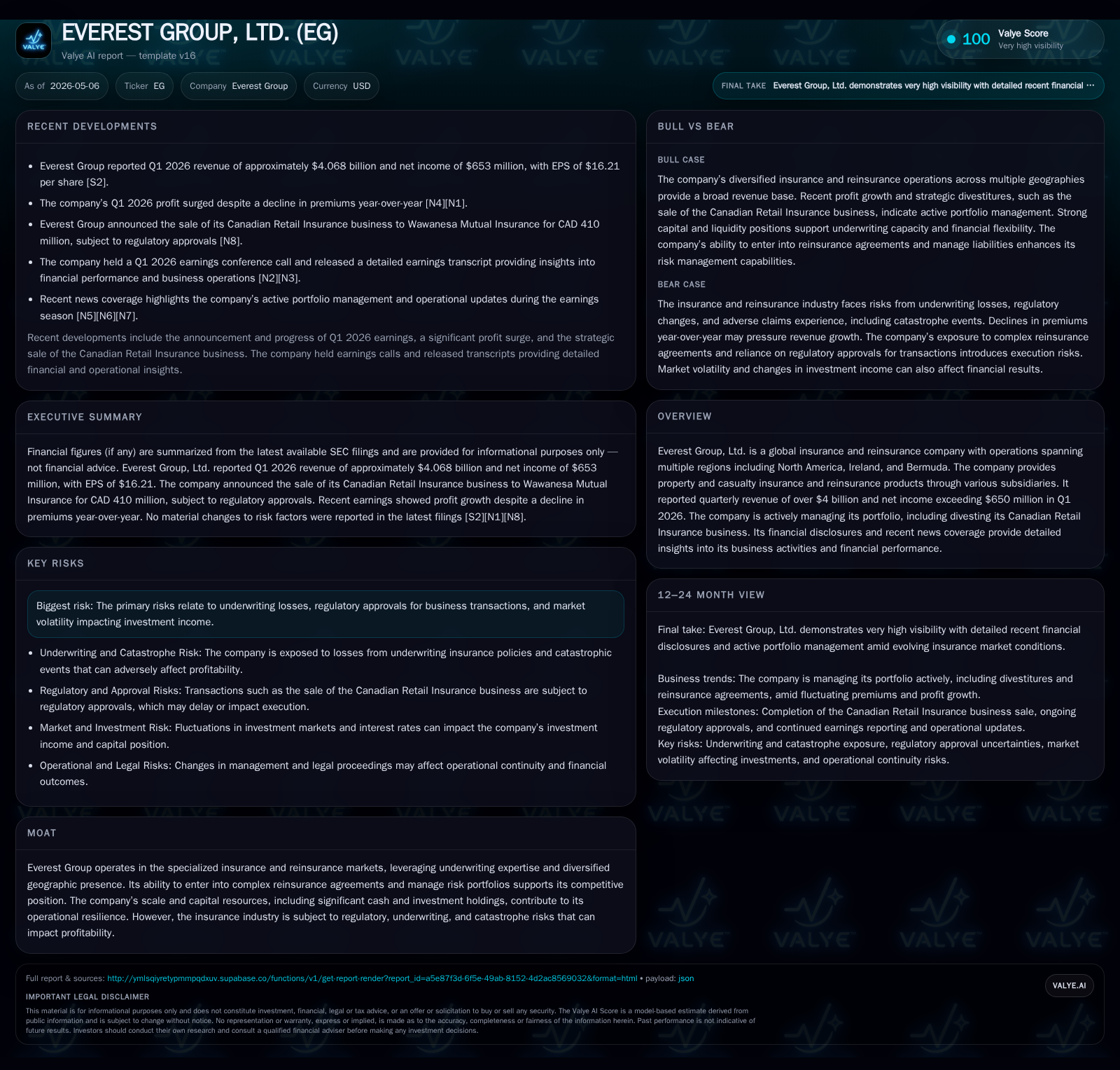
Everest Group, Ltd.'s first quarter 2026 results reveal robust net income surpassing $650 million despite lower premium volumes, driven by disciplined underwriting and active portfolio management. The company progressed on its strategic rationalization by agreeing to sell its Canadian Retail Insurance operations, signaling an emphasis on streamlining risk exposures. Everest benefits from diversified geographic operations and sophisticated underwriting practices that foster competitive advantage in specialty insurance and reinsurance markets. Key risks remain tied to catastrophe frequency and regulatory approvals for transactions. Upcoming milestones include regulatory clearance for asset sales and monitoring combined ratio trends as indicators of underwriting performance.
Q1 2026 Operating Highlights and Portfolio Actions
Everest Group’s Q1 2026 filing [S2] reveals a quarter marked by strong net income performance exceeding $650 million alongside over $4 billion in revenues. Despite facing a decline in premium volumes year-over-year—a common theme given competitive pricing pressures in the specialty insurance market—Everest managed to deliver an earnings beat. This resilience owes primarily to disciplined underwriting and effective risk portfolio management.
Significantly, the company progressed its strategic portfolio rationalization by signing a purchase agreement to divest its Canadian Retail Insurance segment for CAD 410 million with Wawanesa Mutual Insurance [S15,S7]. This transaction includes loss portfolio transfer reinsurance agreements mitigating liabilities related to pre-sale insurance policies. Closing remains subject to customary regulatory clearances including antitrust and Canadian insurance authority approvals [S15].
This deliberate pruning of non-core or lower-return businesses aligns with management’s focus on optimizing capital deployment toward higher-margin specialty lines as reflected in recent conference commentary [N2].
How Everest Group Generates Revenue and Adds Customer Value
As outlined in Everest's latest annual report [S1], the firm operates principally across three segments: Reinsurance Treaty; Global Wholesale & Specialty; and Legacy operations post-retail divestitures. Their revenue arises chiefly from premiums charged on property & casualty insurance policies issued directly or via reinsurance treaties covering commercial insurers’ exposures.
Underlying revenue dynamics depend on the volume of policies written (gross written premiums), pricing adequacy reflecting underlying risk profiles, and retention rates at policy renewal. Underwriting margins hinge critically on claims experience versus premium collections—the combined ratio being the industry's key profitability gauge.
Everest leverages geographic diversity with operations centered in North America, Ireland, and Bermuda to spread catastrophe risk concentrations. This global footprint supports more stable earnings across variable regional loss environments. Sophisticated actuarial modeling supports underwriting discipline essential for navigating volatility inherent in specialty risks such as natural catastrophes.
The company’s value proposition resides in tailored risk transfer solutions that require complex reinsurance treaty structuring, appealing to commercial insurers seeking robust capital partners capable of absorbing large or unusual risks while providing consistent claim servicing capabilities.
Competitive Dynamics in Specialty Insurance and Reinsurance Markets
The specialty insurance/reinsurance sector is characterized by a handful of large firms with significant capital resources enabling them to underwrite large layers of complex risk treaties. Everest differentiates itself through underwriting expertise honed over varied global markets along with prudent risk selection aided by advanced catastrophe modeling tools [S1].
Pricing power is mixed due to heightened competition amidst soft market conditions; however, companies maintaining stringent selection criteria often secure better returns. Market capacity constraints fluctuate seasonally based on renewed catastrophe activity forecasts impacting pricing cycles.
Regulatory environments across different jurisdictions introduce complexity requiring compliance agility—Everest's Bermuda domicile offers advantageous regulatory positioning facilitating access to global risk pools.
Capital strength remains a critical competitive moat since reinsurance counterparties demand assurance of claims-paying ability. Everest sustains considerable cash reserves [F1] minimizing liquidity stress during loss spikes.
Growth Drivers: Market Expansion, Product Diversification, and Risk Expertise
Growth initiatives at Everest focus on penetrating underserved specialty niches and expanding geographic reach within treaty reinsurance domains [S1]. Recent adjustments including exiting certain retail markets via the Canadian business sale free up capital for redeployment into higher-return treaty segments where pricing adequacy appears improving.
Product innovation leveraging data analytics enhances risk selection precision enabling selective capacity increases without diluting underwriting margins. Expanding brokerage relationships broaden new business pipelines while retention efforts aim at stabilizing recurring premium streams.
Investors can monitor growth via metrics such as gross written premiums by segment and region following segment recasts effective January 2026 [S8]. Underwriting margin evolution also signals execution efficacy of tighter risk selection initiatives.
Risks and Constraints: Catastrophe Exposure, Regulatory Oversight, and Market Volatility
Everest's principal risks remain steady compared to prior disclosures [S2,S1]. Natural catastrophe incidence variability poses the largest earnings volatility source given property casualty exposures concentrated in hurricane-, quake-, or wildfire-prone geographies.
Regulatory hurdles particularly relating to transaction clearances such as the Canadian sale might delay expected capital recycling benefits or alter deal economics if conditions are imposed [S15].
Investment income sensitivity linked to fluctuations in equity markets or fixed-income yields adds income unpredictability though balanced against conservative asset allocations.
No material changes in risk factors were noted in the latest quarterly report indicating stable risk profile but emphasizing need for continuous vigilance especially regarding climate-related event frequencies [S2].
Key Milestones and Indicators to Watch Ahead
Critical near-term milestones include completion of the Canadian Retail Insurance disposition contingent on regulatory approvals [S3,S15]. Achieving this would mark a pivotal step toward simplifying operating segments further.
Subsequent quarterly reports will offer insight into premium renewal rates reflecting market acceptance post-divestiture along with combined ratio trajectories signaling improvements or deterioration in underwriting leverage [N2,N4].
Development of new multi-year reinsurance contracts or expansion into emerging specialty product lines should also feature prominently as leading indicators of sustained profitable growth.
Operational execution around cost control during these transitions will be another area warranting scrutiny via margin developments reported each quarter.
Brief Financial Overview: Capital Position and Profitability
The company’s financial posture as of Q1 2026 shows solid profit generation with net income exceeding $650 million contributing to annualized momentum beyond the full-year 2025 net income of approximately $1.59 billion [S2,F1]. Quarterly revenue stood above $4 billion supporting the top-line scale necessary for diversified risk absorption.
Balance sheet strength is evidenced by substantial cash reserves vastly exceeding total debt levels—a reported cash figure from prior filings was around $656 million against negligible debt balances approximating $40 million historically [F1].
Profitable underwriting combined with investment income resilience underpin robust cash flow generation vital for funding growth initiatives or meeting unexpected claim surges.
This analysis strictly reviews factual operating developments disclosed through SEC filings up to May 5, 2026, without offering investment counsel. The presented insights synthesize primary sources including quarterly reports (10-Q), event filings (8-K), annual disclosures (10-K), plus corroborative news transcripts providing comprehensive business context for informed industry evaluation.
Disclaimer: This is research-only, informational analysis and not investment advice. It may include AI-generated interpretation and general industry context. Always verify important details using primary sources.

Comments