
JBT Marel Accelerates Post-Acquisition Integration with Strategic Segment Realignment
Following the Marel acquisition, JBT Marel reshapes its reporting structure and advances integration to drive value in food processing technology.
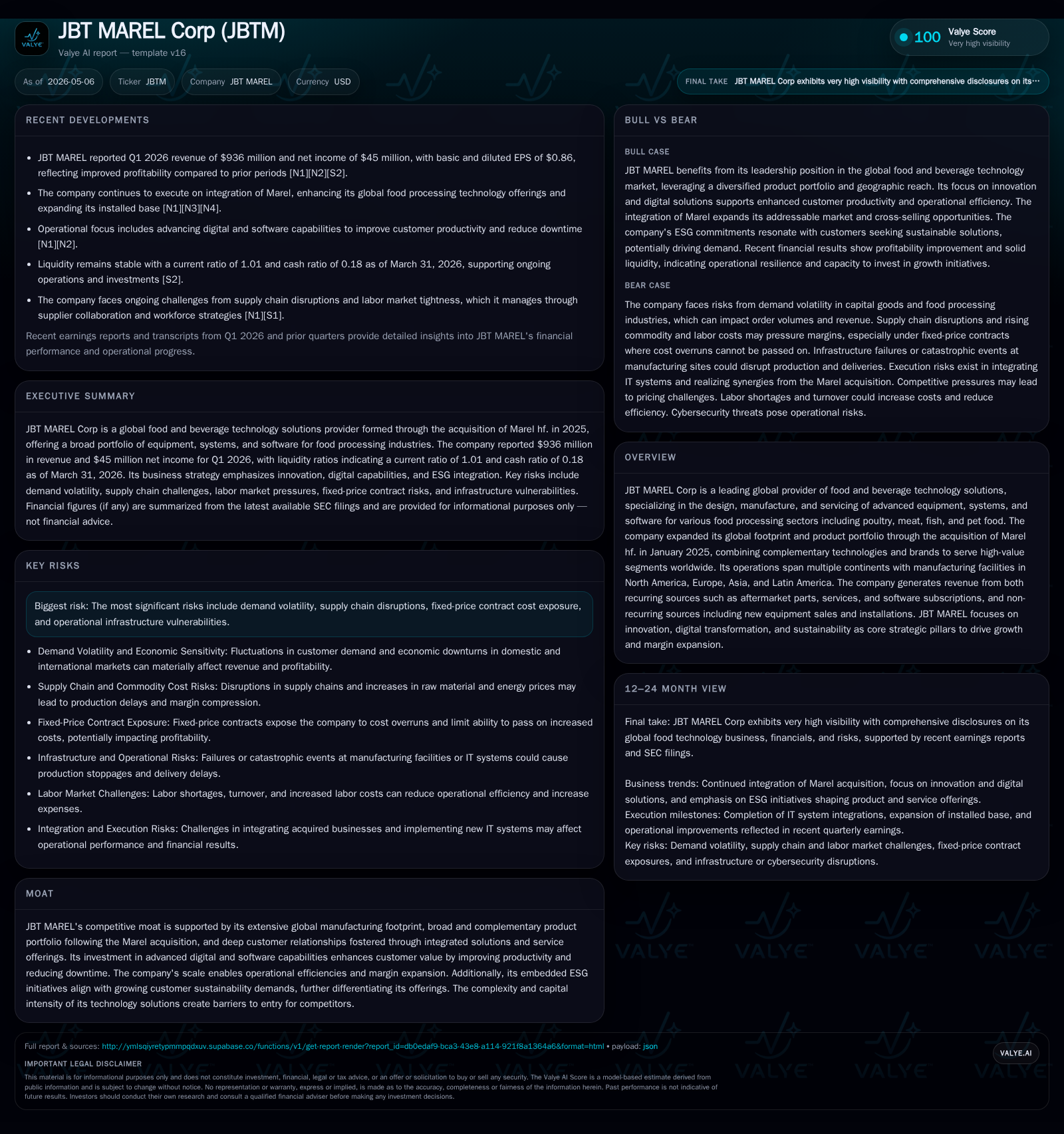
JBT MAREL Corp finalized the acquisition of Marel hf. in early 2025, subsequently realigning its reportable segments into Protein Solutions and Prepared Food and Beverage Solutions to reflect integrated operating models. The latest Q1 2026 filing shows progress in combining complementary product portfolios and digital capabilities, positioning the company for structural growth through recurring aftermarket revenue and sustainability-driven innovation. Key risks remain related to demand cyclicality, supply chain disruptions, and fixed-price contract exposure. Financially, the company maintains compliance with debt covenants amid elevated leverage from acquisition financing while preserving liquidity to invest in growth and integration.
Q1 2026 Operating Update: Realignment and Integration Progress
JBT Marel’s most recent quarterly report dated May 6, 2026 [S2] brings into sharp focus the tangible operational impact of its transformative acquisition of Marel hf., completed in January 2025. The company acquired nearly all outstanding equity interests for a combined consideration exceeding $4.27 billion inclusive of cash acquired [S2]. This deal not only augmented JBT's scale but also prompted a strategic reshaping of its business reporting structure at the close of 2025. To better mirror its integrated operating model, JBT Marel transitioned from legacy segment definitions to two refined reportable segments – Protein Solutions and Prepared Food and Beverage Solutions – aligned directly with the chief operating decision maker’s (CODM) management framework [S2].
This realignment underscores ongoing post-merger efforts at unifying complementary technologies from both entities across poultry, meat, fish processing (Protein Solutions), as well as downstream preparation, preservation, packaging across food & beverage verticals (Prepared Food & Beverage). The updated segmentation enhances transparency regarding financial performance drivers and resource allocation decisions [S2]. The firm provided no explicit short-term revenue or margin guidance shifts but highlighted that these changes reflect continuing integration synergies and operational streamlining tied to the enlarged portfolio [N1][N2].
Business Model Overview: Equipment, Software, and Services Portfolio
JBT Marel’s business model rests on a hybrid revenue construct blending non-recurring capital equipment sales/installations with recurring revenues from aftermarket parts, services contracts, and increasingly vital software subscription offerings [S1][S2]. This mix reflects the company's deep penetration into complex food processing ecosystems whereby customers seek not only advanced machinery but ongoing operational support critical to maintaining uptime and optimizing throughput.
The combination with Marel expanded JBT's product breadth significantly – notably strengthening presence in high-value protein markets (poultry/meat/fish), introducing solutions for pet food, plant-based proteins as well as aqua feed. The Prepared Food & Beverage segment adds capabilities in ready meals, beverages, warehouse automation and specialty pharma/neutraceuticals production technologies [S1][S13].
Embedded within these products is a strategic emphasis on digital transformation – advanced data analytics platforms and machine learning-powered software tools designed to reduce downtime and improve yield efficiency [S1]. These capabilities create sticky customer relationships driven by switching costs embedded in service contracts and software ecosystems.
Sustainability forms another pillar with offerings engineered to align with increasingly stringent regulatory demands and customer-led ESG initiatives globally. This elevates value propositions beyond cost metrics to emphasize environmental footprint reduction throughout food production value chains.
Competitive Landscape and Industry Context in Food Processing Technology
The food processing technology industry is characterized by a small number of global competitors possessing substantial capital intensity and technological complexity barriers. JBT Marel's scale post-acquisition affords geographic manufacturing breadth spanning North America, Europe (notably Netherlands), Asia Pacific, and Latin America [S1][S21], which is a critical competitive advantage given localized customer needs coupled with tight supply chain management requirements.
Few peers combine comprehensive equipment portfolios alongside mature software platforms capable of delivering end-to-end production optimization; this breadth differentiates JBT Marel by enabling seamless system integration accompanied by robust aftermarket servicing frameworks.
Regulatory tightening around sustainability coupled with shifting consumer preference toward plant-based proteins also elevate market entry hurdles by raising R&D thresholds for innovation like that undertaken via JBT's technology assets acquired from Marel [S26]. The post-Marel entity benefits from intertwined ESG compliance measures baked into core product designs aiding penetration into forward-looking customer accounts.
Key Growth Drivers Fueled by Acquisition and Digital Innovation
Several clear structural growth levers assert themselves post-merger:
- Cross-Selling Synergies: The fusion combines complementary portfolios serving varied protein sources allowing upsell across existing accounts wary of managing multiple vendors [N1][S2].
- Recurring Revenue Expansion: Accelerated uptake of software licenses powering production line analytics drives higher-margin service streams alongside parts/service maintenance contracts that lock-in long-term spend visibility.
- Digital Transformation Push: Investment in R&D digital platforms broadens addressable markets among large processors committed to Industry 4.0 standards.
- Sustainability Demand Alignment: ESG regulatory frameworks propel faster customer adoption cycles for greener technologies embedded in new equipment lines.
- Geographic Diversification: Global footprint mitigates regional economic cyclicality enhancing stability.
Analyst commentary during Q1 earnings noted increasing bookings momentum within Protein Solutions particularly reflecting secular demand for efficient animal protein processing capacity [N2], a domain where JBT Marel is building durable economies of scale.
Risk Factors: Demand Variability, Supply Chain, and Contract Exposures
Despite strategic progress risks persist:
- Capital Equipment Demand Volatility: Large ticket nature implies exposed cyclical swings impacting sales timing/lumpiness.
- Supply Chain Disruptions: Global component shortages or logistics delays may curtail on-time delivery affecting customer satisfaction.
- Fixed-Price Contract Sensitivity: Cost inflation pressures especially raw materials/labor can compress margins if not appropriately hedged or passed onto customers swiftly [S26][S2].
- Operational Infrastructure Vulnerabilities: Complex integration raises risks related to execution gaps or unanticipated restructuring costs.
- Environmental/Litigation Risks: Regulatory breaches or liabilities around installations carry potential financial/legal consequences inherent in industrial equipment sectors [S26].
Management disclosures underscore active monitoring with agility aimed at mitigating margin erosions through pricing discipline while ensuring supply continuity via diversified sourcing strategies [S2].
Strategic Outlook and Key Milestones to Monitor
Investors should track several pivotal upcoming developments:
- Execution metrics on segment revenue progression under new Protein Solutions / Prepared Foods framework revealing synergy capture extent.
- Growth trajectory of digital platform subscriptions signaling scalability of high-margin recurring streams.
- Integration-related capital expenditure spend efficiency versus planned $105-$115 million range announced for 2026 alongside $45-$55 million anticipated synergy costs tied to Marel acquisition [S14].
- Refinancing or redemption plan status for the $403 million convertible notes maturing mid-2026 which could affect near-term liquidity deployment priorities [S6].
- Progression of sustainability certifications/customer projects evidencing growing value-add beyond traditional equipment supply contract wins.
Clear communications on these KPIs will sharpen outlook clarity beyond generic growth rhetoric emphasizing tangible delivery on merger rationale claims raised during early deal announcements.
Latest Financial Snapshot: Liquidity and Capital Structure
Latest financial snapshot
| Metric | Value | Period |
|---|---|---|
| Cash & equivalents | $168mm | |
| 2025-12-31 | ||
| Current assets | $1675mm | |
| 2026-03-31 | ||
| Current liabilities | $1657mm | |
| 2026-03-31 | ||
| Current ratio | 1.01x | |
| 2026-03-31 |
Source: SEC companyfacts cache [F1].
Total debt comprises Senior Secured Term Loan B ($891M), Convertible Senior Notes ($978M aggregate nominal less amortizations) based on disclosures from Notes 6 Debt section in Q1 filing [S2] combined with reported debt components [S10].
*Estimated net debt calculated as total debt minus cash equivalents as noted above.
Post-acquisition financing was structured around a $1.8 billion revolving credit facility maturing in early 2030 plus a $900 million Term Loan B maturing in 2032. The company successfully issued convertible notes totaling approximately $978 million split between maturities in 2026 ($403 million) and 2030 ($575 million) underpinning capital structure optimized for merger funding [S4][S5][S6].
In summary, JBT MAREL’s first quarter results reflect disciplined execution amid transformative scale-up following the Marel transaction that fundamentally shapes its competitive stance in global food processing technology markets. The recalibrated segment visibility clarifies internal focus areas while digital innovation paired with sustainability centricity form pillars propelling structural growth opportunities despite ongoing macroeconomic uncertainties characteristic of capital goods industries.
Disclaimer: This is research-only, informational analysis and not investment advice. It may include AI-generated interpretation and general industry context. Always verify important details using primary sources.

Comments