
Alkermes Strengthens Neuroscience Portfolio with Avadel Acquisition Amid Integration Challenges
The recent acquisition of Avadel Pharmaceuticals has augmented Alkermes’ commercial footprint in narcolepsy, introducing LUMRYZ and a specialized sales force, while integration risks and high leverage remain key considerations.
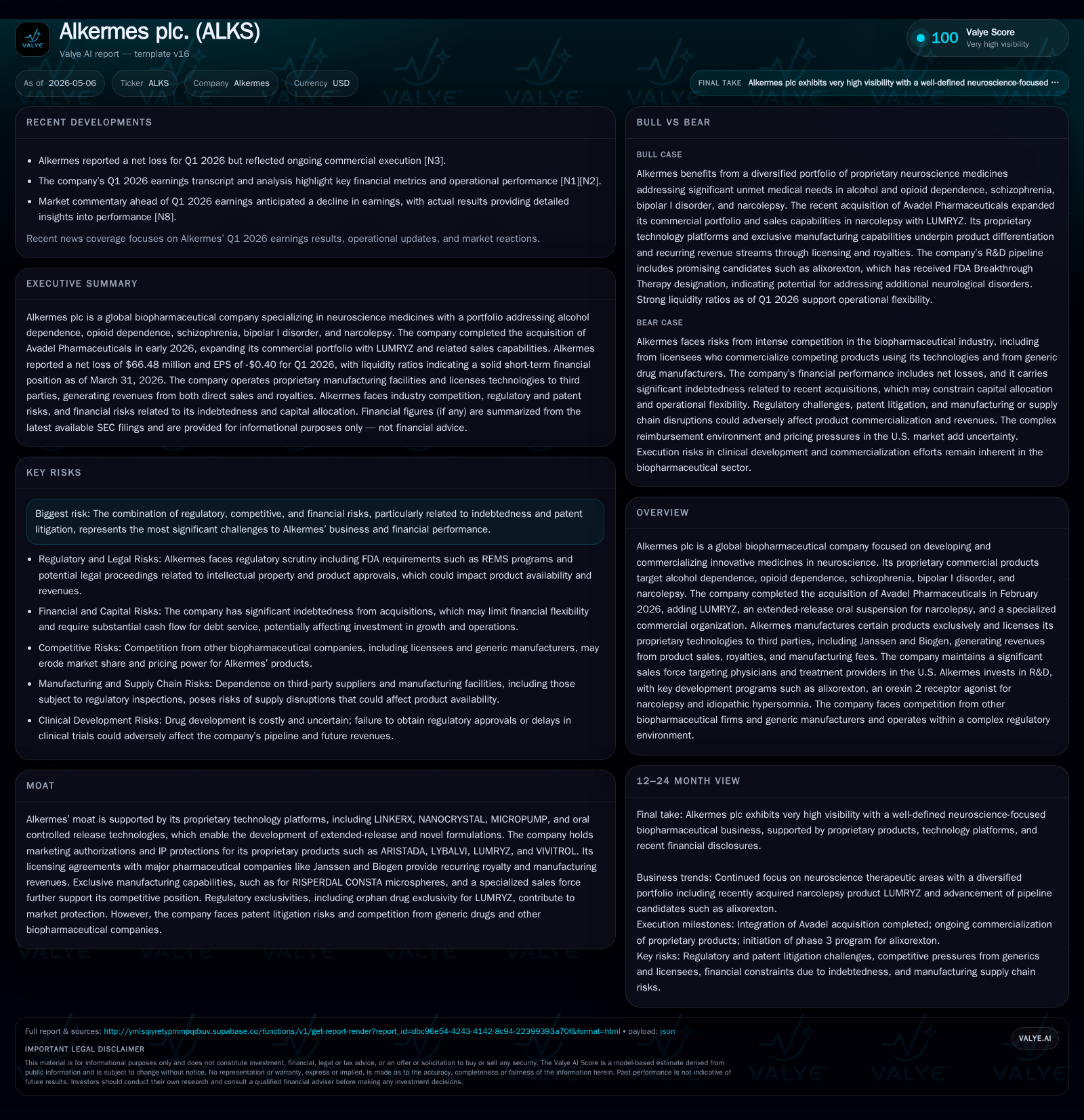
Alkermes plc reported its latest quarterly results on May 5, 2026, highlighting the completion of its strategic acquisition of Avadel Pharmaceuticals and enhanced presence in neuroscience-focused therapeutics. The addition of LUMRYZ expands its proprietary commercial portfolio addressing narcolepsy alongside existing treatments for schizophrenia, opioid dependence, and bipolar disorder. Its business model leverages proprietary extended-release technologies and licensing collaborations to generate diversified revenue streams including product sales, royalties, and manufacturing fees. Competitive positioning benefits from regulatory exclusivities and a specialized U.S. sales force, though pressures include patent litigation risks, generic competition, and significant post-acquisition indebtedness. Near-term growth hinges on successful integration of Avadel’s operations and progress in key pipeline candidates such as alixorexton.
Recent Operating Update
In its May 5, 2026 10-Q filing [S2], Alkermes plc provided its most current operating disclosure following the pivotal completion of its acquisition of Avadel Pharmaceuticals in February 2026 [S1][S3]. This transaction brought into Alkermes’ portfolio LUMRYZ (extended-release sodium oxybate), a treatment for narcolepsy that diversifies its neuroscience therapeutic offerings beyond psychiatry indications like schizophrenia and bipolar disorder. The acquisition included not only the product but also a dedicated commercial organization experienced in narcolepsy care.
The latest filing underscores management's focus on integrating Avadel’s operational infrastructure—including complex administrative systems spanning HR, finance, sales operations, regulatory compliance programs, and supply chain logistics—into Alkermes’ broader corporate framework [S1][S7]. Such integrations bear risk of operational disruptions or cultural misalignment that could challenge expected synergies.
Despite these challenges, Alkermes signaled continued commitment to advancing its R&D pipeline with a particular emphasis on alixorexton (ALKS-2680), a novel selective orexin 2 receptor agonist targeting narcolepsy types NT1, NT2 and idiopathic hypersomnia. Following successful phase 2 results announced in 2025 and Breakthrough Therapy designation from the FDA granted in December 2025 [S21], phase 3 trials commenced early Q1 2026—highlighting a structural investment in expanding treatment options for hypersomnolence disorders.
Business Model
Alkermes operates primarily as a biopharmaceutical company specializing in neuroscience disorders. Monetization is multi-pronged:
Direct Commercial Sales: Proprietary products such as ARISTADA (long-acting injectable antipsychotic), LYBALVI (oral atypical antipsychotic approved for schizophrenia and bipolar I disorder), VIVITROL (opioid and alcohol dependence injectable treatment), and now LUMRYZ are marketed directly to U.S-based physicians predominantly treating psychiatric or addiction-related conditions. Alkermes sustains significant branded pharmaceutical sales forces: approximately 435 reps for ARISTADA-related products and over 100 reps dedicated to VIVITROL [S24].
Royalty Revenue: The company licenses proprietary drug delivery technologies like LINKERX (injectable microspheres) to major pharma partners including Janssen Pharmaceuticals (notably for RISPERDAL CONSTA microspheres) and Biogen. Royalties from these arrangements represent a recurring revenue component linked to third-party product sales.
Manufacturing Fees: Alkermes produces certain extended-release formulations exclusively—such as RISPERDAL CONSTA—generating contract manufacturing income.
The core proposition rests on proprietary sustained-release platforms (LINKERX for injectables; NANOCRYSTAL and MICROPUMP technologies for oral formulations). These platforms provide differentiation by enabling less frequent dosing schedules that support improved patient adherence—a critical factor in chronic neuropsychiatric disease management [S11]. Furthermore, regulatory exclusivities including orphan drug status for LUMRYZ add temporal market protection enhancing revenue visibility.
Supporting this model is a specialized U.S.-focused commercial footprint targeting prescribers who manage serious CNS disorders. Customer engagement includes professional education, direct physician outreach via sales teams, disease state advocacy partnerships, insurance navigation services, fulfillment support via specialty pharmacies and wholesaler networks—all tailored to facilitate patient access amid complex payer environments [S24].
Industry Structure & Competitive Position
The neuroscience biopharmaceutical landscape is marked by intense competition from large pharmaceutical firms with extensive resources alongside generic manufacturers targeting established branded drugs approaching patent expiry [S29]. Alkermes competes on several fronts:
Therapeutic Innovation: Alixorexton represents advancement into orexin-targeted therapies with potential first-mover advantage given its mechanism addressing wakefulness regulation distinct from stimulant-based treatments.
Product Formulation & Delivery: Extended-release injectables like ARISTADA confer clinical advantages that can drive prescriber preference through enhanced compliance; similarly LUMRYZ's extended-release oral suspension differentiates itself via convenience relative to immediate release sodium oxybate competitors.
Regulatory Protections: Patent exclusivities combined with FDA granted REMS frameworks—mandated due to safety concerns surrounding abuse potential—create high entry barriers favoring incumbents but imposing significant post-marketing compliance costs [S14][S22].
Still notable competitive threats loom:
- Generic entrants launching bioequivalent versions may erode market share once exclusivities lapse.
- Competing drug candidates employing new mechanisms or formulations could disrupt demand if proven safer or more efficacious.
- Larger companies possess scale economies in R&D investment and marketing reach that may outpace Alkermes’ capabilities.
Ongoing patent litigation also presents a medium-term risk factor threatening uninterrupted revenue flows from key products [Valye Report Excerpt; S8].
Growth Drivers
Distinct growth catalysts are anchored around:
Integration of Avadel Acquisition: Realizing operational synergies including cross-selling opportunities leveraging the enlarged neuroscience-commercial platform. Successful alignment of LUMRYZ’s marketing with Alkermes’ established psychiatric portfolio could enhance brand penetration in narcolepsy—a specialist yet underdiagnosed indication.
Advancement of Pipeline Candidates: Alixorexton’s progression through phase 3 trials embodies a potential new class treatment option setting stage for launch post-FDA approval. Positive trial outcomes would also diversify revenue beyond existing product lines reliant on older agents approaching lifecycle maturity.
Continued Royalty & Manufacturing Income Growth: Sustained or increased sales by licensees Janssen or Biogen underpin stable royalty inflows supporting overall financial resilience.
Product Life Cycle Management: Label expansions or indication broadening efforts — e.g., exploring additional psychiatric or CNS-related uses — can extend market tenure of core products.
Evolving Patient Access Strategies: Tackling reimbursement headwinds through targeted specialty pharmacy partnerships or innovative patient support initiatives can mitigate payer restrictions increasingly impacting branded drug utilization [S7].
These drivers collectively support Alkermes’ goal to transition toward becoming a fully integrated neuroscience-focused biopharma with multiple commercialized assets supplemented by a promising late-stage pipeline.
Risks / Watchpoints / Constraints
Key risks complicating growth prospects include:
High Post-Acquisition Indebtedness: The roughly $1.525 billion debt raised to fund Avadel adds meaningful leverage burden that will constrain flexibility around capital allocation until deleveraging progresses [F1]. Interest expense consumes cash flow that might otherwise be invested in R&D or commercialization scale-up.
Integration Execution Risk: Complex merging of two specialized commercial infrastructures can distract management focus, dilute employee morale or trigger turnover impacting pace toward synergy capture [S7]. Failure here likely delays realizing expected cost savings or revenue gains.
Regulatory & Compliance Pressures: Maintaining FDA-mandated REMS programs—especially for controlled substances like sodium oxybate—is resource-intensive; any lapses could result in enforcement actions inhibiting market availability [S22][S14]. Additionally evolving payer policies increasing patient cost-sharing reduce therapy uptake potential [S7].
Patent Litigation & Generic Encroachment: Ongoing intellectual property disputes increase legal expenses and create uncertainties over product exclusivity horizons; early generic approvals pose tangible revenue erosion risks [S8].
Clinical Development Risks: Failures or delays in alixorexton or other development candidates could negatively impact growth assumptions dependent on successful pipeline commercialization [S21].
Competitive Dynamics: Larger competitors accelerating alternative therapies development may capture prescriber preference reducing market share available for Alkermes’ agents [S29].
Monitoring mitigation efforts across these dimensions is critical to evaluating future performance trajectory.
What To Watch Next
Investors and industry watchers should track several milestones closely:
- Progress reports on alixorexton’s phase 3 clinical program outcomes expected through late 2026/early 2027 will be pivotal given Breakthrough Therapy designation benefits.
- Updates regarding integration milestones related to Avadel’s sales force unification efficiency metrics such as customer retention rates or cross-brand prescription lift.
- Regulatory developments including REMS compliance audits outcomes around LUMRYZ that could impact marketing scope or require costly remediation efforts.
- Any patent litigation settlements or adverse verdicts affecting core products’ exclusivity tenure.
- Quarterly financial disclosures updating on revenue ramp from LUMRYZ alongside legacy products providing insight into portfolio diversification success versus debt servicing burdens.
- Broader market access shifts driven by insurance benefit redesigns influencing branded drug reimbursement dynamics within CNS therapeutics.
Successful management through these points will clarify whether Alkermes can leverage recent strategic moves into sustainable growth while balancing financial discipline amid industry headwinds.
Latest Financial Snapshot Summary
Latest financial snapshot
| Metric | Value | Period |
|---|---|---|
| Cash & equivalents | $352mm | |
| 2026-03-31 | ||
| Total debt | $1525mm | |
| 2026-03-31 | ||
| Net debt | $1173mm | |
| 2026-03-31 | ||
| Current assets | $1359mm | |
| 2026-03-31 | ||
| Current liabilities | $599mm | |
| 2026-03-31 | ||
| Current ratio | 2.27x | |
| 2026-03-31 |
Source: SEC companyfacts cache [F1].
*Net debt = Total Debt - Cash & Equivalents [F1]
These figures indicate a leveraged balance sheet largely reflective of recent M&A activity; however current liquidity remains adequate at over twice current liabilities offering operational runway amid integration phases [F1][S2].[N1]
This analysis is based solely on public SEC filings up to May 5, 2026 ([S1],[S2],[S3]) supplemented by reliable news sources ([N1]). No investment advice is offered herein; readers should conduct further due diligence before making decisions related to this company or sector.
Disclaimer: This is research-only, informational analysis and not investment advice. It may include AI-generated interpretation and general industry context. Always verify important details using primary sources.

Comments