
Coupang’s First Quarter: Assessing Operational Resilience and Strategic Momentum
Coupang’s Q1 2026 results reveal steady operational performance amid cybersecurity challenges, underpinning its logistics-driven business model in South Korea’s competitive e-commerce market.
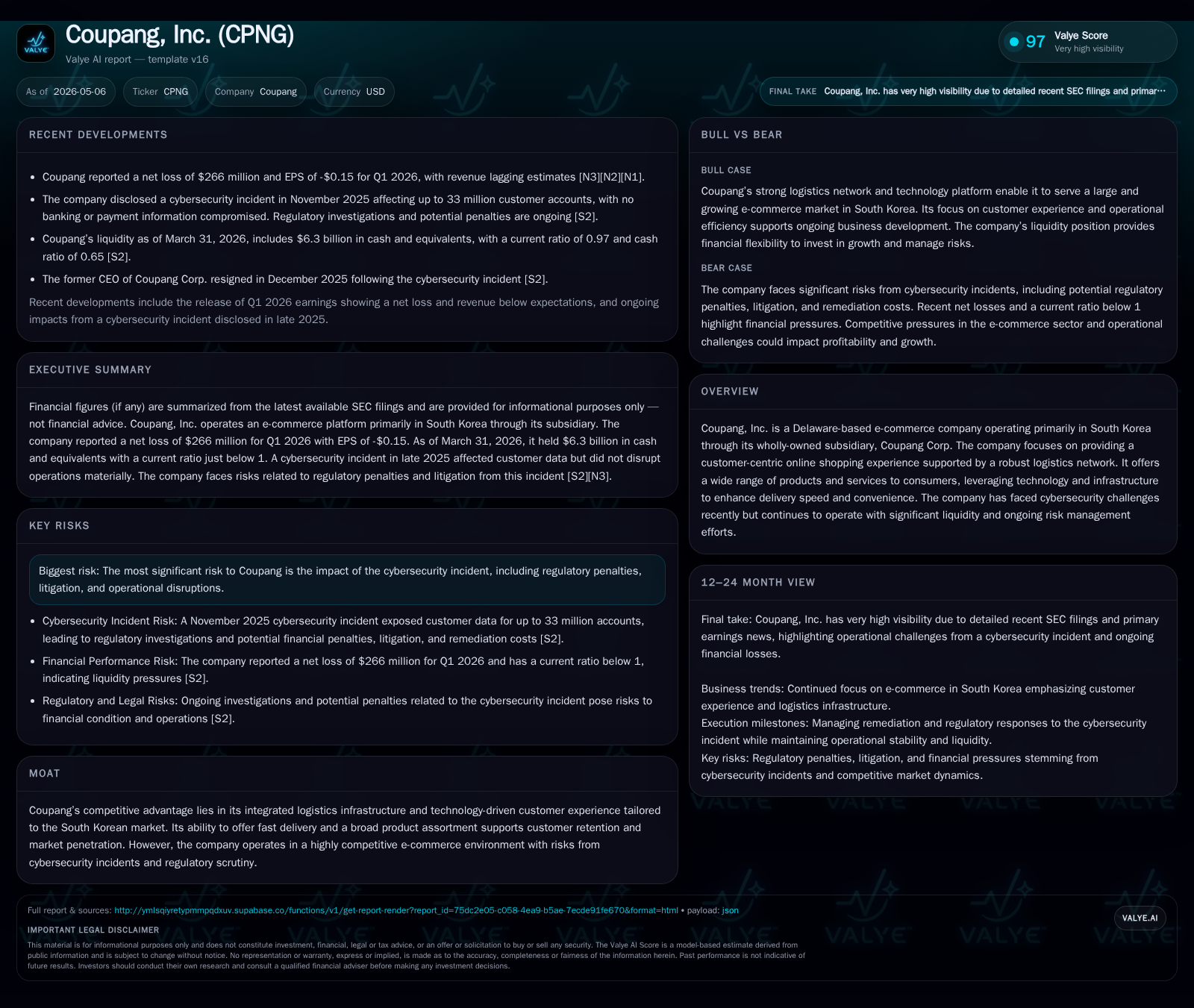
In its latest quarterly filing, Coupang reported revenues slightly below estimates with ongoing losses reflecting cybersecurity remediation costs but demonstrated operational resilience supported by its integrated logistics network. The company continues to leverage advanced delivery infrastructure and technology tailored to South Korean consumers, underpinning a differentiated customer experience. However, material risks persist from a recent cybersecurity incident that impacted millions of accounts and triggered regulatory scrutiny. Moving forward, growth will hinge on expanding product categories and improving logistics efficiency while managing risk and regulatory costs.
First Quarter Highlights: What Shifted in Coupang’s Operating Picture?
Coupang’s first quarter of 2026 reflected a mixed operating performance anchored by resilient revenue generation but dampened by the financial impact of the ongoing remediation following a significant cybersecurity incident disclosed late last year. According to the May 5, 2026 10-Q filing [S2] and corroborating press release [S3], revenue growth was slower than anticipated, contributing to a loss for the quarter as elevated costs were incurred related primarily to security enhancements, litigation preparations, and customer compensation efforts.
Despite these headwinds, Coupang emphasized no material disruption to core operations or fulfillment capacity during the period [S2], underscoring operational resilience in its day-to-day marketplace execution. The incident involved unauthorized access by a former employee affecting data associated with up to 33 million customer accounts, though crucially no payment or login credentials were compromised [S20]. Nonetheless, this has led to active investigations by Korean regulators with financial penalties anticipated though not yet quantifiable [S9].
The resignation of Coupang Corp.’s former CEO and the appointment of the company’s General Counsel as interim leader marked notable leadership adjustments in response to these challenges [S20], signaling an intensified focus on governance and compliance.
Business Model Insights: Integrated Logistics Meets Customer-Centric E-commerce
Coupang’s business model revolves around offering a seamless online shopping experience facilitated by an extensive integrated last-mile logistics network tailored primarily for South Korea. The company operates through its wholly owned subsidiary offering broad categories including consumer goods, electronics, groceries, and others with a strategic emphasis on rapid delivery — often same-day or next-day — supported by a proprietary fulfillment infrastructure detailed in the annual filing [S1].
Revenue is generated from consumer purchases of products sold directly or via marketplace sellers. The pricing mechanism includes item price plus shipping fees where applicable; however, Coupang often absorbs shipping costs as part of promotional strategies aimed at enhancing customer stickiness. This mix of revenue streams combined with high frequency purchase behavior drives volumes. Margins are affected by fulfillment costs which are partially offset through technological improvements in inventory management and route optimization.
Customer retention benefits from fast delivery times enabled chiefly by Coupang's large network of fulfillment centers strategically located across South Korea combined with advanced IT systems powering real-time tracking and AI-based demand forecasting [S1]. This integrated approach creates meaningful switching costs for consumers favoring reliability and convenience.
Competitive Positioning Within South Korea’s E-commerce Industry
The South Korean e-commerce landscape is competitive but distinctive; players like Naver Shopping leverage search engine dominance alongside marketplace models while global entrants offer broad assortment but commonly lack Coupang's localized logistics scale. Regulatory frameworks governing consumer protection and data privacy remain stringent globally but have heightened visibility in South Korea post-incident [S4].
Coupang's moat stems primarily from its vertically integrated logistics capability — controlling inventory flows end-to-end rather than relying heavily on third-party couriers — enabling superior service levels that competitors struggle to match consistently [S1]. This differentiator is critical in a market where consumer expectations for speed and product availability rank extremely high.
Supply chain capacity constraints appear manageable currently given incremental expansion plans disclosed annually; however, this remains an operational focus area as the company balances volume growth against cost structure efficiency—a dynamic central to sustaining competitiveness [S1].
From a switching cost perspective, loyalty is fostered via seamless app experiences, personalized recommendations (supported by internal AI teams), Plus membership benefits including free shipping tiers, all reinforcing customer lifetime value.
Growth Drivers: Leveraging Technology and Delivery Infrastructure
Near-term growth levers identified include accelerating penetration into product verticals such as fresh groceries and lifestyle categories that benefit from quick delivery turnarounds [S2]. Technology-driven operational enhancements—specifically AI-powered logistics routing and predictive inventory stocking—aim to increase throughput capacity without proportionate cost inflation.
Customer base expansion is targeted through marketing initiatives alongside increasing average order frequency driven by improved assortment breadth. KPIs to watch involve order volume growth rates released in quarterly updates plus delivery speed improvements measured internally.
Given that no material disruption occurred post-cybersecurity event [S2], the company expects underlying demand trends to maintain structural momentum.
Risks and Challenges: Cybersecurity Incident and Regulatory Pressures
The cybersecurity breach disclosed on November 18, 2025 poses significant near- to medium-term risks. While no direct theft of payment information was reported [S20], customer personal data accessed exposes Coupang to potential reputational damage alongside material financial liabilities from regulatory fines, litigation costs, customer remediation expenses, and heightened security investment requirements described extensively across filings including Q1 Risk Factors [S9],[S4].
Management distraction from core growth initiatives is also highlighted as a possible consequence given required resource allocations towards investigative cooperation with authorities and remediation efforts [S17],[S20]. These challenges underline uncertainty around profit trajectory despite operational robustness.
Monitoring Forward: Key Milestones and Demand Indicators Ahead
Investor focus should center on upcoming earnings releases for updates on remediation cost trajectories, regulatory outcomes especially quantitative penalty disclosures if any become public [N1],[N2]. Equally important will be metrics around order volume velocity and delivery time improvements which are proxies for demand health and operational scaling success.
Further product category expansions or innovations announced by management can signal sustained strategic ambition despite external headwinds. Additionally, monitoring management commentary regarding cyber risk mitigation progress will provide clarity on risk containment effectiveness.
Latest Financial Snapshot: Balance Sheet Strength and Liquidity Commentary
Latest financial snapshot
| Metric | Value | Period |
|---|---|---|
| Cash & equivalents | $6.3bn | |
| 2026-03-31 | ||
| Total debt | $650mm | |
| 2025-12-31 | ||
| Net debt | $-5.7bn | |
| 2025-12-31 | ||
| Current assets | $9.4bn | |
| 2026-03-31 | ||
| Current liabilities | $9.6bn | |
| 2026-03-31 | ||
| Current ratio | 0.97x | |
| 2026-03-31 |
Source: SEC companyfacts cache [F1].
The balance sheet reflects substantial liquidity reserves with $6.3 billion in cash equivalents as of March 31, 2026 combining with low overall debt levels ($650 million end-2025) yielding a net cash position estimated at approximately $5.65 billion [F1].
This liquidity foundation provides cushioning against episodic risks such as those stemming from cybersecurity remediation expenditures while enabling continued investment into strategic growth avenues.
This analysis presents recent developments grounded strictly in filed SEC disclosures complemented by industry context relevant to Coupang's operational environment. It avoids forecast speculation or valuation commentary consistent with analytical guidelines.
Disclaimer: This is research-only, informational analysis and not investment advice. It may include AI-generated interpretation and general industry context. Always verify important details using primary sources.

Comments