
FibroBiologics Advances Fibroblast Cell Therapy Amid Manufacturing Challenges
The company's recent quarterly filings highlight ongoing operational hurdles and liquidity stress as it pushes its fibroblast-based cell therapy pipeline forward.
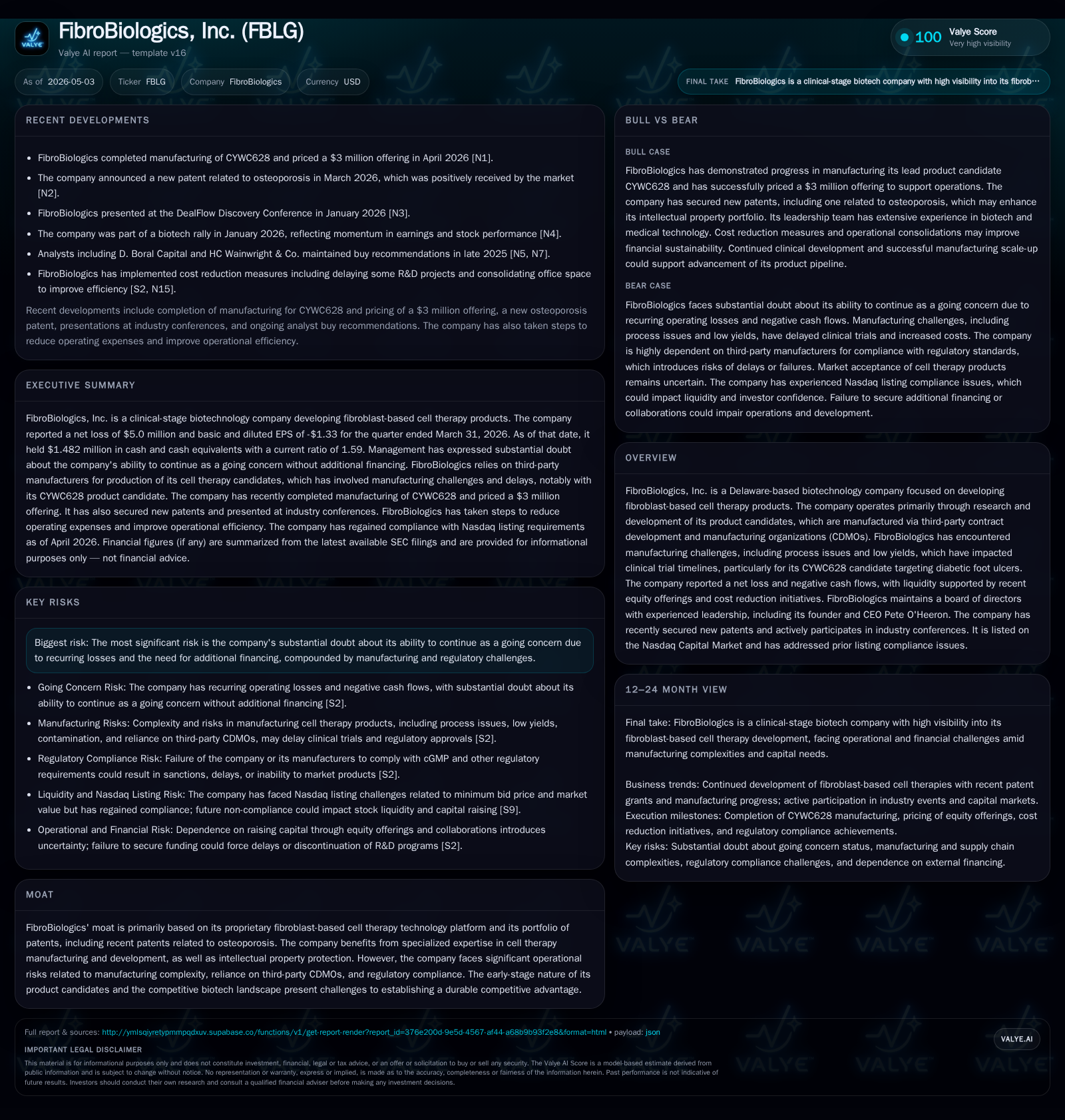
FibroBiologics, Inc. faces significant near-term challenges marked by a going concern warning in its April 2026 10-Q due to recurring losses and limited cash. The company continues to develop its fibroblast-based cell therapy products, primarily CYWC628 for diabetic foot ulcers, but manufacturing complexities and low yields at third-party CDMOs threaten trial timelines. Despite operational headwinds, FibroBiologics has secured new patents and is actively managing costs and financing efforts, including an ATM equity program to extend its runway. The biotech’s future hinges on resolving manufacturing issues, hitting clinical milestones, and successfully raising capital to support development and commercialization activities.
Recent Quarterly Operational Update Highlights
FibroBiologics’ latest quarterly filing dated April 30, 2026 (10-Q) starkly highlights the precariousness of the company’s financial and operational footing. Management explicitly states substantial doubt about the company’s ability to continue as a going concern for the next twelve months due to ongoing operating losses and negative operating cash flows since inception [S2]. Key remedial measures include deferring certain R&D expenses while funneling resources into higher-priority pipeline projects like CYWC628 for diabetic foot ulcers. Administrative costs have been curtailed through cuts in finance, legal, office space utilization, illustrating aggressive expense control amidst constrained liquidity.
Complementing this is the May 1, 2026 filing (8-K) announcing an At-The-Market (ATM) offering agreement enabling up to $6.15 million in equity issuance through H.C. Wainwright & Co., signaling proactive capital raising efforts aimed at bolstering runway [S3]. Notably, earlier in the year the company executed a reverse stock split (1-for-20) effective March 30 to address prior Nasdaq listing deficiencies arising from bid price erosion and market value shortfalls—regulatory hurdles that add pressure on investor confidence and trading liquidity [S24], [S26].
Despite these headwinds, FibroBiologics secured formal Nasdaq compliance by mid-April 2026 though now faces ongoing monitoring which preserves listing status but reflects underlying fragility [S17], [S18]. The April quarter update thus paints a picture of a biotech navigating critical near-term existential risks while striving to sustain clinical progress under substantial financial strain.
FibroBiologics’ Business Model and Product Focus
FibroBiologics centers its business model on developing novel fibroblast-based cell therapy products designed to enhance tissue regeneration and repair. Its lead product candidate CYWC628 targets diabetic foot ulcers—a large unmet medical need characterized by chronic nonhealing wounds prone to infection and amputation risk. FibroBiologics depends heavily on outsourcers—third-party contract development and manufacturing organizations (CDMOs)—to produce its biologic therapies given the capital-intensive nature of cell production infrastructure and technical complexity involved in scaling live-cell therapeutics manufacturing [S1],.
This research-and-development-centric model provides flexibility but introduces systemic risk around process reproducibility, quality assurance, and supply chain dependencies. The proprietary fibroblast technology is underpinned by a portfolio of patents encompassing manufacturing innovations and therapeutic methods including recent additions related to osteoporosis treatment expanding their intellectual property moat potential.
Operationally, FibroBiologics invests primarily in experimental development phases with no commercial product revenues yet reported; revenue generation will depend on eventual FDA approvals followed by market launch or outlicensing partnerships. However, quality issues leading to low yields during manufacturing runs have created bottlenecks delaying clinical trial enrollments especially for CYWC628—amplifying execution risk inherent in biomanufacturing cellular therapies at scale.
Manufacturing Complexities and Competitive Dynamics in Cell Therapy
The manufacturing of cell therapies such as fibroblast-based products is beset with unique challenges absent in traditional pharmaceutical production. Each batch involves living cells that vary with harvesting techniques, culture conditions, donor attributes, and handling processes—all contributing to intrinsic variability impacting yield consistency and potency profiles. FibroBiologics’ disclosures confirm ongoing process difficulties causing low yields that threaten timely supply of investigational product for clinical studies [S2], alongside typical bioprocess scale-up constraints faced by emerging biotech firms.
Reliance on third-party CDMOs offers access to specialized expertise but also introduces counterparty dependency risks regarding capacity availability, component sourcing issues for media reagents or raw materials, quality control compliance burdens under cGMP regulations, and logistics coordination.
Within cell therapy industry peers are contending with similar hurdles intensified by heightened regulatory scrutiny demanding stringent validation protocols across manufacturing stages. Intellectual property saturation in the regenerative medicine field demands innovation not only on therapeutic fronts but also in improving scalable production technology—a domain where FibroBiologics aims differentiation through patented platform components albeit still early stage compared with larger established competitors employing pluripotent stem cells or gene-modified platforms.
Switching costs for CDMO contracts may afford some stability; however delays due to quality failures or yield shortfalls risk eroding client trust if clinical milestones slip behind schedule impacting valuation prospects.
Growth Drivers: Pipeline Progress and Intellectual Property Expansion
Structural growth catalysts remain closely linked to validation milestones within FibroBiologics’ CYWC628 program as well as expansion of its proprietary patent portfolio enhancing defensibility against competitors. Achieving reliable manufacturing scale-up validated per regulatory expectations will unlock capacity sufficient for pivotal trials or early commercial batches—a milestone the company pursues aggressively amid current setbacks.
Recent granted patents related to osteoporosis therapeutics signal broadened application scope beyond wound healing indications enhancing platform versatility potentially attracting licensing or partnership interest. Engagements at industry conferences reflect active scientific communication fostering ecosystem visibility.
KPIs indicative of future growth include successful completion of manufacturing process validations underway per latest announcements [S3], upcoming clinical data readouts expected over ensuing quarters that could demonstrate proof-of-concept efficacy benefiting regulatory dialogue.
Capital initiatives such as the ATM equity facility augment balance sheet strength providing dry powder needed for intensified R&D investment essential for maturation of their pipeline candidates toward late-phase trials or strategic collaboration discussions.
Risks and Constraints: Liquidity, Manufacturing, and Market Position
FibroBiologics faces multiple interlocking risks shaping its outlook: foremost is chronic cash burn producing persistent liquidity pressures culminating in management’s explicit going concern warning revisited each quarter demonstrating fundamental funding scarcity threatening operational continuity absent successful capital raises or revenue inflection points [S2], [S4].
Manufacturing production shortfalls represent acute delivery risk delaying clinical trials thereby jeopardizing timelines for regulatory filings crucial for value creation event horizons. Reliance on external CDMOs compounds uncertainty related to contractual dependence amid variable capacity constraints.
Market competition remains fierce among early-stage regenerative medicine companies where product differentiation pivots on IP strength aligned with tangible clinical success; FibroBiologics’ smaller size relative to bigger biotech players scenarios potential competitive displacement should lead assets falter or rival platforms scale more effectively.
Investor skepticism tied to nascent stage status reflected in stock price volatility compounded by prior Nasdaq listing challenges constrains straightforward equity fundraising approaches forcing reliance on more dilutive ATM programs increasing shareholder dilution risk.
Looking Ahead: Upcoming Milestones and Capital Needs
Key near-term events merit close attention: progress reports detailing resolution status of CYWC628 manufacturing yield issues serve as immediate demand markers signaling technological robustness improvement or ongoing bottlenecks delaying trial accrual schedules.
Clinical trial enrollment updates or interim safety/efficacy findings constitute critical validation steps that could catalyze broader investor interest or partnership dialogues. Additional patent grants expanding IP coverage will enhance perceived moat breadth offering strategic optionality.
On financing front contemporaneous capital raising endeavors via ATM offerings provide flexibility but must be balanced against dilution effects; securing multi-million dollar injections requisite given approx $1.5 million cash balance at quarter end juxtaposed against operational burn rates indicating modest runway vis-à-vis ambitious R&D plans without alternative revenue streams [F1], [S3].
Overall success pivots on credible demonstration of scalable production capabilities converging with positive clinical signals within an acceptable capital structure enabling sustainable progression toward commercialization or partnering outcomes.
Financial Snapshot: Liquidity Status and Operating Losses
Latest financial snapshot
| Metric | Value | Period |
|---|---|---|
| Cash & equivalents | $1482000 | |
| 2026-03-31 | ||
| Current assets | $3mm | |
| 2026-03-31 | ||
| Current liabilities | $1829000 | |
| 2026-03-31 | ||
| Current ratio | 1.59x | |
| 2026-03-31 |
Source: SEC companyfacts cache [F1].
| Metric | Amount (USD) |
|---|---|
| Cash & Equivalents | $1,482,000 |
| Current Assets | $2,905,000 |
| Current Liabilities | $1,829,000 |
| Current Ratio | 1.59 |
As of March 31, 2026, FibroBiologics held approximately $1.48 million in cash alongside total current assets nearing $2.9 million against current liabilities around $1.83 million yielding a current ratio of approximately 1.59 indicating marginal short-term liquidity coverage based on reported figures [F1]. The latest published full-year operating income was negative $16.65 million as of December 31, 2025 reflecting extensive R&D spending characteristic of early-stage biotechs focused exclusively on pipeline advancement without commercial revenues yet realized.
Debt figures are less contemporaneous but best estimates place net debt near $2.8 million suggesting some leveraging though no recent refinancing activity was detail provided tying directly back into Q1 filings or event disclosures implying potential leverage concentration requiring monitoring if financing gaps widen impacting solvency perceptions.
This financial snapshot corroborates the narrative detailing constrained capital reserves prompting urgent need for equity issuances or collaborations underpinning survival prospects rather than growth expansion currently.
This review incorporates factual insights derived solely from the referenced SEC filings ([S1]–[S28]) and validated companyfacts data ([F1]) without speculative extrapolation beyond disclosed information.
Disclaimer: This analysis is provided solely for informational purposes without any recommendation regarding securities of FibroBiologics or any investment action.
Disclaimer: This is research-only, informational analysis and not investment advice. It may include AI-generated interpretation and general industry context. Always verify important details using primary sources.

Comments