
Bank of America’s Q1 Reveals Strategic Balance Amid Evolving Market Risks
Bank of America's latest quarterly results illustrate its diversified revenue streams, prudent risk management, and regulatory navigation amid macroeconomic uncertainties.
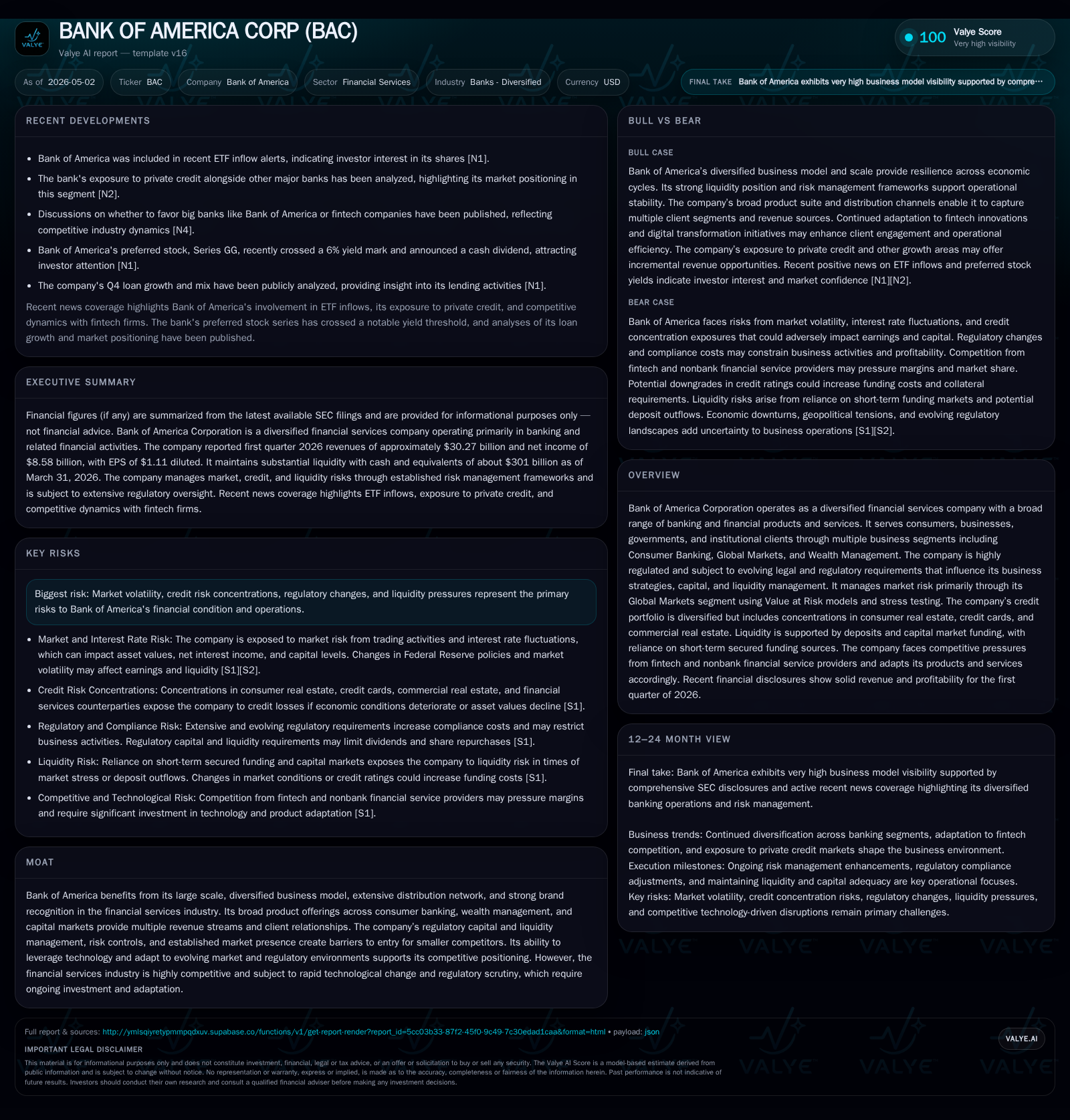
In its Q1 2026 SEC filing, Bank of America reaffirmed a balanced operating stance leveraging its broad business segments to offset market volatility and credit concentration risks. The diversified model spanning consumer banking, global markets, and wealth management remains its core strength, supported by sophisticated risk controls such as VaR monitoring within trading activities. Regulatory capital buffers and liquidity position maintain resilience despite increasing G-SIB surcharges and evolving compliance demands. Key growth opportunities lie in deposit expansion, credit portfolio leveraging in targeted segments, and technology-driven enhancements, while risks from market swings, credit concentrations, and regulatory complexities warrant ongoing scrutiny.
Q1 2026 Operating Update Highlights
Bank of America’s latest quarterly filing (Form 10-Q dated May 1, 2026) provides a focused view into how the bank manages evolving market risks through diversified operations and rigorous risk measurement. Notably, the trading Value at Risk (VaR) across all business segments remained relatively stable at about $46 million at period end on a 99% confidence level with one-day holding period [S2]. This figure encodes market risk exposure primarily within the Global Markets segment. Although there was a modest decline from prior quarters’ peaks, the sustained elevated levels relative to early-2025 reflect persistent volatility in foreign exchange, interest rate products ($30M VaR), credit instruments ($36M VaR), equity-related instruments ($27M VaR), mortgage-related exposure ($26M VaR), and commodities ($11M VaR).
Credit risk disclosures underscore notable concentrations particularly in consumer real estate and credit cards alongside commercial real estate lending [S2], consistent with prior periods but with continued vigilance evident in capital provisioning strategies. Liquidity analysis reveals a foundation of substantial deposit funding complemented by active access to capital market instruments. According to companyfacts data as of March 31, 2026, total debt stood close to $326 billion with an estimated net debt (adjusting for cash & equivalents) near $25 billion [F1]. Although the filings do not detail leverage ratios explicitly this quarter, they highlight the importance of maintaining strong liquidity coverage ratios and stable funding metrics against a backdrop of patchy economic conditions [S2].
The April 15th event filing (8-K) reconfirms continued engagement with preferred stock issuance activity as part of diversified capital structure management [S3]. This optionality provides flexibility during rising regulatory capital buffer expectations.
Bank of America’s Diversified Business Model and Product Offering
Bank of America operates through multiple interconnected business segments which collectively underpin its revenue generation pathways. Consumer Banking remains a cornerstone providing retail deposits, mortgage lending, credit cards, home equity loans and small business services. This unit benefits from the bank’s extensive branch network and digital platform capabilities adapted to evolving consumer preferences including AI-enhanced personalization [S1].
Global Markets delivers sales and trading services that manage market risk through derivatives dealing across interest rates, foreign exchange, equities and commodities clients [S1]. This segment functions as a crucial earnings engine but is inherently exposed to market fluctuations requiring sophisticated quantitative risk models like VaR.
The Wealth Management segment serves affluent clients with investment advisory services and asset management products. Its fee generation depends strongly on Assets Under Management (AUM), which is subject to valuation volatility tied not only to market prices but also client retention success [S1].
Crucially for BAC’s business resiliency is the breadth across both fee-based advisory income streams and interest margin-rich lending portfolios. The company’s product strategy is marked by continuous adaptation driven by competitive pressures from fintech challengers and regulatory mandates demanding enhanced technological workflows including AI implementations to improve pricing analytics, customer engagement, fraud detection and operational efficiency [S1].
Competitive Positioning Within the Banking Industry
Bank of America benefits from one of the largest scales globally among diversified banks resulting in distinct advantages. Its extensive distribution footprint includes thousands of branch locations nationwide combined with robust digital platforms enabling broad consumer reach. Regulatory capital requirements function effectively as barriers limiting smaller entrants who lack scale or buffers required for G-SIB designation compliance [S1][N3].
Additionally, BAC’s brand recognition supports client loyalty which alongside integrated servicing models raises switching costs for retail customers while institutional clients benefit from one-stop access to comprehensive products spanning treasury services to complex derivatives.
Technology investment forms a key pillar countering fintech disruption risks; BAC emphasizes embedding AI into customer-facing channels while reinforcing cyber resilience amidst rising threats [S15]. Regulatory complexity continues mounting given global operations across jurisdictions—the bank's compliance infrastructure is both costly and essential to safeguard franchise value against reputational damage or sanction-related disruptions [S9][S21].
Key Growth Drivers Shaping Future Opportunities
Several measurable growth vectors emerge:
- Deposit Growth: Driven by consumer confidence albeit challenged by higher yielding alternatives; BAC leverages cross-sell initiatives within Consumer Banking alongside digital onboarding enhancements.
- Loan Book Expansion: Selective growth targeting prime consumer real estate loans and credit card borrowing balances where underwriting discipline balances volume gains against rising credit risk.
- Wealth Management Penetration: Increasing AUM through enhanced digital sales funnels supported by data-driven client segmentation; ongoing rise in assets managed translates directly into recurring fee income.
- Net Interest Margins: Benefiting from current interest rate environment with potential tailwinds as spread dynamics evolve; however margin compression risks remain from competitive deposit pricing or spikes in funding costs.
- Operational Efficiency: Technology modernization particularly AI enables cost containment via automation across back-office processes including compliance checks.
These drivers connect explicitly to KPIs like deposit balances trends reported quarterly [S2], loan portfolio mix shifts visible through disclosures [S2], AUM fluctuations linked to market valuations [S1] and expense ratio movements related to technology spend [S1][N3][N6].
Risks and Constraints Impacting Performance
Persistent risks frame BAC’s operating landscape:
- Market Volatility: Fluctuations impact trading revenues variability measured via VaR metrics; also affect asset prices influencing AUM fees.
- Credit Concentrations: Exposure notably within consumer mortgages and credit cards tied closely to economic cycles could elevate provisions during downturns [S18][S19].
- Regulatory Headwinds: Capital rule changes including expected increase of G-SIB surcharge from 3.0% to 3.5% in 2027 constrain dividend pay-outs or share repurchases while mandating capital accumulation imposing opportunity costs [S6][S16].
- Liquidity Pressures: Reliance on short-term secured funding exposes BAC to refinancing timing risks exacerbated during stress periods; contractually complex intercompany liquidity transfers can limit parent company agility under duress scenarios [S16][S20].
- Legal/Compliance: Continuing investigations around anti-money laundering programs plus emerging privacy technology laws heighten litigation potentials with significant cost implications plus reputational hazard [S21][S23].
- Operational Risks: AI adoption introduces new compliance complexities related to data governance and model transparency; third-party dependencies amplify control concerns.
Upcoming Milestones and Market Signals to Monitor
Investor attention should focus on:
- Q2 Earnings releases tracking net interest income trajectory reflecting rate environment developments.
- Regulatory announcements pertinent to G-SIB surcharges or stress test outcomes impacting capital planning.
- Deposit flow metrics including ETF-driven movements influencing liquidity profile per detailed disclosures or market commentary [N6].
- Credit quality indicators such as delinquency rates or provisioning changes signaling stress within concentrated portfolios.
- Execution progress on technology projects especially AI integration assessed through expense efficiency ratios or customer satisfaction markers.
Each serves as an actionable pulse check on the operational momentum underpinning Bank of America’s strategic ambitions.
Concise Financial Profile and Capital Management Overview
As reported in recent filings plus supplemental companyfacts data points: total debt approximates $326 billion with net debt adjusting for liquid cash reserves around $25 billion as of March 2026 quarter-end [F1]. Capital levels are actively managed responding ahead of an anticipated G-SIB surcharge increase scheduled for 2027 raising it from the current 3% level closer toward 3.5% necessitating calibrated capital retention strategies that may pressure dividend distributions or share buyback programs [S6][N4]. Risk-weighted assets (RWAs) remain carefully scrutinized given concentration risks notably in consumer real estate portfolios balancing growth prospects against potential provisioning needs.
Overall financial flexibility supports sustainable growth execution despite macroeconomic headwinds.
This analysis synthesizes public disclosures from Bank of America's filings as of Q1 2026 without providing investment recommendations or forward-looking guidance beyond documented statements. All financial figures referenced adhere strictly to SEC-reported data or validated company facts ensuring objectivity grounded in verified sources.
Disclaimer: This is research-only, informational analysis and not investment advice. It may include AI-generated interpretation and general industry context. Always verify important details using primary sources.

Comments