
Perella Weinberg Partners’ Q1 2026 Update: Balancing Growth and Volatility in Advisory
PWP’s latest quarterly filing underscores revenue volatility driven by deal timing while spotlighting the firm’s strategic investments in global expansion and independent advisory differentiation.
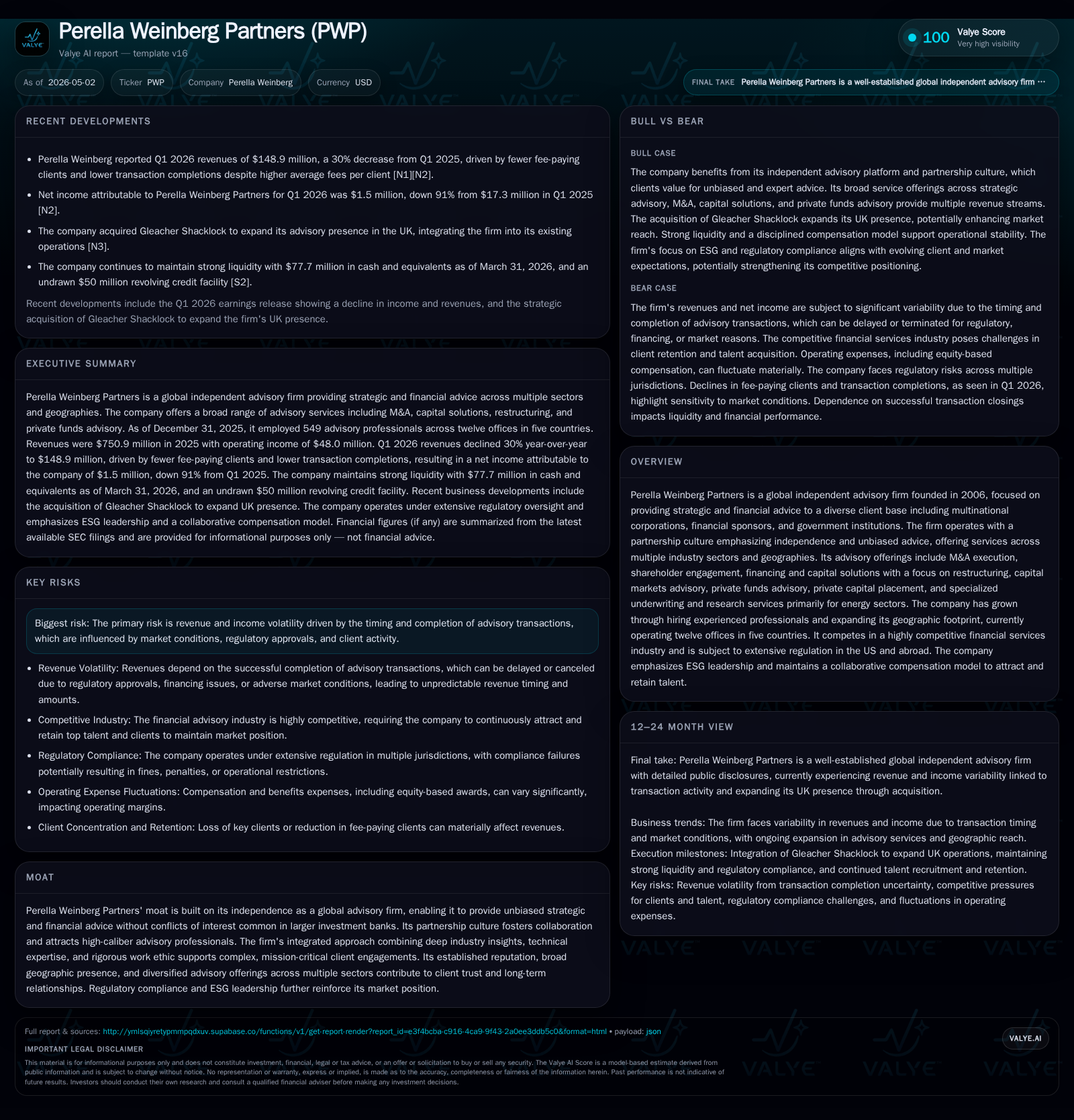
Perella Weinberg Partners reported notable revenue fluctuations in Q1 2026 due to the unpredictable timing of transaction closures, reflecting a broader industry challenge. Despite this volatility, the firm pursues growth via geographic expansion, including its recent UK acquisition, and deepening its integrated advisory offerings. PWP’s independent partnership model and conflict-free advice underpin its competitive advantage in a tight talent market. Risks remain elevated from client turnover, regulatory delays, and macroeconomic headwinds.
Latest Quarterly Operating Summary and What Changed
Perella Weinberg Partners’ first quarter of 2026 illustrated the inherent revenue volatility endemic to the independent advisory business. The May 1, 2026 Form 10-Q reveals significant unpredictability in revenue recognition tied directly to the timing of transaction completions—an operational reality that remains a defining feature of the firm’s performance [S2]. Strategic engagements frequently conclude on staggered schedules as transactions await regulatory approval, board authorizations or final financing arrangements. Despite active client dialogues and new wins highlighted in concurrent earnings discourse [N1], transactional calendars compressed into Q1 led to uneven fee realization compared both sequentially and year-over-year.
Alongside ongoing organic activity, PWP announced progress on expanding its geographic reach notably through its acquisition of Gleacher Shacklock to bolster UK presence [N2]. This move reflects PWP’s commitment to cultivating global footprint diversity amid uneven deal flow cycles. Additionally, recent event filings validate an orderly management transition underpinning operational continuity [S3]. However, compensation expense swings aligned closely with variable revenues present a continuing challenge for managing cost structure predictability.
Overview of Business Model and Service Mix
PWP generates revenue primarily by providing discrete but often bundled advisory services: strategic corporate finance counsel, mergers and acquisitions execution, restructuring advisory with liability management emphasis, shareholder engagement strategies, plus private funds and capital placement advisory. This integrative service delivery leverages cross-functional teams tailored to client needs rather than compartmentalized product lines [S1]. The firm does not segment its revenues by advisory category because engagements typically encompass multiple overlapping services requiring seamless collaboration among senior professionals.
Clients range from multinational corporations to financial sponsors and government bodies seeking unbiased strategic insight free from conflicts found in large global banks. Independence is the core differentiator enabling candid dialogue critical for complex transactions. This partnership culture attracts distinguished advisory partners who lead teams across PWP’s twelve offices in five countries [S1].
Independent Advisory Firm’s Competitive Edge
PWP’s moat rests significantly on its identity as an independent partnership. Freed from conflicting interests intrinsic to larger investment houses engaged simultaneously in lending or proprietary trading activities, PWP can offer honest opinions—even those contrary to client views—strengthening trust [S1]. The firm cultivates a close-knit ‘advisory partners’ structure that fosters retention of seasoned talent vital for tackling high-profile mandates.
The recent acquisition of Gleacher Shacklock reinforces PWP’s capacity to serve UK-based mandates while complementing US operations [N2]. Regulatory compliance underpins operations globally; PWP rigorously adheres to SEC net capital rules as a registered broker-dealer among other regimes across jurisdictions [S1]. This discipline lends credibility amid heightened scrutiny of boutique advisors’ capital adequacy.
Industry Structure and Market Position
Operating within a fiercely competitive landscape dominated by bulge brackets yet punctuated by specialized independents, PWP navigates fee pressures intensified by commoditization risks yet leverages differentiated industry knowledge. The relationship-driven nature of deal origination means new client sourcing depends heavily on trusted introductions and maintaining senior advisor networks [S1]. Talent scarcity constrains capacity growth; hiring seasoned managing directors remains critical to sustaining qualitative advantage.
Regulatory complexity shapes operational conduct as broker-dealer regulations impose stringent capital requirements and governance standards impacting liquidity management [S1]. These factors collectively create barriers but also necessitate finely tuned internal controls.
Key Growth Drivers Supporting Expansion
Geographic scaling constitutes a cornerstone growth driver highlighted by the April acquisition in the UK sector [N2]. Expanding into European markets addresses demand for integrated advisory across borders.
Strategic recruitment elevates expertise breadth allowing deeper penetration into sectors requiring nuanced financing solutions or restructuring advice [S2]. Increasing frequency of multi-product mandating through cross-disciplinary teams boosts wallet share per client even if overall fee volume exhibits cyclical traits.
Macro environment shifts toward greater corporate realignment amid economic uncertainty favor demand for conflict-free advisories capable of navigating complex restructurings or shareholder activist scenarios [N1]. This structural trend supports sustained opportunity pipelines.
Risks and Constraints on Performance
Core risk lies in transaction timing unpredictability—a recognized vulnerability as larger deals cycle through elongated closing processes often delayed indefinitely by externalities such as regulatory review or market disruptions [S2]. Client attrition risk emerges from management upheavals at client organizations or consolidation trends reducing mandate multiplicity [S1].
Heightened competition compresses pricing power with clients leveraging alternative advisors available globally. Compensation expense represents a volatile component tied closely to realized revenues given discretionary bonus frameworks responsive to performance fluctuations [S2]. Regulatory developments could impose stricter capital criteria or licensing constraints limiting operational agility.
Upcoming Milestones and What to Watch Next
Key upcoming signals include quarterly transaction completion rates post-Q1 pressure points; integration synergies realization from Gleacher Shacklock enhancing UK income streams; monitoring retention metrics amongst senior advisory partners as cultural cohesion remains essential; management guidance updates particularly regarding operating expense calibration; regulatory clearance progress on pending complex mandates; alongside macroeconomic indicators influencing deal issuance volumes across primary sectors served [N1][N2][S3].
Concise Financial Profile Snapshot
As of March 31, 2026, PWP maintained a strong liquidity position with $77.7 million in cash balances supplemented by zero recorded debt underscoring a conservative balance sheet posture supportive of operational flexibility [F1][S2][S3]. The current ratio calculated historically reflects adequate short-term asset coverage though seasonal variation arises notably from incentive compensation payout cycles concentrated early each fiscal year [F1]. Net income swung negative in Q1 reflecting normal volatility yet full-year metrics reflect profitability gains achieved previously [F1][S2]. Capital allocation priorities continue emphasizing reinvestment for platform expansion alongside shareholder returns executed via ongoing share repurchase authorizations reiterated at year-end filings [S21].
This analysis is based solely on publicly filed documents and verified news sources without speculative content. It is intended for informational purposes without advocating for any investment action related to Perella Weinberg Partners.
Disclaimer: This is research-only, informational analysis and not investment advice. It may include AI-generated interpretation and general industry context. Always verify important details using primary sources.

Comments