
Trupanion's Q1 2026 Execution Highlights Subscription Growth Amid Strategic Leverage of Veterinary Partnerships
The latest quarterly report underscores Trupanion’s steady subscription momentum supported by its proprietary veterinary network and software innovation.
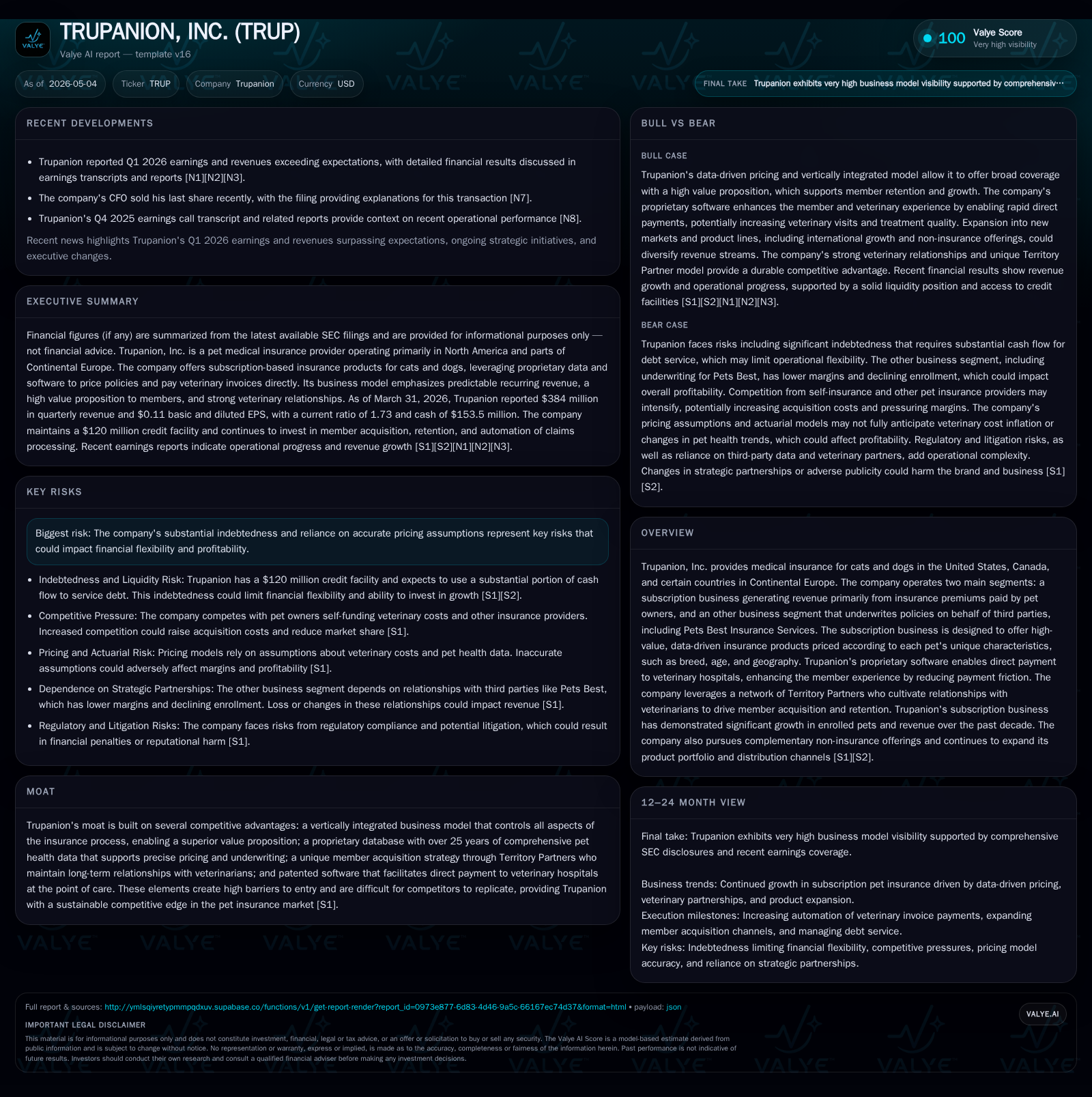
Trupanion, Inc. reported continued traction in its subscription pet medical insurance business in Q1 2026, reinforcing the strategic relevance of its Territory Partner model and patented direct payment software to veterinary hospitals. The company leverages a vertically integrated data-driven approach allowing precise pricing per pet, fostering long-term memberships and retention. While the other business segment with third-party underwritten policies remains lower margin and in decline, the focus on core subscription products drives predictable, recurring revenue. Key risks include significant indebtedness and exposure to regulatory and competitive dynamics in a fragmented but consolidating pet insurance market. Investors should monitor new pet acquisition efficiency, member retention trends, and potential expansion of non-insurance offerings as near-term growth drivers.
Recent Operating Update
Trupanion's Q1 2026 Form 10-Q filing dated April 30, 2026 [S2] along with an accompanying 8-K press release [S3] highlight continued momentum in its subscription business — the cornerstone of its operations. The company reaffirmed that there were no material changes to risk factors compared to the prior annual report [S9], indicating stable operating assumptions during its industry environment.
While the official revenue figure for Q1 was not explicitly stated in filings or news releases, the company’s most recent full-year revenue stood at approximately $1.44 billion [F1]. Commentary from earnings transcripts [N1] suggests that underlying subscription metrics such as new pets enrolled and retention rates remain strong drivers of recurring revenues in early 2026.
Business Model
Trupanion operates primarily through two segments: the subscription business and an 'other' segment comprised largely of underwriting policies on behalf of third parties like Pets Best [S12]. The subscription business constitutes the strategic focus; it delivers medical insurance products tailored via actuarial science and proprietary data capturing over 25 years of pet health outcomes [S1],[S7],[S21].
Revenue principally derives from insurance premiums paid monthly by pet owners (“pet parents”). Pricing is individualized based on each pet's breed, age, geography, deductible choice, and coverage level. This permits risk pooling where premium inflows from healthier (or "lucky") pets subsidize claims from those requiring more intensive care [S12]. Revenue growth is volume-driven by new member acquisitions plus retention of existing customers — both heavily dependent on efficient customer acquisition costs (CAC) managed through multi-channel marketing.
A key differentiator is Trupanion's vertically integrated model controlling underwriting, claims processing, marketing via Territory Partners, technology deployment, and reimbursement.
The patented software platform enables direct payment of approved veterinary invoices within seconds at point-of-service [S21]. This reduces friction for both members and vets since customers pay deductibles only post-service while claims are settled instantaneously between vet clinics and Trupanion. This real-time reimbursement capability enhances customer satisfaction and encourages adherence to recommended veterinary treatments. Increasing automation via AI/ML is underway to further reduce human oversight costs [S13].
Territory Partners act as independent contractors rooted regionally to foster trust-based relationships with veterinarians who recommend Trupanion insurance to their clients [S5]. This strategy aligns incentives with frontline veterinary professionals rather than typical third-party marketing models. These long-term relationships form a unique moat --- hard for competitors to replicate quickly or cost-effectively.
The other business segment involves underwriting policies for third parties like Pets Best Insurance Services — generating substantially lower margins relative to the subscription business [S10],[S20]. Enrollment here is declining as third parties shift underwriting relationships elsewhere. Managing this decline while maintaining profitable core segments forms part of Trupanion's current strategic priorities.
Industry Structure & Competitive Position
Pet insurance markets remain structurally underpenetrated relative to total pet populations — about 3.9% in North America versus average disease burden among pets suggesting room for further adoption [S10]. Consolidation trends have been notable recently, with multiple brands absorbed into fewer larger carriers; yet many traditional insurers focus only on narrow coverage plans or wellness add-ons that provide less comprehensive lifetime protection compared to Trupanion's offering [S7].
Trupanion competes not only with these providers but also against self-insuring pet parents who pay out-of-pocket for veterinary care using credit or savings accounts [S5]. The company believes education around cost predictability combined with superior claim service underpins competitive advantage.
Its integrated ecosystem—combining actuarial precision, Territory Partner-fed referrals tied directly into vet practices, proprietary direct payment technology, and attentive member experience—is distinctive in the industry [S7],[S22]. This leverages entrenched network effects: more vets recommending Trupanion increases lead generation quality; more insured pets raised by veterinarians increase claim data volume improving pricing accuracy; better pricing supports sustainable profit margins enabling reinvestment into technology and partnerships.
However, substantial competition exists from legacy insurers investing in technology upgrades and entrants backed by larger financial resources aiming to capture growing pet insurance demand [S22]. The company's ability to sustain its moat depends on continuous refinement of pricing algorithms, customer retention initiatives, software enhancements, and Territory Partner ecosystem resilience.
Growth Drivers
Subscription Membership Expansion
The core growth lever is unit growth––new pet enrollments acquired efficiently through website conversion funnel improvements, Territory Partner referrals from veterinarians who educate consumers about insurance benefits, targeted online marketing channels including social media leads, and strategic partnerships across retail and employee benefits platforms [S13],[N1]. Successfully increasing lead-to-enrollment conversion rates while containing CAC is critical.
Retention & Member Experience Enhancement
Improving member retention through personalized communication segmented by cohorts (new members vs high-rate increase groups) aims to reduce churn risk when premiums reprice annually—particularly important given pet health expenses can predictably escalate with age [S14]. Increasing direct vet payments via proprietary software also elevates perceived value driving loyalty.
Technology & Claims Automation
Investments in AI-powered invoice adjudication accelerate claim turnaround time reducing overhead costs while enhancing service levels [S13].
Geographic & Product Diversification
International expansion efforts focus on Continental Europe where penetration remains similarly low but market conditions differ with regulatory nuances. Launching lower-middle ARPU products under Furkin brand in Canada targets more price-sensitive customer segments maintaining margin alignment despite lower price points. Ongoing exploration of complementary offerings such as calorie-controlled premium pet food could enhance health outcomes justifying potentially reduced insurance costs long term [S12],[N1].
Risks / Watchpoints
Indebtedness & Financial Flexibility Constraints
Trupanion carries meaningful debt load drawn from a $120 million credit facility executed in late 2025 consisting mostly of a $100 million term loan plus $20 million revolving commitments [S16],[F1]. Interest expense variability tied to SOFR floating rates introduces unpredictability amid volatile credit markets impacting cash flow allocation away from growth capital toward debt service if not well managed.
Regulatory & Compliance Complexity
Operating across multiple jurisdictions exposes the company to diverse insurance regulations affecting capital requirements, licensing obligations, sales practices compliance, data privacy laws encompassing consumer communications channels such as e-commerce and texting platforms [S28],[S29]. Non-compliance risks fines or operational disruptions.
Competitive Pressures & Market Dynamics
Entrants backed by traditional large insurers or consolidators with superior scale might erode market share or induce increased acquisition costs. Furthermore, alternative medical financing options such as lending or credit-based products could appeal to some pet parents as substitutes for insurance coverage [S22].
Reliance on Territory Partners & Veterinary Network Stability
Employment classification as independent contractors renders some relationship volatility risk whereby key Territory Partners may disengage if dissatisfied limiting lead flow or requiring expensive redeployment efforts disrupting growth capacity [S5],[S24].
Accuracy of Pricing & Underwriting Assumptions
Because premiums are set individually per pet leveraging predictive analytics derived from historical cost databases exceeding two decades in length requiring accurate actuarial assumptions stays paramount. Mispricing risks loss ratio deterioration undermining profitability targets [S28],[S29].
What To Watch Next
- Quarterly updates on new pets enrolled versus CAC trends reflecting efficiency improvements or headwinds.
- Retention metrics segmented by rate change cohorts signaling potential attrition spikes.
- Expansion milestones into strategic partner channels such as employee benefits platforms or international markets.
- Progress on AI-powered claims automation rollout quantifying reduction in manual adjudication percentage.
- Developments regarding investment/pilot projects related to non-insurance revenue streams like the premium diet initiative.
- Debt covenant compliance disclosures given leverage sensitivity under current market conditions.
- Any updates around changes within the Territory Partner base or shifts in underlying veterinary referral patterns impacting acquisition pipeline.
Financial Profile (Q1/Early 2026 Context)
Latest financial snapshot
| Metric | Value | Period |
|---|---|---|
| Cash & equivalents | $153mm | |
| 2026-03-31 | ||
| Current assets | $705mm | |
| 2026-03-31 | ||
| Current liabilities | $408mm | |
| 2026-03-31 | ||
| Current ratio | 1.73x | |
| 2026-03-31 |
Source: SEC companyfacts cache [F1].
As of March 31, 2026 (end Q1), Trupanion held cash & equivalents totaling $153 million against total current liabilities roughly $408 million creating a current ratio near 1.73 which suggests solid short-term liquidity cushions despite sizable liabilities [F1]. Total debt per company facts was noted at approximately $29.6 million as last recorded circa mid-2014 due to limited newer explicit disclosures; however, regulatory narrative confirms active borrowings under a $120 million PNC-issued credit agreement executed November 2025 thus reflecting newer obligations externally referenced but not yet tagged within disclosed balance sheet data sets evaluated here [F1],[S16],[S18].
Summary Comment
Trupanion stands as an innovator focused squarely on delivering differentiated pet medical insurance by combining data-rich actuarial science with unique distribution powered by entrenched veterinary networks enhanced through exclusive technology facilitating quick payment cycles. Its vertically integrated model generates defensible competitive advantages difficult for new entrants or consolidated incumbents shifting generic coverage portfolios to replicate quickly.
Going forward this model’s success depends strongly on execution around growing membership efficiently while managing underwritten risk exposures prudently against evolving competitive threats amid an expanding but still immature market adoption curve for insured pets domestically and abroad. Close attention will be warranted on how effectively Trupanion invests incremental cash flows between technology improvement cycles versus servicing its recently acquired debt burdens without diluting core operational focus critical for sustained customer engagement momentum.
Disclaimer: This is research-only, informational analysis and not investment advice. It may include AI-generated interpretation and general industry context. Always verify important details using primary sources.

Comments