
Westlake Chemical Partners Strengthens Cash Flow Post-Turnaround While Reliant on Westlake Ties
First-quarter 2026 cash flow rebounds sharply following Petro 1 turnaround, highlighting operational leverage and long-term contractual stability with Westlake Corporation.
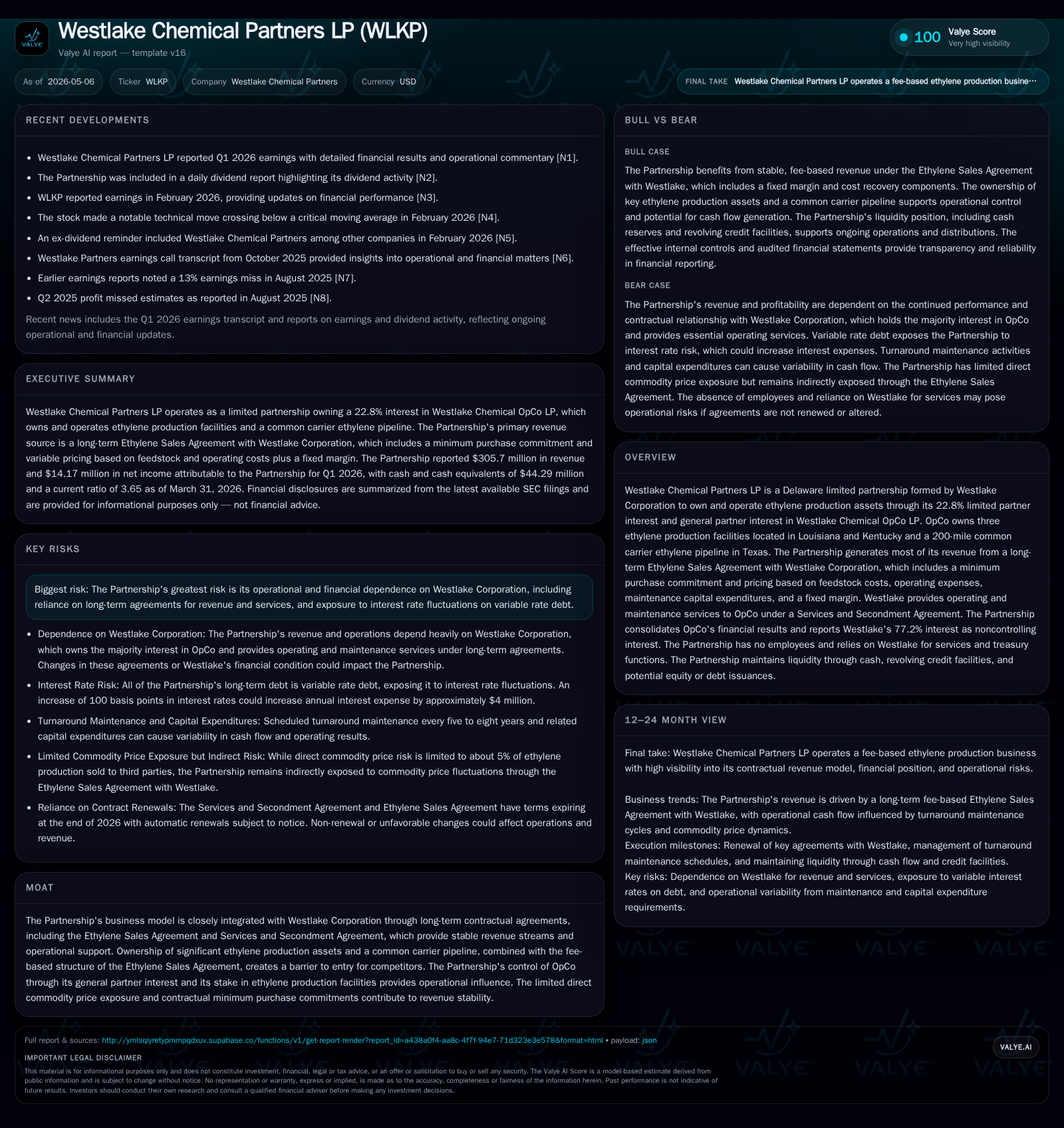
Westlake Chemical Partners LP's latest quarterly filing reveals robust improvement in cash flow and operating income compared to the prior-year period affected by a major plant turnaround. Central to its revenue and margin stability is a fee-based Ethylene Sales Agreement with Westlake Corporation that features minimum purchase commitments and cost-based pricing mechanisms. The partnership's asset base includes three ethylene production facilities and a critical ethylene pipeline, operated under close integration with Westlake. While growth drivers include stable contractual volumes and potential expansions funded by related party credit facilities, dependence on Westlake for revenue and operating services alongside variable rate debt exposure present key risks. Monitoring upcoming contract renewals, turnaround schedules, and leverage metrics will be essential.
Recent Operating Update
Westlake Chemical Partners LP reported a significant rebound in first-quarter 2026 results after a challenging prior-year period impacted by the extensive Petro 1 turnaround completed in April 2025 [S2][S11][N1]. Operating cash flows more than doubled to $110.2 million compared to $45.8 million in Q1 2025, reflecting both higher ethylene sales volumes—up over 36% due to resumption of full plant operations—and improved operational leverage [S2][S11]. Gross profit nearly doubled from $54.1 million to $93.8 million while gross margins jumped from 22.8% to 30.7%, underscoring the recovery post-turnaround despite a notable 34% rise in natural gas fuel costs offset partially by declining ethane feedstock costs [-14%] as inputs [S11]. Selling, general & administrative expenses remained stable around $7.2 million, aiding bottom-line leverage.
Notably, interest expense related to variable rate borrowings declined slightly year-over-year ($5.1 million vs. $5.5 million), benefiting from lower interest rate conditions despite exposure to SOFR-based adjustments implemented after LIBOR's phase-out in mid-2022 [S2][S13].
Business Model
Westlake Chemical Partners derives its revenue primarily through its indirect ownership stake (22.8%) in Westlake Chemical OpCo LP ("OpCo"), which operates three ethylene production facilities concentrated in Louisiana (Petro 1 and Petro 2 at Lake Charles) and Kentucky (Calvert City Olefins) alongside a strategically located common carrier pipeline stretching over 200 miles between Mont Belvieu and Longview, Texas [S1]. Key commercial underpinning is the long-term Ethylene Sales Agreement with majority owner Westlake Corporation that mandates annual minimum purchases of approximately 95% of OpCo's planned production at formula-based prices.
This contract uses a fee-based structure where prices are set according to the actual costs of feedstocks (primarily ethane), natural gas fuel expenses, operating costs including maintenance capital expenditures amortized over multi-year averages, plus a stable fixed margin per pound of ethylene produced ($0.10) adjusted for revenues generated from co-products sold externally [S1][S2]. In cases where Westlake buys less than its commitment or force majeure events reduce deliveries below threshold durations (<45 days), deficiency fees apply ensuring coverage of fixed margins and unrecouped expenses.
The reliance on formula cost-plus pricing substantially insulates Westlake Chemical Partners’ revenue stream from commodity price volatility affecting feedstocks or ethylene market prices directly; only about ~5% of production is sold commercially outside this framework exposing the Partnership modestly to market fluctuations [S1].
Further operational integration occurs via the Services and Secondment Agreement whereby Westlake supplies all operating staff, utilities management, maintenance services, and other operational functions for OpCo’s assets effectively outsourcing day-to-day plant management while retaining control through its general partner rights over OpCo [S1]. This setup reduces overhead but concentrates operational risk within affiliated service providers.
Cash distributions received by the Partnership are generated predominantly through excess cash flow from OpCo operations after funding maintenance capital expenditures and turnaround reserve accumulations intended to smooth cash flow volatility caused by cyclical major plant shutdowns roughly every five to eight years [S2][S13].
Industry Structure and Competitive Position
Operating within the basic chemicals sector focused on ethylene—one of the world’s primary petrochemical building blocks—Westlake Chemical Partners occupies a niche as an asset-owning entity closely linked with an integrated chemical producer rather than an outright commodity merchant or independent midstream operator.
Ownership of physical assets across multiple sites with substantial processing scale provides barriers to entry given the high capital intensity of modern cracker plants combined with logistical advantages from control over a dedicated interstate common carrier pipeline enabling efficient feedstock delivery and product distribution within key US Gulf Coast petrochemical hubs.
On the competitive front, Westlake’s vertical integration via OpCo ensures reliable feedstock availability through affiliated supply agreements as well as operational efficiencies derived from centralized management by experienced operational teams at Westlake Corporation [S1]. The fee-based nature of contracts reduces earnings volatility relative to pure merchant peers exposed heavily to spot ethylene pricing swings.
However, this tight integration means Westlake Chemical Partners has limited independence or product diversification outside this single core asset class. It competes indirectly against other integrated petrochemical companies owning crackers or large-scale regional pipeline systems but does not operate standalone merchant cracker assets competing on spot economics.
Growth Drivers
Growth avenues stem mainly from sustained demand for ethylene derivatives underpinning plastic resins, packaging materials, automotive parts manufacturing, consumer goods components—end-markets reflecting structural trends such as population growth and urbanization supporting polyethylene consumption globally.
Incremental growth can emerge from expansions or debottlenecking efforts sponsored by Westlake aimed at boosting throughput capacity at existing facilities or extending pipeline reach subject to favorable project economics [S4][N1]. These expansions would typically be financed through relationships maintained with Westlake including incremental borrowings under revolving lines or equity contributions.
Operational reliability improvements reducing unplanned downtime alongside scheduled turnaround efficiency enhancements will also bolster output consistency translating into better cash flow predictability for distributions [S2]. Pricing power remains limited given commodity market dynamics but steady contractual prices linked explicitly to cost inputs limit downside risk.
The Partnership’s disciplined approach reserving funds annually toward future turnaround costs indicates prudent capital management designed to reduce cash flow variability historically associated with major maintenance cycles [S2][S13].
Risks / Watchpoints / Growth Constraints
Principal risk revolves around concentration: virtually all revenues depend on one customer—Westlake Corporation—via long-term contracts whose continuation beyond initial terms rests on mutual renewal agreements which currently renew automatically but could be subject to future renegotiations [S1][S13]. Should market conditions shift or strategic priorities diverge within Westlake parent entities, continuity risk arises.
Dependence on related-party service arrangements places operational risks squarely on the performance quality of affiliated entities limiting third-party operational oversight mechanisms.
Variable rate debt exposure subjects profitability metrics sensitive to rising interest rates despite manageable utilization levels under corporate revolvers due mid-2027; refinancing needs may intensify if macroeconomic tightening accelerates raising borrowing costs materially beyond current levels [S2][F1].
Expansion funding relies heavily on willingness by Westlake affiliates or capital markets acceptance; failure or delays here could constrain growth prospects materially given no independent capital generation sufficiency [S1][S6].
Additionally, cyclicality inherent in maintenance turnarounds imposes episodic operational shutdowns impacting short-term cash flows although partially mitigated through reserve accumulation programs [S2]. Exposure to environmental regulations remains routine industry risk though not flagged as material currently.
What to Watch Next
Milestones include scheduled updates regarding renewal or amendments of the Ethylene Sales Agreement and Services and Secondment Agreement post-2027 horizon currently covered by automatic extensions contingent on notice periods; any changes here would materially affect revenue certainty structure [S12][N1].
Management commentary during upcoming earnings calls about timing for next major maintenance shutdowns beyond Petro 1 completions will signal near-term production visibility balanced versus planned capital requirements.
Tracking volume shipments data vs annual minimum commitments will provide insight into operational performance stability further influenced by global petrochemical demand cycles.
Lastly, macro-narratives around input cost inflation—particularly natural gas—and regional cracker capacity additions elsewhere shaping supply-demand balances warrant attention due to their potential subtle influence on contract renegotiations or third-party sales volumes beyond core arrangements.
Financial Profile Snapshot (Q1 Ended March 31, 2026)
Latest financial snapshot
| Metric | Value | Period |
|---|---|---|
| Cash & equivalents | $44mm | |
| 2026-03-31 | ||
| Current assets | $149mm | |
| 2026-03-31 | ||
| Current liabilities | $41mm | |
| 2026-03-31 | ||
| Current ratio | 3.65x | |
| 2026-03-31 |
Source: SEC companyfacts cache [F1].
Liquidity remains healthy supported by stable working capital fundamentals even during volatile turnaround periods while debt outstanding reflects manageable utilization levels under corporate revolvers sourced mainly via related parties consistent with strategic tight integration [F1][S2][S13].
This analysis is based strictly on disclosed regulatory filings as of May 6, 2026 ([S1]-[S3], companyfacts [F1]), supplemented by sector knowledge without investment advice or recommendations.
Disclaimer: This is research-only, informational analysis and not investment advice. It may include AI-generated interpretation and general industry context. Always verify important details using primary sources.

Comments