
Translational Development Acquisition Corp.: Assessing Post-Combination Prospects and Structural Challenges
TDAC confronts liquidity pressures and execution risks as it pursues its inaugural business combination amid structural SPAC sector dynamics.
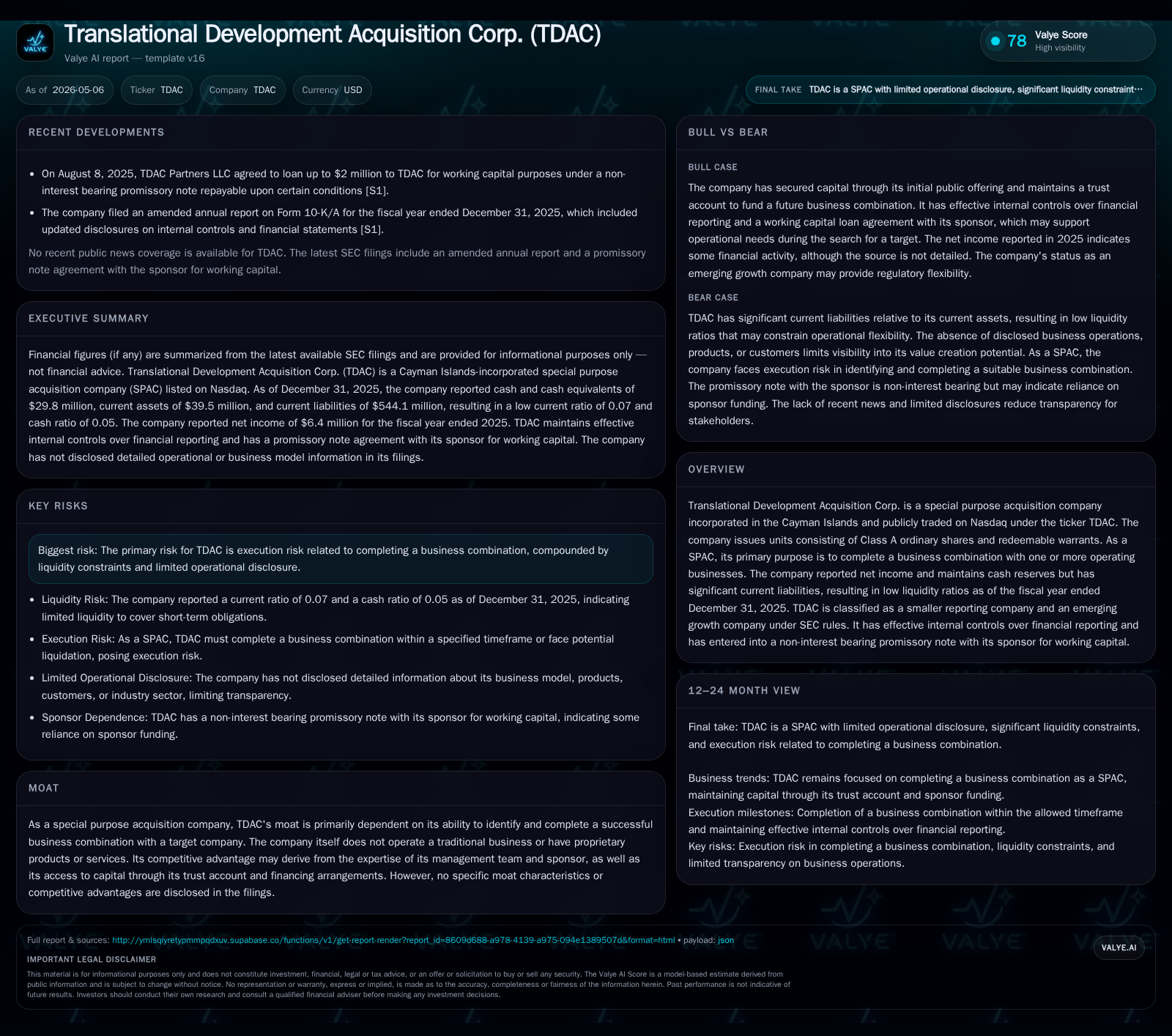
Translational Development Acquisition Corp. (TDAC) operates as a special purpose acquisition company (SPAC) with its core mission centered on securing a business combination to transition into an operating entity. As per its 2025-11-14 quarterly filing and supplemented by the latest annual disclosures, TDAC is navigating severe liquidity constraints characterized by a critically low current ratio of 0.07 and reliance on a non-interest-bearing sponsor promissory note. The company’s competitive positioning relies entirely on management’s deal-sourcing capabilities in a saturated SPAC market lacking proprietary moats. The path to growth hinges on timely deal closure and attracting quality PIPE investment amid evolving SPAC investor sentiment. Key risks include execution failure, funding adequacy, regulatory compliance boundaries as an emerging growth company, and potential shareholder redemptions.
Latest Operational Update and Its Significance
The November 14, 2025, 10-Q filing presents a stark picture of TDAC's near-term operational state [S2]. Critical financial metrics underline pressing liquidity concerns: current assets stand at $39,465 versus current liabilities surpassing $544,000 at the fiscal year-end [F1]. While the company reported net income of $6.36 million for the fiscal year ending December 31, 2025, this figure largely reflects non-operating gains rather than sustainable operating performance, which instead posted a significant loss near $945,000 [F1]. Moreover, operating cash flow remains negative at over $608,000 annually despite some YoY improvement [F1]. Faced with constrained liquid resources amidst substantial short-term obligations, TDAC has incorporated a non-interest bearing promissory note from its sponsor for working capital support [S4]. These financial characteristics frame an immediate imperative: the company must consummate its business combination promptly or risk intensifying liquidity strain.
SPAC Business Model and TDAC’s Capital Structure
Translational Development Acquisition Corp. is structured as a Cayman Islands-incorporated special purpose acquisition company (SPAC), publicly listed on Nasdaq under ticker TDAC [S1]. It issues units composed of Class A ordinary shares coupled with redeemable warrants carrying an exercisable price of $11.50 per share [S1]. Unlike traditional operating companies, TDAC does not generate revenues from products or services; its entire economic model is predicated on identifying and closing one or more qualifying business combinations within prescribed lifecycle windows.
Post-offering proceeds are generally held in trust accounts subject to release conditions tied to merger success [S12], limiting operational capital availability despite sizable gross cash on hand ($29,787) reported at fiscal year-end [F1]. The company’s sponsor further extends working capital loans evidenced by promissory notes maturing upon business combination completion [S4], serving as vital stopgap funding given negligible pre-merger operating cash flows.
This arrangement underscores structural constraints typical amongst SPACs: reliance on escrowed IPO proceeds for transaction funding while managing overhead through sponsor credit extensions. TDAC's classification as both a smaller reporting company and emerging growth company imposes reduced regulatory burdens but also limits some disclosure granularity, impacting investor transparency [S1].
Competitive Setting and Industry Dynamics for TDAC
Within the crowded US SPAC landscape that experienced expansion early in the decade followed by contraction due to market cooling and regulatory tightening, competitive positioning for entities like TDAC hinges on effective deal sourcing capabilities and sponsor reputation rather than proprietary assets or operational scale [S1],[S4]. The absence of classic moats means that intangible factors such as management networks, sector expertise aligned with target industries, and access to PIPE investors differentiate one SPAC from another.
The pressure of meeting predetermined deadlines typically around two years post-IPO enforces stringent time discipline on securing viable targets before forced liquidation triggers shareholder distributions back from trust funds. Market sentiment toward SPACs continues to fluctuate with investor scrutinity increasing notably following SEC interventions targeting disclosure adherence and conflict-of-interest management [N/A - analysis]. This environment favors sponsors that can demonstrate disciplined governance frameworks alongside proactive pipeline development.
Drivers Behind Demand Expansion and Successful Deal Closure
Growth levers for TDAC remain transactional by nature. The critical catalysts will be public announcements regarding potential target businesses accompanied by filed definitive agreements evidencing progress towards closing the combination [S6]. Further demand expansion depends heavily on breakout PIPE placement subscription levels providing additional capital infusion alongside existing trust account reserves.
Investor confidence in both deal quality and alignment between sponsors’ incentives and minority shareholders’ interests will dictate redemption behaviors—a key determinant of whether sufficient capital endures post-merger [N/A - analysis]. Additionally, any disclosed strategic focus areas matched by the sponsor team’s domain knowledge could attract specialized investors seeking exposure through the combined entity. These factors collectively shape volumetric demand for shares once the transaction is executed.
Risks Related to Execution, Liquidity, and Market Conditions
Foremost among suspensive factors is execution risk — failing to consummate an approved business combination within deadline parameters would effectively precipitate liquidation absent alternate financing routes [S2],[F1]. Reliance on the sponsor’s non-interest bearing promissory loan provides temporary relief but lacks permanency should deal timelines extend beyond expectations [S4]. Moreover, shareholder redemption rights can exacerbate financing gaps if substantial redemptions materialize ahead of deal closure given reduced trust account balances available for deployment post-close.
Regulatory compliance risks also lurk beneath the horizon; EDGAR comment letters have prompted recent amendments underscoring careful adherence requirements under emerging growth company provisions without obfuscation or delay in disclosures critical for prospective investors’ evaluations [S18],[S19]. Dilution via warrant exercises adds another layer of complexity affecting capitalization structures post-business combination.
Key Milestones and Metrics to Monitor Going Forward
Investors and analysts should calibrate attention toward discrete deal-related inflection points that signify progression beyond mere shell status. Monitoring SEC filings announcing preliminary intent letters or definitive merger agreements will be paramount [S5],[S6]. Subsequent PIPE fundraising activities—measured through subscription volumes relative to planned commitments—offer transparent barometers of investor appetite and financial muscle backing targeted transactions.
Additionally, updates concerning SEC comment letter resolutions highlight ongoing regulatory navigation efficacy—a vital process warranting scrutiny given SPACs’ amplified public-market oversight since reforms were enacted [S18]. Post-merger operational metrics become relevant contingent upon transaction completion but fall outside the current pre-revenue entity scope.
Financial Overview: Capital Adequacy and Operating Performance
Historical performance (annual)
Capital returns and efficiency (annual)
Data shows that while TDAC has achieved positive net income in FY2025 primarily due to non-operating gains — most likely reflecting accounting entries related to financing arrangements or mark-to-market valuation changes — operating losses remain pronounced with corresponding negative cash flow from operations [F1]. Total debt standing at $200K at year-end reflects borrowings including those structured as sponsor loans providing critical short-term liquidity padding [F1],[S4]. Long-term solvency hinges directly on completed business combinations unlocking trust account funds tied up under IPO escrow conditions restricting immediate operational use until merger approval completion—a fundamental characteristic delineating SPACs from conventional operating firms.
Overall equity remains deeply negative around -$6.54 million emphasizing that until successful merger execution transpires generating operating revenue or fresh equity injections via transaction proceeds or PIPE dispatches, the firm’s financial structure remains dependent on external sponsor support stimuli rather than organic profitability generation.
This analysis is based solely on information disclosed in official SEC filings dated through May 6, 2026.
Disclaimer: This is research-only, informational analysis and not investment advice. It may include AI-generated interpretation and general industry context. Always verify important details using primary sources.

Comments