
CNH Industrial's Q1 2026 Performance Reflects Precision Technology Focus Amid Cyclical Pressures
Q1 results demonstrate disciplined pricing and operational management against seasonal industry headwinds, with ongoing investment in technology poised to support recovery.
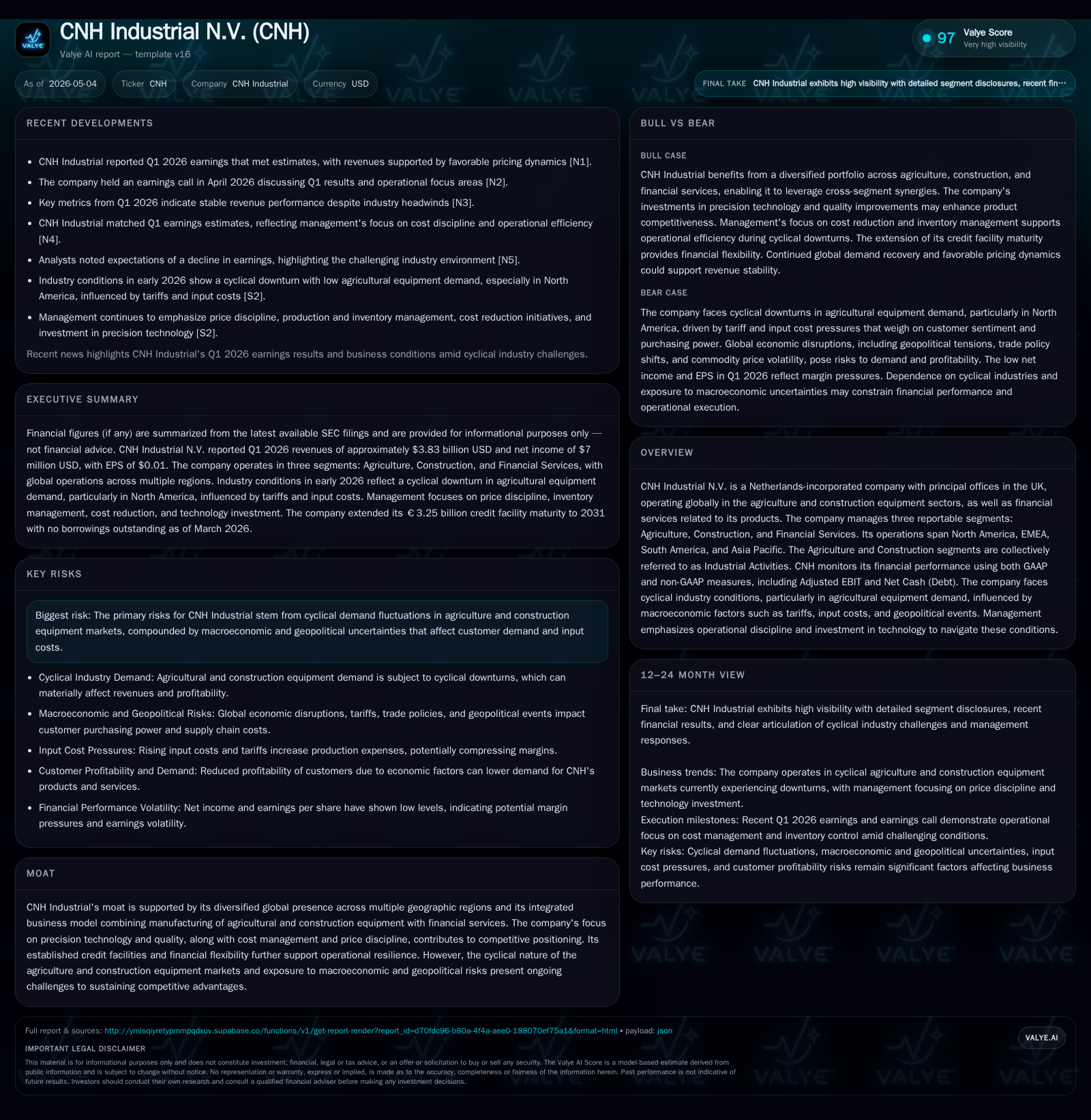
CNH Industrial’s first quarter of 2026 reflects persistent cyclical softness in agricultural equipment demand, most pronounced in North America, driven by tariff-related cost pressures and cautious farmer sentiment. The company maintained pricing discipline and tight inventory controls while continuing to invest in precision agriculture technologies. Its integrated business model—spanning Agriculture, Construction, and Financial Services—offers resilience through diversified revenue streams. Management views current conditions as cyclical rather than structural and is focusing on leveraging geographic diversification and technology innovation to navigate volatility.
First Quarter 2026 Operating Update: What Changed
In its latest quarterly filing dated April 30, 2026, CNH Industrial reported that the global agriculture equipment market remained in a cyclical downturn during Q1 2026, characterized by historically low demand especially in North America. The key factors cited were ongoing tariff-induced cost pressures impacting input prices for farmers, which weighed heavily on farmer profitability and purchasing decisions [S2]. Against this backdrop, the company adhered to stringent price discipline policies to defend margins while carefully managing production volumes and inventory levels to align with subdued order inflows.
Management emphasized that these conditions are cyclical rather than reflecting a structural shift in end markets. Despite volume contraction weighing on top-line results, revenue benefits from favorable pricing actions partially offset margin pressures. Furthermore, CNH maintained its commitment to investing in precision agriculture technology development throughout the quarter to enhance future product competitiveness and operational efficiency [S2].
An accompanying April 30 event filing reinforced these themes: the company issued a press release and investor presentation highlighting its operational discipline amidst the challenging environment while showcasing continued strategic investment focus on innovation alongside cost containment [S3].
Business Model Overview: Integrated Agriculture and Construction Equipment with Financial Services
CNH Industrial's corporate structure consists of three principal segments: Agriculture (designing and manufacturing agricultural machinery), Construction (equipment for infrastructure and building activities), and Financial Services (providing financing solutions supporting the purchase of CNH machinery). The Agriculture and Construction units together form its Industrial Activities.
This integrated structure allows CNH not only to supply durable capital equipment but also to offer captive financing options that reduce customer acquisition friction and promote loyalty. By combining manufacturing with financial services tailored for agricultural producers and construction firms, CNH creates a more stable revenue base that cushions cyclical fluctuations inherent in equipment sales.
The company’s product portfolio includes tractors, harvesters, construction vehicles such as excavators and loaders, all incorporating advanced precision farming technologies—GPS-guided automation, telematics analytics, and IoT-enabled sensors—that differentiate CNH's offerings by enhancing productivity for end-users. This technological edge maintains pricing power even when volume demand softens.
Quality control remains a focal point in manufacturing processes to uphold brand reputation across diverse global markets spanning North America, EMEA, South America, and Asia Pacific [S1].
Industry Structure: Competitive Positioning Amid Cyclical Agriculture Equipment Demand
The agricultural equipment industry is highly cyclical with sharp swings tied closely to commodity price cycles, farmer income variability, input cost dynamics including tariffs, along with macroeconomic factors such as interest rates impacting financing availability. CNH competes globally against major peers such as Deere & Company and AGCO.
CNH’s moat rests on its diversified global footprint mitigating geographic market turbulence—for instance softening demand in North America is partially offset by stronger activity or emerging opportunities in Asia-Pacific or EMEA regions. The company's strict adherence to price discipline helps buffer margin erosion during down-cycles when competitors might resort to discounting.
Supply chain resilience amid continuing tariff-induced headwinds remains critical. Elevated raw material costs have been partially absorbed but remain a threat to gross margins if prolonged. However, aftersales parts sales provide a more stable revenue stream less sensitive to new equipment sales volatility.
Technological leadership through rapid adoption of precision ag tools further enhances CNH’s competitive stance by embedding higher switching costs within their customer base via digital platform integration [S1], [N5], [N6].
Growth Drivers: Precision Technology Investments and Geographic Market Opportunities
Despite the current challenging demand environment for traditional large-scale agricultural machinery, CNH continues significant R&D efforts focused on precision agriculture technologies—automation systems enhancing fuel efficiency, soil monitoring sensors improving fertilizer use efficiency, autonomous vehicle controls—all designed to raise farm-level productivity sustainably.
Management has prioritized maintaining these technological investments during the downturn to emerge competitively stronger when industry conditions improve. Beyond technology itself, growth prospects lie in expanding penetration of agri-equipment into underdeveloped regions like Asia Pacific where mechanization rates are lower but rising steadily.
Additionally, shifts towards environmentally sustainable farming practices globally may increase demand for advanced equipment capable of optimizing inputs precisely—a factor reinforcing CNH’s long-term relevance [S2], [S6], [N2].
Risks and Constraints: Cyclical Demand, Tariff Headwinds, and Input Cost Pressures
Key risks outlined remain consistent with prior disclosures: the pronounced cyclicality of agriculture and construction markets leads to volatile order volumes dependent on macroeconomic health and farmer profitability globally. The ongoing tariff regime contributes to elevated input costs affecting both raw material expenses for CNH’s machinery production as well as farmers’ operating expenses.
These factors combine to restrain near-term market expansion while applying tension on gross margin sustainability despite firm price management initiatives by CNH. No material changes were reported in risk disclosures at this filing stage but vigilance on geopolitical developments affecting trade policies remains necessary [S1], [S2], [S18].
Farmer sentiment appears cautious due to these headwinds with purchasing deferrals typical until clearer commodity pricing or economic signals emerge.
Forward Look: Key Milestones and Market Signals to Monitor in Upcoming Quarters
Investors should monitor several important near-term indicators based on management commentary around the Q1 earnings announcement:
- Order backlog trends in Agriculture segment as leading signal for inventory replenishment cycles;
- Pricing effectiveness measured via realized average selling prices amid competitive pressure;
- Tariff negotiations or easing that could materially influence input cost inflation;
- Commodity price movements which directly affect farmer income outlook;
- Progression of R&D translation into commercially viable precision agriculture products enhancing margin profiles;
- Geographic performance shifts especially potential acceleration in Asia Pacific or EMEA regions where mechanization rates still have growth runway.
These milestones will be critical in validating whether CNH’s disciplined approach can sustain earnings quality until sector cyclical recovery occurs more broadly [S3], [N2], [N4].
Financial Snapshot: Balance Sheet Strength and Capital Allocation Priorities
Supporting operational resilience amid volatile end markets is CNH Industrial’s solid liquidity position evidenced at quarter-end March 31, 2026. Cash & equivalents stood at approximately $1.6 billion while total debt is minimal relative to cash holdings per latest available data—implying a net cash position that underpins balance sheet flexibility for continued R&D spend or potential strategic initiatives without near-term refinancing concerns [F1], [S2], [S3].
This capital conservatism aligns with stated priorities around technology investment continuity alongside disciplined capital allocation.
This analysis focuses solely on operating disclosures filed with regulatory authorities through April 30, 2026 ([S2], [S3], [S1]) supplemented by sector-specific news insights () without offering specific investment recommendations or valuations. Please consider these operating characteristics within broader industry context when forming operational views about CNH Industrial N.V.
Disclaimer: This is research-only, informational analysis and not investment advice. It may include AI-generated interpretation and general industry context. Always verify important details using primary sources.

Comments