
United Fire Group Highlights Resilient Commercial Lines Growth in Q1 2026
United Fire Group sustained strong underwriting discipline and expanded its agency-driven commercial insurance footprint in the first quarter of 2026.
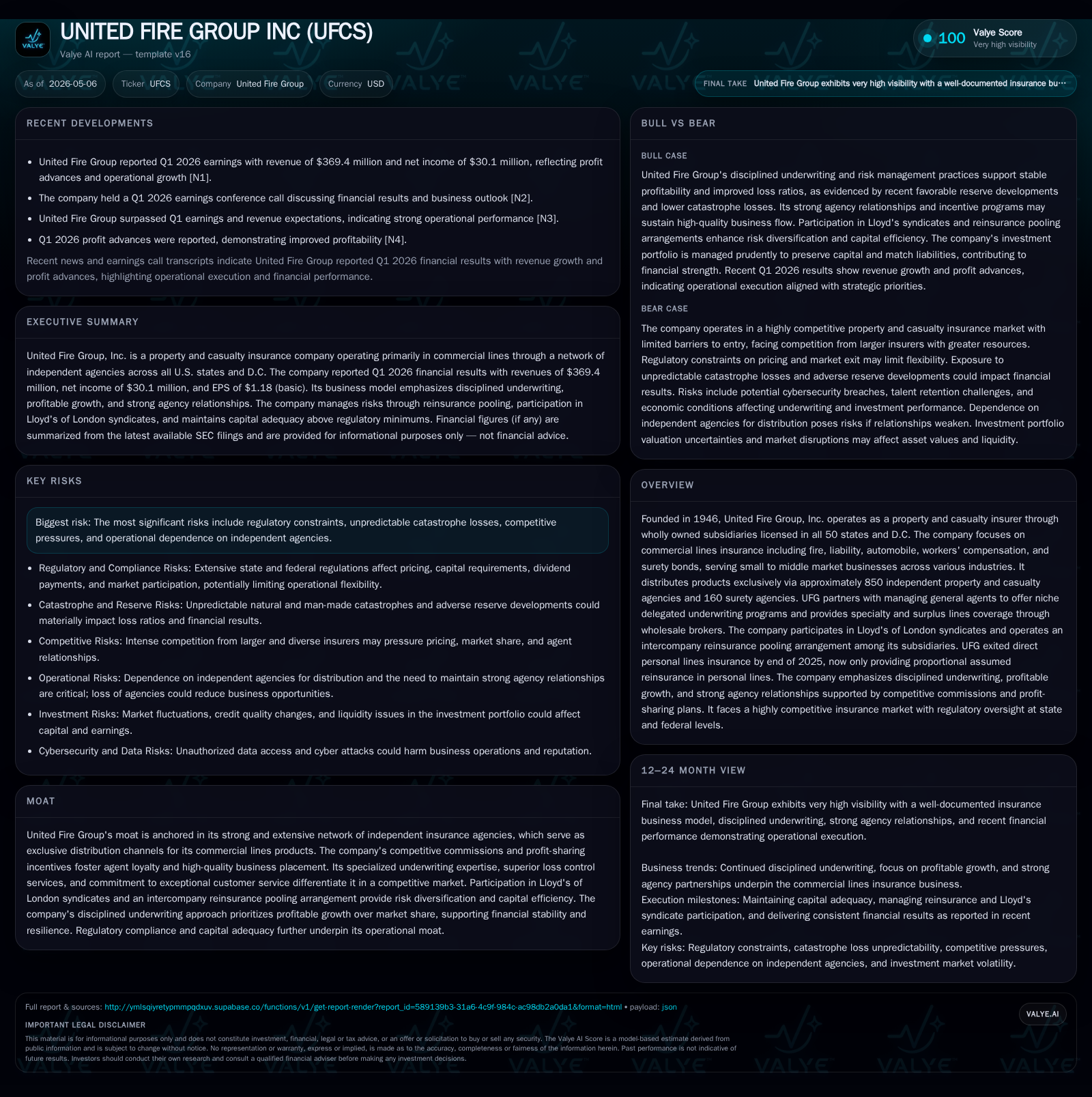
In Q1 2026, United Fire Group demonstrated operational resilience through disciplined underwriting and stable agency partnerships, contributing to continued growth in its core commercial lines business. The company’s exclusive network of independent agencies remains a strategic moat, while expanded specialty and surplus lines via Lloyd's syndicates support incremental diversification. Key risks include regulatory dynamics and catastrophe loss uncertainty. Monitoring upcoming loss ratios, reinsurance renewals, and MGA program developments will be critical for assessing ongoing execution.
Q1 2026 Operational Update: Signals from the Latest 10-Q Filing
United Fire Group's most recent quarterly report filed May 6, 2026 ([S2]) stresses the importance of critical accounting judgments that heavily influence reported insurance liabilities and revenue recognition. Management underscores ongoing evaluations of these assumptions grounded in historical experience while acknowledging potential variability due to external factors — a prudent stance given the unpredictable nature of claims development in property casualty insurance. This focus on disciplined estimation coincides with results that positively surprised expectations as noted in accompanying earnings releases ([N3]), signaling operational stability.
Alongside these accounting disclosures, no major shifts in underwriting strategy were announced, confirming United Fire Group's commitment to its commercial lines underwriting discipline and risk appetite focus. This is consistent with commentary during the recent earnings conference call ([N2]) emphasizing steady premium growth balanced with careful expense management.
Business Model Focused on Commercial Lines and Agency Partnerships
Founded in 1946, United Fire Group's core business model revolves around writing commercial property and casualty insurance through a network of roughly 850 independent agencies plus about 160 surety agencies ([S1]). These agencies exclusively distribute UFG’s offerings including fire and allied lines, other liability coverage, automobile liability, workers’ compensation, and surety bonds. Revenue streams are generated primarily from premiums collected on these policies.
The company’s deployment of specialized underwriting expertise ensures tailored risk selection aligned with its stated profitable growth strategy. Ancillary loss control services provide agents and clients with risk mitigation tools enhancing the value proposition. Additional diversification into delegated underwriting programs via managing general agents (MGAs) extends reach into niche products like marine specialty or professional liability insurance — typically harder-to-price risks requiring sector expertise ([S1]).
UFG also participates actively in Lloyd’s of London syndicates through its McIntyre Cedar Corporate Member affiliate providing specialty and surplus lines solutions on both admitted and non-admitted bases. This multi-channel approach allows UFG to address varied customer needs while optimizing capital efficiency via an intercompany pooling arrangement that diversifies risk among subsidiaries ([S1]).
Importantly, the company completed exit from direct personal lines insurance at end-2025; it now only retains proportional assumed reinsurance exposure for this segment ([S1]). This strategic focus sharpens resources towards higher-margin commercial opportunities.
Competitive Position within the Independent Agency Ecosystem
UFG’s moat chiefly rests upon its embedded relationships with independent agencies that inherently serve multiple insurers but select UFG for competitive commission structures coupled with profit-sharing incentives ([S25]). These financial alignments foster agent loyalty incentivizing them to place high-quality risks within UFG’s appetite. This network effect creates switching costs that can be difficult for competitors relying on direct distribution or technology-driven platforms to replicate.
However, there are imminent challenges as various insurers adopt advanced data analytics platforms improving their pricing precision and underwriting agility. If competitors leverage such tech innovations more swiftly than UFG, the company may face margin compression or agency defections. Maintaining differentiation through superior loss control consultation and service quality remains crucial ([S25]).
Competition also arises in market segments served by exclusive agents or direct writers whose scale benefits may challenge UFG's smaller size. Yet the company’s disciplined focus on middle market businesses mitigates head-to-head battles with large diversified carriers.
Growth Trajectory: Drivers of Expanding Market Penetration and Product Mix
Growth drivers include increasing penetration within middle market commercial sectors where insureds demand comprehensive business packages spanning multiple coverages ([S1]). UFG's ability to bundle fire, liability, auto, workers’ compensation and surety enhances cross-selling opportunities leveraging established agency trust.
Strategic partnerships with MGAs facilitate expansion into specialist markets otherwise underserved or complex to underwrite at scale {[}S1{]}. Meanwhile, participation in Lloyd’s syndicates amplifies surplus lines offerings typically associated with higher premiums reflecting elevated risk profiles or unique exposures.
Wholesale broker distribution channels further extend reach into non-admitted insurance markets allowing product innovation unimpeded by state regulatory approvals typical for admitted lines ([S1]). These vectors collectively diversify premium base while reinforcing top-line momentum observed in recent quarters.
Risks and Constraints Impacting Near-Term Performance
UFG faces persistent risks including regulatory constraints across multiple state jurisdictions where rate filings require approval or are subject to scrutiny designed to prevent excessive charges ([S16]). Unpredictable catastrophe losses driven by climate change add claim volatility challenging reserve adequacy assumptions ([S25]). The company’s heavy dependence on independent agencies makes maintaining these relationships critical; any erosion could markedly affect new business flow or renewal persistency.
Furthermore, rising claim litigation costs due to social inflation phenomena threaten to erode underwriting margins if not offset by price adjustments ([S25]). Cybersecurity risks bring operational vulnerabilities especially given reliance on data exchange between multiple agent systems. Competitor pricing aggressiveness backed by analytics could compel rate compression in certain classes hampering profitability gains derived from recent rate increases.
Key Upcoming Milestones and What Investors Should Monitor
Upcoming quarterly reports will reveal whether United Fire Group sustains improved loss ratios amid prevailing market conditions along with clarity on reinsurance program renewal prices essential for managing catastrophe risk costs ([S2][S3]). Activity around launching or expanding MGA delegation agreements should be monitored as an indicator of strategic progress towards niche product penetration ([N2]).
Given the recent exit from personal lines direct writing finalized at end-2025, analysts should evaluate effects on proportional assumed reinsurance results demonstrating success of this refocus effort ([S1]). Finally, premium rate actions reflecting responsiveness to inflationary pressures will indicate underwriting agility; timing of approvals could affect near-term revenue ramp.
Current Financial Profile and Balance Sheet Overview
Latest financial snapshot
| Metric | Value | Period |
|---|---|---|
| Cash & equivalents | $162mm | |
| 2026-03-31 | ||
| Total debt | $146mm | |
| 2026-03-31 | ||
| Net debt | $-16mm | |
| 2026-03-31 |
Source: SEC companyfacts cache [F1].
As of March 31, 2026 quarter-end balance sheet data shows liquidity strength supported by $162 million cash & equivalents versus $146 million total debt resulting in approximate net cash position near $16 million ([F1]), bolstering capacity to support underwriting activity without raising capital amid uncertain market cycles. The absence of explicit covenant-related concerns combined with positive profitability signals from Q4 2025 annual results reinforce financial flexibility.[F1][S2]
UFG’s conservative investment philosophy targets preservation of principal while optimizing yield contributing incremental earnings complementary to underwriting profits ([S9]). Operating metrics including reduced catastrophe loss ratios recently suggest disciplined risk selection translating into steady adjusted operating income growth despite a still competitive environment.[F1]
This analysis synthesizes latest SEC-disclosed data alongside related earnings communications to present a grounded view of United Fire Group’s current positioning within the U.S. commercial property & casualty insurance sector. No investment recommendations are made herein; readers should consult official disclosures for decision-making purposes.
Disclaimer: This is research-only, informational analysis and not investment advice. It may include AI-generated interpretation and general industry context. Always verify important details using primary sources.

Comments