
ADT Inc. Reinforces Subscriber Base with Integrated ADT+ Platform Innovation
ADT’s latest quarterly report highlights stable recurring revenue and strategic AI-driven platform enhancements amid competitive and debt-related pressures.
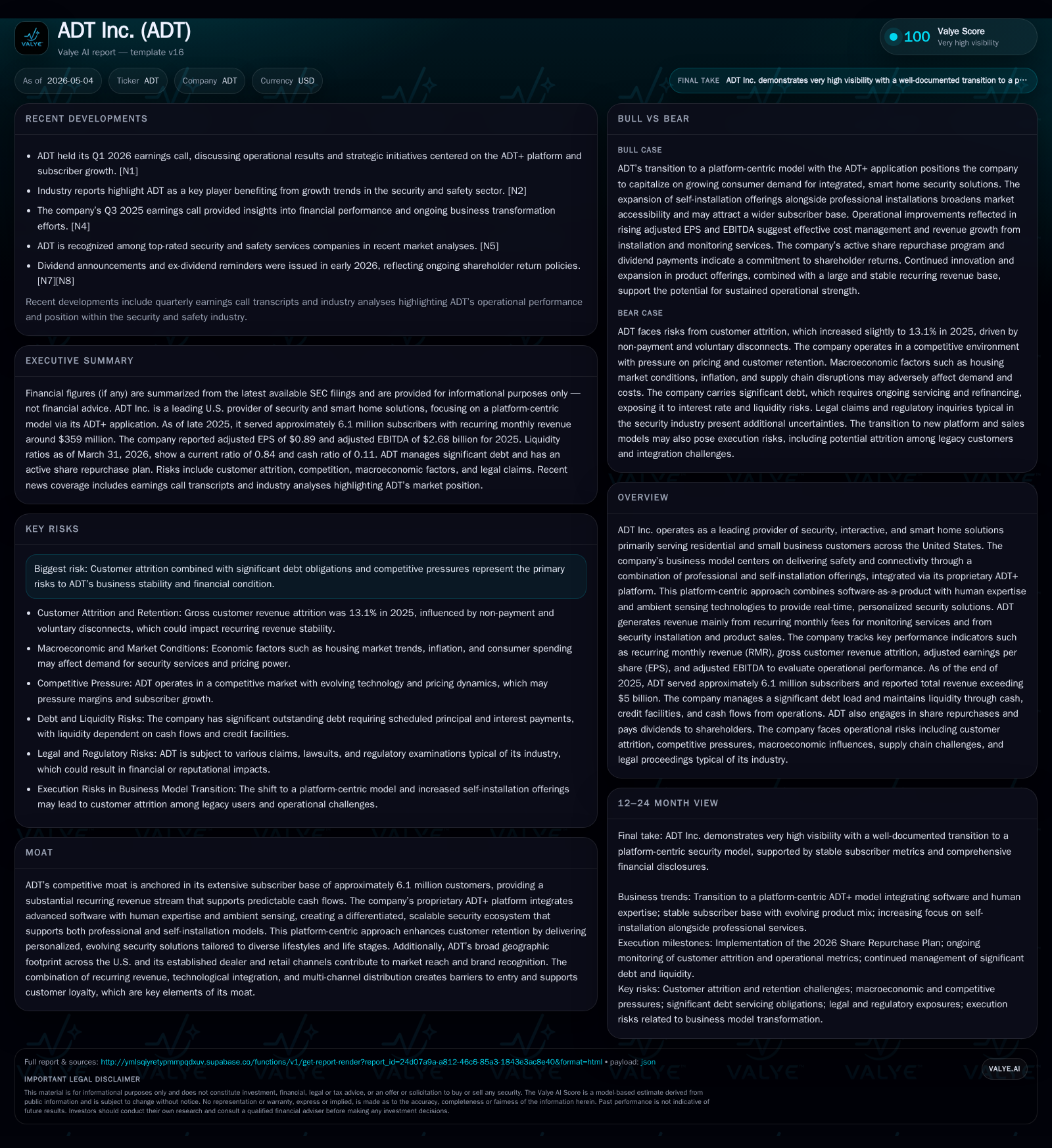
In its Q1 2026 filing, ADT Inc. reported steady recurring monthly revenue (RMR) with near-flat subscriber count, while advancing its proprietary ADT+ platform through the acquisition of Origin AI to enhance smart home security capabilities. The company's business model leverages a multi-channel approach combining professional and self-install solutions to drive recurring subscription fees and installation sales. Despite a substantial debt load exceeding $7 billion, ADT’s scale and platform integration underpin its competitive moat amidst evolving market dynamics. Key growth levers include upselling via innovative offerings and expanding small business penetration, while risks center on customer attrition and financial leverage. Market watchers should monitor subscriber trends, margin improvements, and platform rollout progress in upcoming quarters.
Latest Quarterly Operating Results Illustrate Momentum in Subscriber Management
ADT’s Q1 2026 filing [S2] reveals a consistent RMR level of approximately $358.7 million versus $359.5 million a year ago [S24], indicative of pricing power balancing out a modest reduction in subscriber volume. The company maintains roughly 6.1 million subscribers across residential and small business segments [S1], reinforcing its leadership scale in the U.S. market.
The quarterly update spotlights stable customer retention despite industry churn headwinds — gross revenue attrition hovers around 13%, slightly elevated from prior periods but within historical norms [S24]. Installation revenues continue to benefit from a higher mix of professional installations relative to DIY solutions, driving favorable revenue mix effects but at somewhat increased cost levels due to complexity [S24]. Additionally, ADT announced a common stock dividend of $0.055 per share payable mid-2026 [S3], underscoring cash flow confidence.
Financially, operating income rose by nearly $100 million year-over-year to $1.31 billion (annualized basis) suggesting effective cost control alongside revenue stability [F1]. However, interest expense remains a sizable headwind due to significant leverage reflecting over $7 billion in total debt as of March 31, 2026 [F1], signifying ongoing capital structure risks.
Business Model and Product Suite Centered on the ADT+ Platform Ecosystem
ADT’s core value proposition stems from providing security monitoring services monetized via contractually recurring monthly fees known as Recurring Monthly Revenue (RMR) supplemented by installation and product sales associated with system setup [S1]. Its proprietary ADT+ platform consolidates these offerings into an integrated ecosystem blending software-as-a-product with embedded human expertise and ambient sensing technologies.
This platform-centric model supports both professionally installed systems—generating higher upfront revenues—and self-installed packages appealing to more cost-conscious customers seeking flexibility, thus broadening market penetration without sacrificing long-term engagement potential. The break-even economics for installations typically materialize over roughly two years given upfront acquisition costs offset by subsequent steady monitoring revenues [S5].
ADT’s strategic investment in Origin AI further enriches this ecosystem by embedding AI-driven presence detection leveraging radio frequency signals instead of traditional cameras or wearables, enhancing alarm verification accuracy while mitigating false alerts—a key customer satisfaction driver that strengthens retention [S13][N1].
Competitive Landscape: Strengths, Barriers, and Market Dynamics in U.S. Security Services
Within the fragmented yet fiercely competitive U.S residential security market—populated by other notable players such as Vivint, SimpliSafe (acquired by Amazon), and emerging tech companies—ADT distinguishes itself through scale (~6.1 million subscribers), entrenched brand recognition, and multi-channel distribution including dealer networks and retail partnerships [S1].
The integrated nature of its offerings creates practical switching costs; customers are less inclined to migrate given hardware installation permanence coupled with ecosystem lock-in via personalized software features tailored across life stages. Moreover, ADT’s dual approach catering to both DIY adopters and professional install customers allows it to flexibly match demand shifts amid evolving consumer preferences.
Pricing power is moderated by technological innovation cycles introducing cheaper or more customizable alternatives; however, ongoing investments in AI-enhanced analytics aim to preserve competitive differentiation [N6]. Macroeconomic factors such as housing market health and crime perception also influence demand elasticity for security products.
Growth Opportunities Powered by Recurring Revenue and Innovative Offerings
A key growth driver is expanding RMR by upselling enhanced smart home features—including integration of AI-enabled sensors from Origin AI—that improve user experience and justify premium pricing tiers [N1]. This not only deepens customer wallet share but also reduces churn risk through evolving service relevance.
Simultaneously, accelerating penetration into underserved small business verticals represents organic expansion potential, leveraging the same platform infrastructure with scalable cost structures. Geographic dispersion across U.S markets provides additional upside via localized marketing initiatives.
Adoption trends favoring self-installation options cater to digitally-savvy demographics seeking convenience at lower initial investment points—helping increase new subscriber acquisition efficiency while diversifying product mix without compromising margins materially.
Operational KPIs supporting growth include tracking incremental RMR increases per subscriber cohort, reductions in gross customer attrition rates via targeted retention programs, new bookings momentum for advanced sensor packages, and cost-to-serve improvements enhancing adjusted EBITDA margins over time.
Key Risks: Customer Attrition, Debt Load, and Market Pressures
Despite scale advantages, ADT contends with material risks:
- Customer attrition remains persistently elevated near 13% annually in gross revenue terms [S24], pressuring net subscriber growth and predictable cash flows critical for servicing debt obligations.
- Financial leverage is substantial; total debt stood at approximately $7.36 billion as of Q1 end with net debt around $7.24 billion after considering cash balances of ~$119 million—resulting in a constrained current ratio of 0.84 illustrating short-term liquidity tightness [F1]. High interest expenses derived from this leverage reduce operational flexibility.
- Competitive pressures intensify as technology incumbents introduce alternative smart home security solutions potentially eroding pricing power or triggering accelerated churn.
- Regulatory risk persists related to privacy laws governing sensor data alongside potential legal claims arising from alleged alarm failures or contractual disputes noted historically in filings [S1].
- Macroeconomic volatility influencing consumer discretionary spending could dampen new subscriber additions or prompt downsizing among existing customers.
Close monitoring of these risks alongside effective capital management will remain crucial for sustaining operational resilience.
Upcoming Catalysts: Subscriber Trends, Technology Rollouts, and Margin Expansion
Investors should watch several upcoming markers:
- Quarterly disclosures on net subscriber counts versus guidance will signal whether pricing gains offset attrition fully or if customer base stabilizes/improves post-Origin AI deployment.
- Progress integrating intelligent sensing capabilities into the ADT+ ecosystem will reveal execution pace on R&D initiatives enhancing service distinctiveness.
- Operational efficiencies targeted at lowering cost-of-service could yield margin expansion visible through adjusted EBITDA enhancements.
- Strategic announcements pertaining to channel expansion or new product launches may redefine competitive positioning further beyond core domestic markets.
Management commentary during earnings calls has emphasized confidence in meeting these milestones supported by recent acquisitions [N1][S3].
Financial Snapshot: Capital Structure, Liquidity, and Profitability Metrics
ADT's financial position reflects a highly leveraged profile consistent with capital-intensive industry dynamics focused on subscription-based business models requiring significant upfront installation investments balanced against steady monthly monitoring fees [F1].
Disclaimer: This is research-only, informational analysis and not investment advice. It may include AI-generated interpretation and general industry context. Always verify important details using primary sources.

Comments