
OneMain’s Q1 2026 Operating Strength Highlights Growth in Nonprime Lending Amid Capital and Regulatory Dynamics
OneMain Holdings extended its foothold in nonprime consumer finance through a solid quarter marked by robust loan originations, diverse funding, and regulatory vigilance.
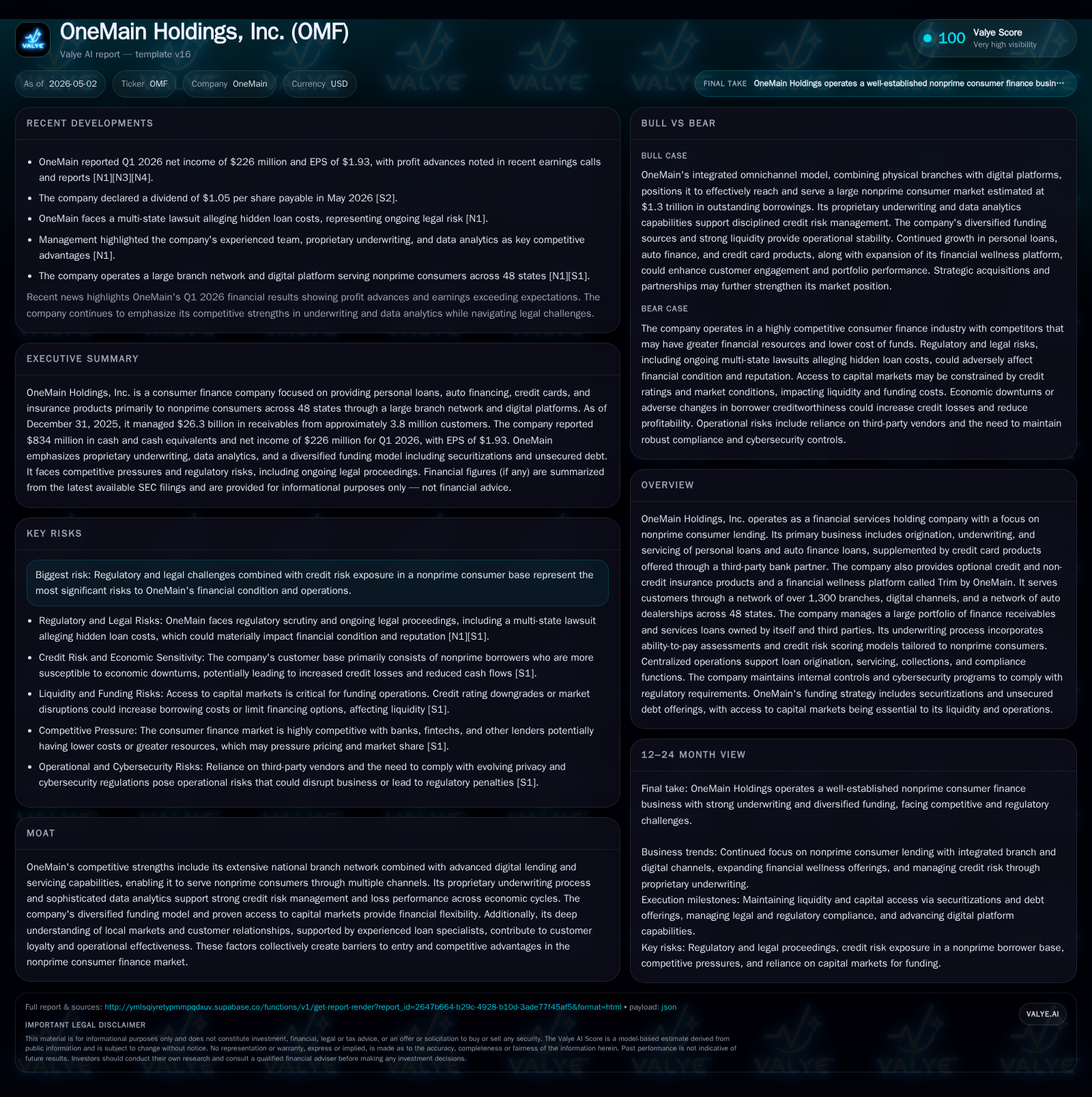
In its Q1 2026 report, OneMain Holdings demonstrated operational resilience with strong personal and auto loan origination volumes across its extensive branch and digital network. The company’s integrated lending model, combining physical branches with advanced analytics and a digital platform, continues to differentiate OneMain in the competitive nonprime finance sector. Key growth is driven by demand in personal and auto loans among underserved borrowers, supported by proprietary underwriting and an effective multi-channel distribution system. However, persistent regulatory scrutiny and exposure to credit risk from economically sensitive nonprime consumers remain significant watchpoints. Maintaining capital market access alongside managing legal contingencies will be crucial as OneMain navigates evolving industry challenges.
Recent Operating Update: Q1 2026 Performance
OneMain Holdings’ latest quarterly filing (10-Q dated May 1, 2026) paints a picture of operational stability combined with strategic execution across its nonprime consumer lending franchise [S2]. The company reported continued robust origination volumes in personal loans and secured auto financing through both its expansive branch network exceeding 1,300 locations and increasingly sophisticated digital platforms [S2]. Loan servicing volumes remained high with approximately 3.6 million customer accounts representing $24.8 billion of finance receivables on balance sheet, while managed receivables — which include loans owned by third parties — totaled approximately $26.3 billion [S1]. This scale underscores OneMain's footprint across 48 states.
Alongside organic loan growth, the company integrates BrightWay credit card offerings via a partnership with a third party bank, purchasing receivable balances that complement its core secured lending products [S1]. These moves diversify revenue streams while deepening customer wallet share.
Financially, OneMain disclosed cash and equivalents of approximately $834 million with total debt near $22.7 billion at quarter-end March 31, 2026 [F1], reflecting substantial leverage typical within consumer finance but reliant on continual access to debt markets and securitization conduits [S5][S9]. Capital discipline remained a focus alongside a declared dividend payout set at $1.05 per share for Q2 payable mid-May [S4].
Business Model: Diversified Nonprime Lending Ecosystem
OneMain operates primarily within the sub-prime or nonprime consumer lending niche where traditional banks often do not compete aggressively due to higher perceived credit risks [S1]. Its revenue is generated principally through interest income on personal loans—secured chiefly by automobiles or other titled assets—and indirect auto loans originated at dealerships. Supplementary income arises from purchased credit card receivables as well as insurance products bundled optionally with loans.
Loan volume growth directly drives top-line revenue via increased principal outstanding accruing interest charges. Pricing power stems from the necessity-driven nature of offerings for nonprime consumers who face restricted credit options elsewhere, providing some insulation against pricing erosion although subject to regulatory caps and competitive pressure [S1][S24].
A crucial strength lies in OneMain’s proprietary underwriting process utilizing customized credit scoring models focused on ability-to-pay metrics tailored for this borrower profile [S1]. Coupled with advanced analytics developed over years of operational data, this helps mitigate loss severity despite inherent subprime portfolio risks.
Revenue mix quality improves with increasing penetration of secured auto financing at dealerships powered by strategic partnerships such as the integration of Foursight dealers which broaden origination touchpoints [S24]. Credit card offerings through BrightWay add unsecured product depth without the direct lending risk profile since receivables are purchased rather than originated internally.
Customer engagement is bolstered via multi-channel access—borrowers can transact in-person at branches staffed by experienced loan specialists or opt for digital application routes backed by central operations support—enhancing convenience and retention potential [S1][S24]. The addition of a financial wellness platform branded Trim by OneMain further supports customer loyalty while reinforcing social responsibility messaging.
Industry Structure and Competitive Position
The U.S. consumer finance space catering to subprime borrowers is fragmented but intensely competitive with players ranging from regional lenders and fintech disruptors to specialty finance arms of large banks [S1][S24]. Barriers include regulatory complexity spanning federal to state jurisdictions that affect pricing structures, disclosures, product design, and collection practices.
OneMain's competitive moat derives from its balanced physical-digital omni-channel distribution model augmented by deep local market expertise embedded within its branch footprint [S1]. This hybrid approach contrasts with pure fintech challengers that lack physical presence and with traditional lenders who may not specialize sufficiently in nonprime segments.
Moreover, the firm’s underwriting rigor bolsters portfolio resilience—a key differentiator given cyclicality risks for subprime defaults—and sophisticated data-driven decision tools enhance loss forecasting accuracy across economic cycles.
Capital markets diversity further supports competitive positioning; OneMain accesses unsecured debt issuances and structured securitization transactions ensuring liquidity while managing funding costs [S5][S9]. While peers sometimes depend heavily on single funding sources or government programs post-pandemic disruptions, OneMain maintains flexibility amid tightening credit conditions.
Nevertheless, competitors including other nonbank specialty lenders such as Enova Financial or regional auto finance firms exert pressure particularly on price sensitivity segments requiring continuous innovation in product features and service delivery [N9][N10].
Growth Drivers
- Expanding Nonprime Consumer Demand: With approximately $1.3 trillion estimated outstandings among U.S. nonprime consumers in personal loans, auto finance leases/payments, and credit cards per recently sourced market data aligned internally [S1], OneMain stands to benefit structurally from ongoing unmet demand.
- Multi-Channel Originations: Persistent investment in technology enhances digital borrowing experiences alongside established branch presence ensuring accessibility to diverse customer preferences—a key adoption driver in a demographics-diverse borrower base.
- Auto Finance Expansion: Increasing penetration into auto retail installment sales via dealer partnerships including Foursight broadens client acquisition near point-of-sale—a traditionally high-conversion channel enhancing yield stability.
- Credit Card Receivable Purchase Program: Through BrightWay partnership arrangements purchasing third-party originated unsecured credit card balances provides yield lift opportunities without direct origination exposure.
- Financial Wellness Initiatives: Programs like Trim by OneMain seek to deepen customer engagement beyond lending transactions fostering brand loyalty potentially reducing default rates through education.
- Capital Markets Access: Proven ability to execute securitizations and unsecured debt issuance underpins scalable loan portfolio growth funded at competitive costs.
Risks / Watchpoints / Growth Constraints
- Regulatory Scrutiny: Heightened enforcement risk stemming from federal (CFPB) consent orders related to optional product marketing practices imposes compliance costs/reputational risk; multi-state examination potential increases oversight intensity [S27][S28].
- Credit Risk Exposure: Economically vulnerable nonprime borrowers inherently carry elevated default probabilities necessitating vigilant underwriting adjustments relative to macroeconomic conditions; allowance adequacy impacts earnings volatility [S1][S2].
- Capital Structure Leverage: Approximate net debt position near $21.9 billion against cash equivalents around $834 million demands disciplined liquidity management amid variable capital market conditions where downgrades could increase funding costs substantially [F1][S9][S19].
- Geographic Concentration: Regional economic shocks may disproportionately impact certain state-level borrowerships given branch footprint concentration requiring diversified geographic risk monitoring [S1].
- Competitive Intensity: Fintech entrants leveraging AI-driven underwriting or alternative data sources could erode market share if OneMain’s technology evolution lags behind rapid innovation cycles in lending platforms.
- Dividend Sustainability: Dividend payments remain discretionary influenced by cash flow availability post-debt servicing obligations limiting return predictability for shareholders despite current declared dividends [S4][S14].
What to Watch Next
Investors and analysts should monitor following execution markers:
- Quarterly reports elaborating on loan originations mix trends between personal versus auto finance segments verifying sustained demand signals;
- Changes in credit loss provisions reflecting shifts in borrower repayment behavior tied to economic indicators like employment rates and consumer spending;
- Regulatory developments especially outcomes from ongoing examination activities or any newly imposed enforcement actions affecting product offerings or operational approaches;
- Capital market activities signaling refinancing success or struggles indicating funding cost pressures or liquidity constraints;
- Adoption metrics for financial wellness platform initiatives measuring engagement impact on customer retention or delinquency rates;
- Any announcements regarding acquisitions or strategic partnerships that could expand scale or technological capabilities.
Financial Profile Summary
Latest financial snapshot
| Metric | Value | Period |
|---|---|---|
| Cash & equivalents | $834mm | |
| 2026-03-31 | ||
| Total debt | $22.7bn | |
| 2026-03-31 | ||
| Net debt | $21.9bn | |
| 2026-03-31 |
Source: SEC companyfacts cache [F1].
| Metric | Value | Period Ending |
|---|---|---|
| Cash & Equivalents | $834 million | March 31, 2026 |
| Total Debt | $22.7 billion | March 31, 2026 |
| Net Debt | ~$21.9 billion | March 31, 2026 |
The capital structure reflects typical high leverage common among specialty nonprime lenders balancing growth ambitions with funding cost management imperative. Liquidity appears adequate though contingent on continued access to capital markets securitization channels given sizeable indebtedness [F1][S5][S9].
Disclaimer: This analysis is intended solely for informational purposes based on public filings and news disclosures as of early May 2026. It does not constitute investment advice nor an endorsement of securities. Readers should conduct independent due diligence considering their specific circumstances before making any financial decisions related to OneMain Holdings or the consumer finance sector.
Disclaimer: This is research-only, informational analysis and not investment advice. It may include AI-generated interpretation and general industry context. Always verify important details using primary sources.

Comments