
Xenia Hotels & Resorts Strengthens Portfolio with Rising RevPAR and Strategic Debt Management
Xenia’s Q1 2026 performance reflects improved premium lodging demand and disciplined capital strategy amid evolving industry dynamics.
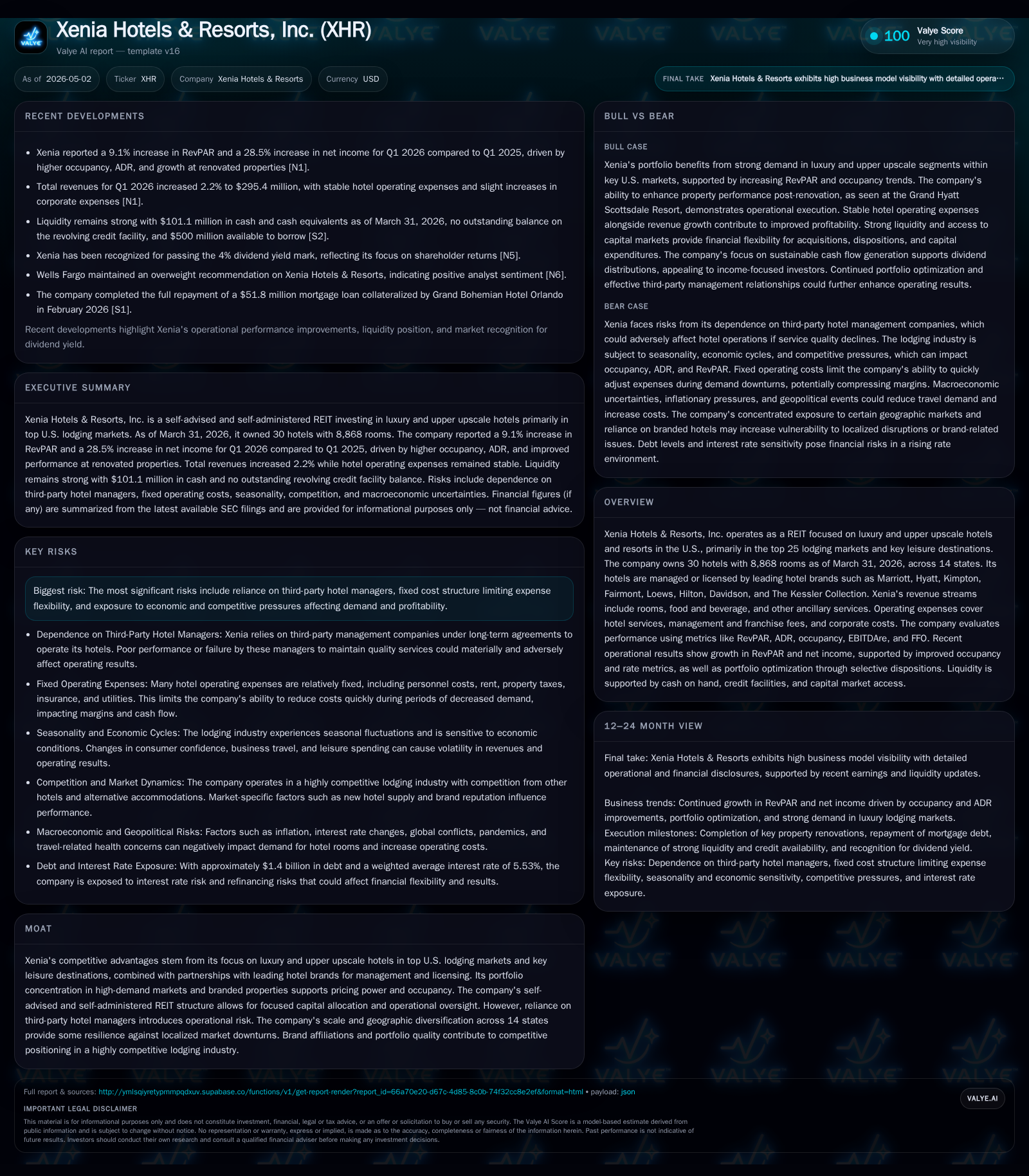
In its latest quarterly report, Xenia Hotels & Resorts demonstrated growth in key operational metrics including RevPAR, supported by enhanced occupancy and average daily rates across its luxury and upper upscale hotel portfolio. The company’s focus on top U.S. lodging markets and partnerships with leading hotel brands underpins its competitive positioning. Meanwhile, proactive debt repayments and a robust credit facility provide financial flexibility to support ongoing portfolio optimization and growth initiatives. Risks remain around third-party management dependencies and fixed cost structures, but selective dispositions and strong brand affiliations offer resilience in a competitive lodging landscape.
Recent Operating Update
Xenia Hotels & Resorts’ Q1 2026 results revealed positive momentum in its upscale lodging portfolio characterized by rising revenue per available room (RevPAR), which benefitted from both higher occupancy levels and an increase in average daily rates (ADR) across its 30-hotel collection [S2]. This uptick underscores resilient demand in premium U.S. hotel markets amid broader economic uncertainties affecting travel behavior. Strategic mortgage loan repayments early in the year—$51.8 million collateralized by Grand Bohemian Hotel Orlando and $6.3 million related to Andaz Napa—demonstrate deliberate balance sheet management to reduce leverage ahead of scheduled maturities [S19]. Simultaneously, Xenia’s unchanged access to a substantial $500 million revolving credit facility provides operational liquidity headroom through November 2028, facilitating capital deployment for renovations or opportunistic acquisitions [S4][S19].
The Q1 earnings call transcript further emphasized steady consumer confidence recovery in leisure travel segments alongside cautious optimism about group business volumes given lingering shifts toward hybrid meeting formats [N1]. These insights align with management’s continued focus on maximizing property-level profitability while selectively disposing of non-core assets to improve portfolio composition.
Business Model
Xenia Hotels & Resorts operates as a self-advised real estate investment trust (REIT) specializing in luxury and upper upscale hotels predominantly situated within the top 25 U.S. lodging markets plus key leisure destinations [S1]. Its portfolio consists of premier branded properties managed or franchised under marquee names like Marriott, Hyatt, Kimpton, Fairmont, Loews, Hilton, Davidson, and The Kessler Collection totaling nearly 9,000 rooms distributed across 14 states.
Revenues derive chiefly from room rentals but also include food & beverage sales and various ancillary guest services. The company does not directly manage hotel operations; instead it relies on long-term agreements with third-party hotel management firms responsible for day-to-day service delivery. While this model reduces direct operational burdens—and enables scalable asset ownership—it introduces dependency risks tied to the effectiveness of these external managers [S1].
Expenses mainly encompass costs tied to hotel servicing (labor-intensive personnel expenses), franchise and management fees paid to brand operators, property taxes, insurance premiums, utilities, marketing spend, corporate overheads, along with contributions to furniture, fixtures & equipment (FF&E) reserves mandated by agreements for future renovations or refurbishments.
Performance metrics remain anchored in industry-standard measurements such as RevPAR (which blends occupancy and ADR), EBITDAre (earnings before interest, tax depreciation adjusted for real estate operations), FFO (funds from operations exclusive of non-cash items like depreciation), alongside non-financial KPIs reflecting customer experience quality and brand compliance [S1].
Industry Structure and Competitive Position
Within a highly fragmented yet intensely competitive lodging industry segment—especially at luxury tiers—Xenia’s concentration on branded properties in premier urban and resort locations offers tangible advantages that underpin its sustainable competitive moat. Brand affiliation provides pricing power by attracting loyal customers through reservation platforms with global reach. It also facilitates differentiated service standards that appeal to high-net-worth travelers seeking consistent experiential quality.
The company’s geographic diversification across resort hubs (e.g., Napa Valley) alongside top-tier metro centers helps mitigate localized market volatilities such as energy sector downturns affecting business travel or regional tourism headwinds linked to adverse weather events or pandemics [S2][S1]. However, demand remains vulnerable to macroeconomic cycles impacting discretionary spending on travel.
Competition arises not only from other branded hotels but also from burgeoning alternate accommodations channels like short-term rental platforms that appeal increasingly to leisure travelers desiring unique experiences or lower price points. Additionally, consolidation trends among hotel management companies have placed pressure on negotiated fee structures while technological shifts towards virtual conferencing may permanently dampen group business overnight stays.
Growth Drivers
Xenia’s growth trajectory is anchored first in strong secular trends favoring upscale leisure travel recovery post-pandemic coupled with sustained consumer willingness to pay premium rates at well-located branded hotels [N1][S2]. Enhanced RevPAR during Q1 validates this structural rebound.
Incremental growth is fostered through selective acquisition activity focused on assets that complement existing clusters or fill gaps in key markets where brand recognition can be leveraged fully.
Operational upside emerges from active capital expenditure programs funded partially via FF&E reserves—which are periodically replenished through contractual agreements—and augmented with revolving credit borrowings for larger scale renovations aimed at maintaining property competitiveness vis-à-vis new developments or neighboring upgraded hotels [S22][S23].
Furthermore, ongoing disposition of non-core assets helps redeploy capital into higher-return opportunities or deleverage the balance sheet while trimming exposure to underperforming markets or properties less aligned with brand standards.
Risks / Watchpoints / Growth Constraints
Key risks stem from Xenia’s reliance on third-party managers whose performance directly impacts guest satisfaction indices measurable through occupancy trends and rate-setting ability [S1]. Any deterioration in these relationships or failure to uphold service standards could materially impair revenue generation.
Fixed operating costs—property taxes, insurance premiums elevated due to inflationary pressures, guaranteed labor commitments—limit expense elasticity during downturns generating margin compression when revenue falters unexpectedly.
Supply side pressures remain salient: new hotel developments entering the same markets can suppress RevPAR gains unless demand sufficiently outpaces supply growth; cost escalations from tariffs on imported FF&E goods may inflate renovation budgets beyond anticipated thresholds thereby hampering returns on invested capital [S2][S1].
Macro risks such as geopolitical conflict dampening international inbound travel demand or unforeseen health crises could create episodic industry volatility despite current momentum.
Competitive disruptions—including technology-enabled virtual meetings replacing some business travel—may permanently constrain certain transient guest segments despite broader leisure market improvements.
What To Watch Next
Investors should monitor next quarter’s occupancy and ADR metrics closely for signs of sustained momentum after seasonal peaks given prevailing economic volatility.
Capital expenditure execution aligned with targeted renovation schedules funded through FF&E reserves versus incremental borrowing will indicate prudent financial stewardship.
Debt maturity profile starting late-2026 necessitates scrutiny around refinancing risk or potential asset sales required for deleveraging if external conditions tighten credit availability notably [S19][N1].
Updates on strategic asset dispositions will serve as indicators regarding portfolio rationalization progress aimed at sustaining high-quality asset mix.
Management commentary regarding any shifts in third-party management agreement terms—or changes prompted by evolving competitive pressures—will illuminate operational risk adjustments critical for forward-looking guidance integration.
Financial Profile Brief Contextualization
Latest financial snapshot
| Metric | Value | Period |
|---|---|---|
| Cash & equivalents | $101mm | |
| 2026-03-31 | ||
| Total debt | $1376mm | |
| 2026-03-31 | ||
| Net debt | $1275mm | |
| 2026-03-31 |
Source: SEC companyfacts cache [F1].
As of March 31, 2026, Xenia reported approximately $101 million cash & equivalents against total debt near $1.38 billion leading to net debt close to $1.27 billion [F1], consistent with disclosed Q4 leverage profile but reflecting incremental mortgage repayments earlier in calendar year [S19]. Operating income stood at roughly $108 million recognized at FY-end December 2025 indicating stable profitability base level though current quarterly specifics were pending detailed disclosure.[F1]
The company's access to an ample $500 million revolving credit line maturing November 2028 without outstanding draws provides flexibility amid debt maturities clustered between late-2026 through 2030 across term loans and senior notes bearing moderate fixed interest rates predominantly sub-7% levels following recent refinancings completed last year including redemption of mid-2020 notes replaced by longer-dated issues at more manageable coupons [F1].
Distribution policies remain subject to Board discretion tied closely to cash flow generation stability post-capital investments accounting for seasonal fluctuations typical within the hospitality sector.[S22]
This analysis synthesizes publicly filed data as a basis for comprehensive understanding of Xenia Hotels & Resorts’ operating environment without constituting investment advice or recommendation.
Disclaimer: This is research-only, informational analysis and not investment advice. It may include AI-generated interpretation and general industry context. Always verify important details using primary sources.

Comments