
Farmland Partners Advances Income and Sustainability Amid Farmland Value Appreciation
Q1 2026 results reflect strong operational performance with beat on FFO and revenues, sustained by long-term farmland demand and renewable projects.
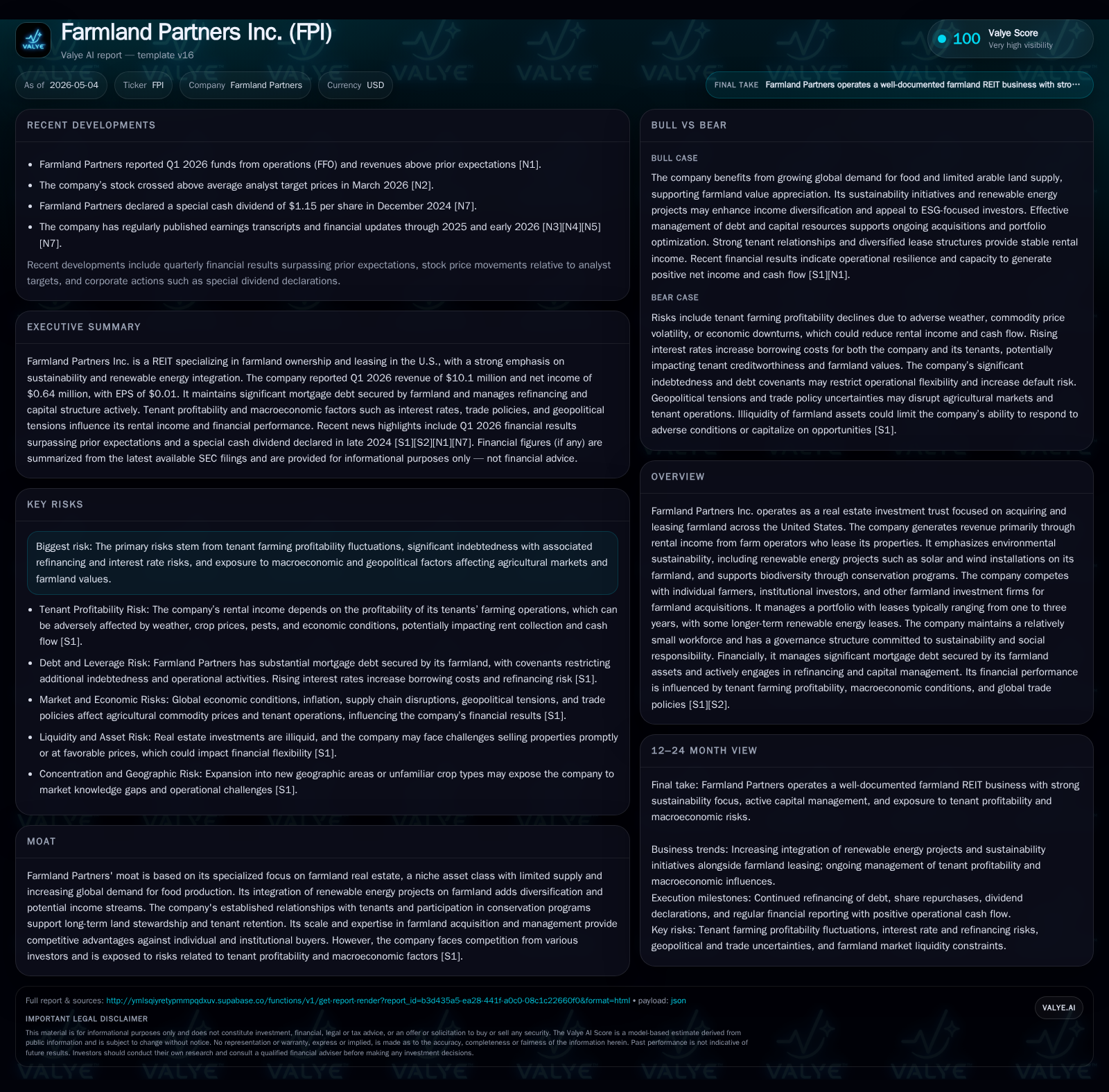
Farmland Partners Inc. (FPI) delivered a solid Q1 2026 operating update anchored by rental revenue strength and renewable energy leases, surpassing estimates on funds from operations (FFO) and revenues. The company’s business model centers on leasing U.S. farmland to operators amid appreciating land values fueled by strong commodity prices and food demand growth. Its integration of solar projects enhances income diversification. Competitive pressures persist from various investors and individual farmers, while tenant profitability variability and refinancing risk remain notable factors. Continued execution on farmland acquisitions, lease renewals, and renewable energy expansions will be key milestones to watch.
Recent Operating Update
Farmland Partners’ latest quarterly filing for Q1 2026 reveals fundamental stability and slight performance improvement in its operating portfolio. The company reported FFO and revenue figures that beat market estimates, underscoring the ongoing strength in its rental income base from leased farmland [N1][S2]. No material changes were recorded in risk factors compared to the prior year’s disclosures, indicating consistent operating conditions albeit within a context of macroeconomic uncertainties impacting agriculture.
The 10-Q details that rental revenues continue to be generated primarily through fixed- and variable-rate farmland leases with durations generally spanning one to three years. Additionally, renewable energy lease payments tied to solar projects on its acreage represent a growing contributor to recurring revenue [S2][S1].
Business Model
Farmland Partners operates as a real estate investment trust concentrating exclusively on acquiring U.S. farmland properties which it then leases primarily to farm operators. The company generates most of its revenue via lease rents that may be fixed or include variable components linked to crop yields or commodity prices. These leases provide stable cash flows but require active asset management given their relatively short tenor (typically one to three years).
Distinctively, the company has integrated environmental sustainability into its business framework. Farmland Partners incorporates renewable energy installations such as solar arrays across selected farms—boasting operational capacity of roughly 207 MW as of year-end 2025—and participates actively in government conservation programs like the USDA Conservation Reserve Program (CRP). These initiatives not only stabilize income streams but also enhance long-term land value through stewardship.
A secondary but complementary source of earnings stems from loans made under the FPI Loan Program—secured by first- or second-lien mortgages on farmland—adding modest financing income but exposing the company somewhat to tenant creditworthiness risks [S19].
Industry Structure and Competitive Position
The U.S. farmland investment landscape is fragmented yet competitive. Individual farmers historically represent the largest cohort of buyers for farmland acquisition. However, the sector has attracted growing interest from institutional investors, specialized funds (e.g., Nuveen Natural Capital), other agricultural REITs like Gladstone Lands Corporation, as well as private equity agriculture platforms.
Farmland Partners positions itself through scale expertise in specialized farmland acquisition and management combined with an emphasis on sustainability practices that improve tenant retention and land productivity over time [S1]. Its relationships with tenants are reportedly deep-rooted with incentives aligned around land stewardship.
Nevertheless, competition remains intense due to limited arable land supply (compounded by urban conversion pressures) amid rising global food demand. This creates a backdrop where pricing power could be sustainable but acquisition cap rates compressible.
Growth Drivers
The foundation for Farmland Partners’ growth lies in several structurally supportive trends:
Expanding global food demand: Driven by population growth coupled with increases in per capita GDP globally (notably in emerging markets), more calories—and thereby more agricultural output—are required long term. This bolsters demand for productive farmland which underpins rental rate growth and property appreciation [S1].
Farmland scarcity: Arable land per capita declines globally due to urbanization and repurposing for commercial uses while productivity improvements face natural limits in some regions. This supply constraint supports sustained value appreciation [S1].
Renewable energy integration: The expansion of solar lease agreements on owned acreage diversifies income away from pure farming rent dependency while leveraging existing land assets for alternative revenue generators [S1].
Portfolio optimization: Opportunistic acquisitions and selective dispositions enable portfolio quality enhancement focused on high-return cropland with favorable tenancy characteristics.
Risks and Watchpoints
Several risks temper the company’s growth outlook:
Tenant farming profitability volatility: Income from rent depends heavily on operator viability which is susceptible to weather aberrations, input cost inflation (fertilizers, labor), commodity price swings, and regulatory changes. Tenant defaults or restructurings impose leasing downtime or necessitate legal action affecting cash flow continuity [S21].
Macroeconomic sensitivity: Elevated interest rates elevate borrowing costs directly for FPI’s mortgage debt (~$233 million) and indirectly for operator tenants potentially curbing affordability and rent collections. Although some refinancing efforts are underway for near-term maturities ($68 million maturing within 12 months), broader credit market tightening could constrain capital availability [F1][S4][S8].
Capital markets reliance: The company needs access to debt or equity financing both for property acquisitions and distribution requirements driven by REIT tax rules mandating >90% taxable income payout.
Legal contingencies: Rising legal expenses related to ongoing litigation may signal future operational risks though current impacts appear manageable [S13].
Environmental regulation compliance: Though sustainability is a strength strategy-wise, evolving environmental regulations can impose operational costs or affect farming practices that might influence tenant economics.
What to Watch Next
Market participants should track several indicators reflecting Farmland Partners’ execution steps:
- Quarterly updates on leasing activity including renewal rates, re-letting timing/duration changes,
- Progress in expanding renewable energy footprint across farms,
- Outcomes of debt refinancing transactions particularly regarding interest costs and covenant relief,
- Tenant default metrics or restructuring developments impacting cash flow stability,
- Farmland acquisition pace relative to availability pricing trends,
- Any change in dividend distribution policies tied to underlying cash flow health.
These elements will collectively illuminate whether Farmland Partners can sustain its dual focus on income stability plus strategic growth anchored around environmental integration.
Financial Profile Summary
Supporting the operational story at quarter end Q1 2026 is an approximately $233 million total debt load offset against available cash balances (~$9 million as of mid-2023) yielding net leverage around $224 million [F1]. Interest expenses have declined markedly over prior periods reflecting past deleveraging efforts but will be sensitive going forward given recent higher rate environment noted at year-end 2025 (weighted average reset rate ~5.64%) [S1][S8].
Operating cash flows benefit from lump-sum rental payments concentrated seasonally before planting or after harvest periods consistent with agricultural cycles providing working capital predictability despite some variable rent components [S20]. Gains from asset dispositions have contributed intermittently but offset near-term by impairments principally related to select West Coast properties affected by localized conditions such as drought or wildfire risk revaluation [S16].
Management continues share repurchase activity where capital allocation permits while balancing debt maturity coverage supported by access lines ($163 million undrawn credit at end 2025) providing liquidity flexibility [S4][S5][S8]. Overall financial discipline aligns with sustaining REIT qualification requirements including mandatory distribution levels.
Disclaimer: This analysis is intended solely for informational purposes regarding Farmland Partners Inc.’s recent filings and industry context without any investment advice or recommendation. It relies exclusively on publicly filed data as cited without speculative projections or unidentified sources.
Disclaimer: This is research-only, informational analysis and not investment advice. It may include AI-generated interpretation and general industry context. Always verify important details using primary sources.

Comments