
Bitwise Ethereum ETF Updates Reflect Challenges and Opportunities in Ether Exposure
The Trust’s recent quarterly filing underscores operational dependencies, regulatory uncertainties, and market dynamics shaping its competitive landscape and growth prospects.
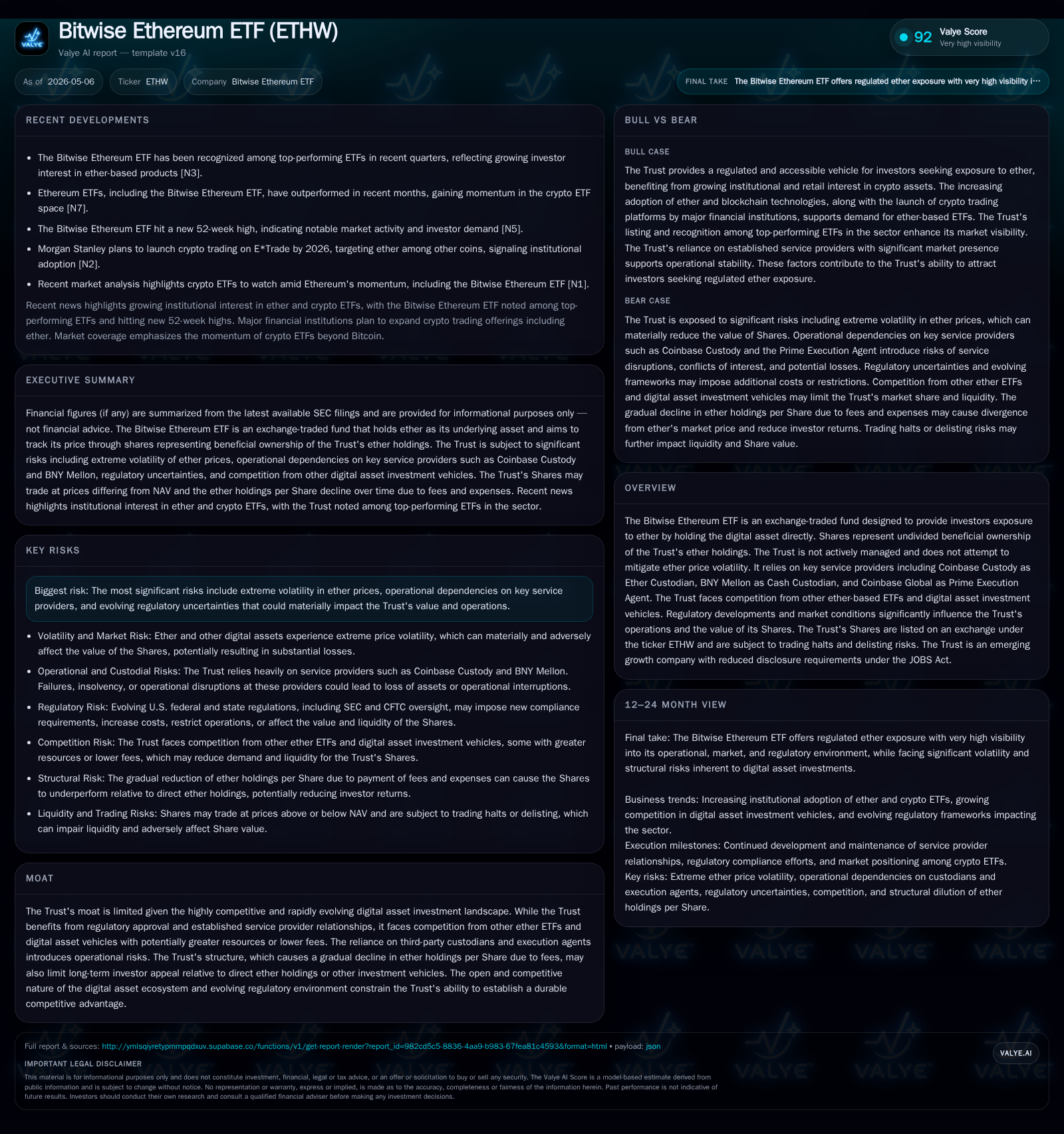
The Bitwise Ethereum ETF’s 2026 Q1 10-Q highlights persistent risks from ether price volatility, third-party custodial reliance, and evolving U.S. regulatory scrutiny. Its business model centers on direct ether holdings with exposure passed to investors without active management, while structural dilution from fees presents limitations on long-term returns. Competition remains intense in an open digital asset ecosystem with few barriers to entry, though established service relationships offer some operational stability. Growth drivers include expanding institutional acceptance of regulated ether products and network upgrades enhancing Ethereum’s usability. Key risks persist around regulatory actions, operational failures, and market liquidity constraints, positioning the Trust at a critical juncture as regulatory frameworks and digital asset demand continue to evolve.
Latest Quarterly Update: Key Developments from the 2026Q1 Filing
Bitwise Ethereum ETF’s most recent quarterly report filed May 6, 2026 (Form 10-Q) reinforces core risks that shape the Trust’s operating environment [S2]. Notably, it reiterates concerns over the extreme volatility inherent in ether’s trading price that materially influence the value of Shares. The filing stresses that this volatility remains a cornerstone uncertainty for investors given ether’s ongoing technology maturation and market speculation dynamics.
Additionally, the filing highlights the Trust’s dependence on key intermediaries—specifically Coinbase Custody as Ether Custodian, BNY Mellon managing cash holdings as Cash Custodian, and Coinbase Global serving as Prime Execution Agent. These roles are critical for asset safekeeping and trade execution but expose the Trust to counterparty risks including operational disruption, insolvency risk, or conflicts of interest if providers prioritize other clients [S2].
Importantly, the document references intensified regulatory oversight by federal agencies such as the SEC's Crypto Task Force. Potential new compliance demands or registration obligations may result in non-recurring expenses or strategic constraints upon the Trust or Sponsor. These regulatory considerations underscore a fragile near-term outlook framed by evolving policy uncertainty.
Understanding Bitwise Ethereum ETF’s Business Model and Product Offering
The Bitwise Ethereum ETF is structured as a grantor trust providing holders with undivided beneficial ownership of the Trust's directly held ether assets [S1]. The Fund doesn’t engage in active portfolio management aimed at stabilizing token price exposure; instead, investors assume full exposure to ether’s market movements day-to-day.
Revenue generation derives from management fees assessed as a percentage of total Assets Under Management (AUM). These fees gradually dilute the underlying ether quantity each Share represents—an attrition effect common among commodity-based trusts but one that can be disadvantageous over prolonged investment horizons compared with direct wallet holdings or alternative investment vehicles offering staking rewards or yield enhancement.
Operationally, custody agreements with Coinbase Custody entrust the physical safekeeping of ether tokens while BNY Mellon oversees cash reserves to meet liquidity needs. Coinbase Global acts as Prime Execution Agent facilitating creations/redemptions of shares through market transactions. This triad forms a core service ecosystem enabling trust functionality but concentrates risk if any party encounters financial distress or regulatory sanctions [S1][S2].
By design, there is no attempt to hedge or offset price fluctuations; investors are exposed fully to upside and downside market swings without mitigants embedded within the trust structure.
Competitive Landscape and Industry Structure for Ether Investment Vehicles
The competitive environment for spot-based ether ETFs like Bitwise Ethereum ETF is characterized by an expanding array of options including rival ETFs sponsored by other institutional asset managers and synthetic derivatives offered through brokerages. Regulatory approvals received since mid-2024 have catalyzed product launches but also intensified pressure on fee compression and liquidity provision.
Moat defensibility remains limited due to low switching costs—investors can readily move between listed suppressant-traded funds or explore direct custody/self-custody options at low friction. While established partnerships with dominant custodians such as Coinbase provide operational credibility, they carry cross-product conflict risk given their extensive client roster across competing digital asset funds,[S11].
Execution quality depends critically on stable banking relationships supporting payments flow; recent turbulence in cryptocurrency-friendly banks suggests potential fragility that could impede creation/redemption mechanics essential for maintaining NAV alignment.
Additionally, competitors leveraging vertically integrated crypto platforms or those offering enhanced features such as staking capabilities may erode demand for pure holding trusts with fee-induced token dilution.
Drivers Behind Demand and Growth Potential for Bitwise ETHW
Growth catalysts stem largely from three vectors: increasing institutional adoption of regulated crypto ETFs post-US approval regimes; maturation of Ethereum network infrastructure improving transaction throughput and security; and broadening retail interest as centralized exposures become investable with traditional brokerage accounts.
Spot ETH ETFs enjoy backdrop support from improved price discovery versus futures-linked products, making them attractive portfolio building blocks in diversification strategies [N1]. Goodwill accumulated by early entrants like Bitwise provides some benefit but must be reinforced through scale & liquidity advantages.
Ethereum protocol upgrades addressing scalability bottlenecks—proof-of-stake finality enhancements and layer-2 solutions—increase confidence in long-term value proposition underpinning ether demand [S1]. As decentralized applications gain traction in DeFi and NFT ecosystems reliant on ethereum transactions, network utility drives fundamental token use cases.
The convergence of these trends supports asset inflows into liquidity pools behind these ETFs; net new subscription volumes can be leveraged as KPIs reflecting investor confidence in crypto allocation growth through regulated channels.
Risks and Constraints Impacting Trust Stability and Investor Returns
Key risks remain prominently around:
- Ether Price Volatility: Persistent swings can trigger sharp NAV fluctuations hurting passive investors not equipped for sudden drawdowns [S2].
- Operational Dependencies: Centralization notably in custody & prime execution heightens exposure to single points of failure including outages or disruptions at Coinbase entities [S11].
- Regulatory Uncertainty: SEC enforcement patterns remain fluid; Crypto Task Force activities signal ongoing threat of novel compliance mandates raising costs or restricting operations [S23]. CFTC jurisdictional shifts over ether products could impose overlapping rules creating complexity [S6].
- Structural Dilution: Fees reduce cumulative token holding over time versus owning raw ether; this may deter holders seeking maximal upside participation.
- Market Liquidity & Trading Risks: Digital asset exchanges face hacking risks/withdrawal suspensions that impact pricing indices used for NAV calculation potentially causing divergences from fair value [S16].
- Technological/Network Risks: Ethereum protocol forks or validator penalties might destabilize network functionality impairing both token usability and associated ETF valuations [S1].
Any adverse material development among these factors could induce valuation shocks or forced liquidations adversely impacting shareholders.
Looking Ahead: Key Milestones, Regulatory Signals, and Market Metrics to Monitor
Analysts should closely monitor several indicators shaping near-term trajectory:
- Regulatory Policy Updates: Outcomes from SEC Crypto Task Force deliberations including potential registration rules portending increased compliance costs.
- Ethereum Upgrades: Deployment status of major scalability improvements like sharding rollout influencing network throughput metrics.
- Assets Under Management Trends: Quarterly subscription/redemption patterns signaling investor appetite shifts amid volatile markets.
- Institutional Adoption Metrics: Public data on ETF holdings vs. secondary market volumes reflecting portfolio allocation preferences by pension funds/endowments.
- Service Provider Stability: Financial health updates from Coinbase Global/BYN Mellon signaling continuity risks or enhancements.
- Market Liquidity Conditions: Trade volume changes on constituent exchanges used for Pricing Index assessments impacting NAV accuracy [S28].
Tracking these milestones will inform assessment of whether Bitwise Ethereum ETF can maintain competitive positioning while managing intensifying operational/regulatory challenges.
Financial Snapshot: Current Fiscal Standing and Operational Scale
While detailed current quarter financial metrics beyond risk disclosures are sparse in the latest filings [S2], publicly available annual data indicate ongoing net losses consistent with investment stage pressures intrinsic to emerging digital asset trusts [F1]. No explicit new debt issuance or liquidity distress events were cited in Q1 disclosures suggesting stable capital adequacy supports continued operations absent unexpected shocks.
Losses reflect aggregate compliance costs related to public reporting requirements alongside necessary spend on custody contracts and trading counterparties mandated by regulatory regimes. Absent scale economies typical for nascent crypto ETF sponsors, overhead intensity remains elevated but should moderate as AUM grows if investor demand converges favorably.
Overall, the financial profile supports continued operation focused on building trusted regulated access points for ether amidst challenging external conditions rather than immediate profitability.
Disclaimer: This analysis is provided solely for informational purposes based on publicly available SEC filings and news sources up to May 2026. It does not constitute investment advice or an offer to buy/sell securities. Readers should perform independent due diligence before making any financial decisions regarding Bitwise Ethereum ETF shares.
Disclaimer: This is research-only, informational analysis and not investment advice. It may include AI-generated interpretation and general industry context. Always verify important details using primary sources.

Comments